
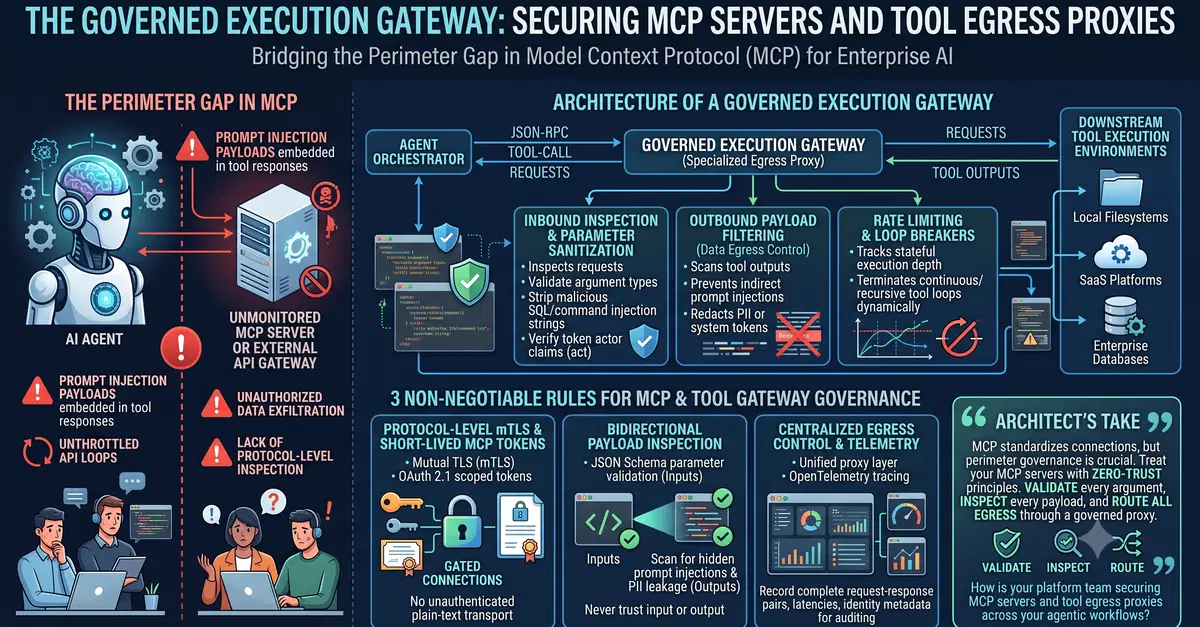


The Perimeter Gap in Model Context Protocol (MCP)
As the Model Context Protocol (MCP) rapidly becomes the industry standard for connecting LLMs to local filesystems, SaaS platforms, and enterprise databases, platform engineering teams face a new security boundary.
Connecting an autonomous AI agent directly to an unmonitored MCP server or external API gateway introduces severe enterprise risks:
- Prompt injection payloads embedded in tool responses
- Unauthorized data exfiltration
- Unthrottled API loops and runaway recursive calls
- Lack of protocol-level inspection
To run MCP servers and tool execution safely at scale, enterprise architectures must introduce a Governed Execution Gateway—a specialized egress proxy positioned between the agent orchestrator and downstream tool execution environments.
Architecture of a Governed Execution Gateway
The Governed Execution Gateway operates as a bidirectional security proxy for all non-human tool invocation payloads:
-
Inbound Inspection & Parameter Sanitization: Inspects incoming
JSON-RPCtool-call requests generated by the agent. Validates argument types, strips malicious SQL/command injection strings, and verifies token actor claims (act) before forwarding requests to the target MCP server. - Outbound Payload Filtering (Data Egress Control): Scans tool outputs returned by downstream systems prior to context hydration. Prevents indirect prompt injections hidden in retrieved data and automatically redacts sensitive PII or system tokens.
- Rate Limiting & Loop Breakers: Tracks stateful execution depth. If an agent loops continuously or triggers recursive tool calls within a single trace context, the gateway dynamically terminates execution.
3 Non-Negotiable Rules for MCP & Tool Gateway Governance
Protocol-Level Mutual TLS & Short-Lived MCP Tokens: Direct TCP or
stdioconnections to MCP servers must be gated behind mutual TLS (mTLS) or OAuth 2.1 scoped tokens. Unauthenticated, plain-text MCP transport in production environments must be strictly prohibited.Bidirectional Payload Inspection: Never trust input from the model or output from the tool. Inputs must undergo strict JSON Schema parameter validation; outputs must be scanned for hidden prompt injection markers and sensitive data leakage before hydrating the context.
Centralized Egress Control & Telemetry: All tool invocations must route through a unified proxy layer equipped with OpenTelemetry tracing—recording complete request-response pairs, execution latencies, and identity metadata for auditing.
Architect’s Take
Key Insight: MCP standardizes how AI agents interface with enterprise systems, but standardizing connection protocols without establishing perimeter governance creates an unmonitored back door into your infrastructure.
Treat your MCP servers with the same Zero-Trust security principles as public-facing microservices: validate every argument, inspect every payload, and route all egress through a governed proxy.
Sources & References
- Anthropic: Model Context Protocol (MCP) Architecture Specification
- Cloudflare: Securing AI Agent Egress and MCP Connections at Scale
- OWASP: Top 10 for Large Language Model Applications – OWASP LLM07: Insecure Plugin Design
- Solo.io: API Gateway Patterns for AI Agent Tool Execution and Governance
About Me
I'm an Enterprise Cloud & AI Architect with 14 years of experience in the IT industry, helping organizations design and scale enterprise-grade cloud, AI, and automation solutions.
My current work focuses on building enterprise-scale AIOps platforms, accelerating customers' AI-first transformation journeys, driving FinOps adoption, and developing production-ready Generative AI applications that create measurable business impact.
Feel free to connect with me on LinkedIn or X (Twitter) @jitu028. For 1:1 architecture guidance, visit my Topmate.
0 Comments
Log in to join the conversation.No comments yet. Be the first to share your thoughts.