
[Submitted on 30 Jul 2026]
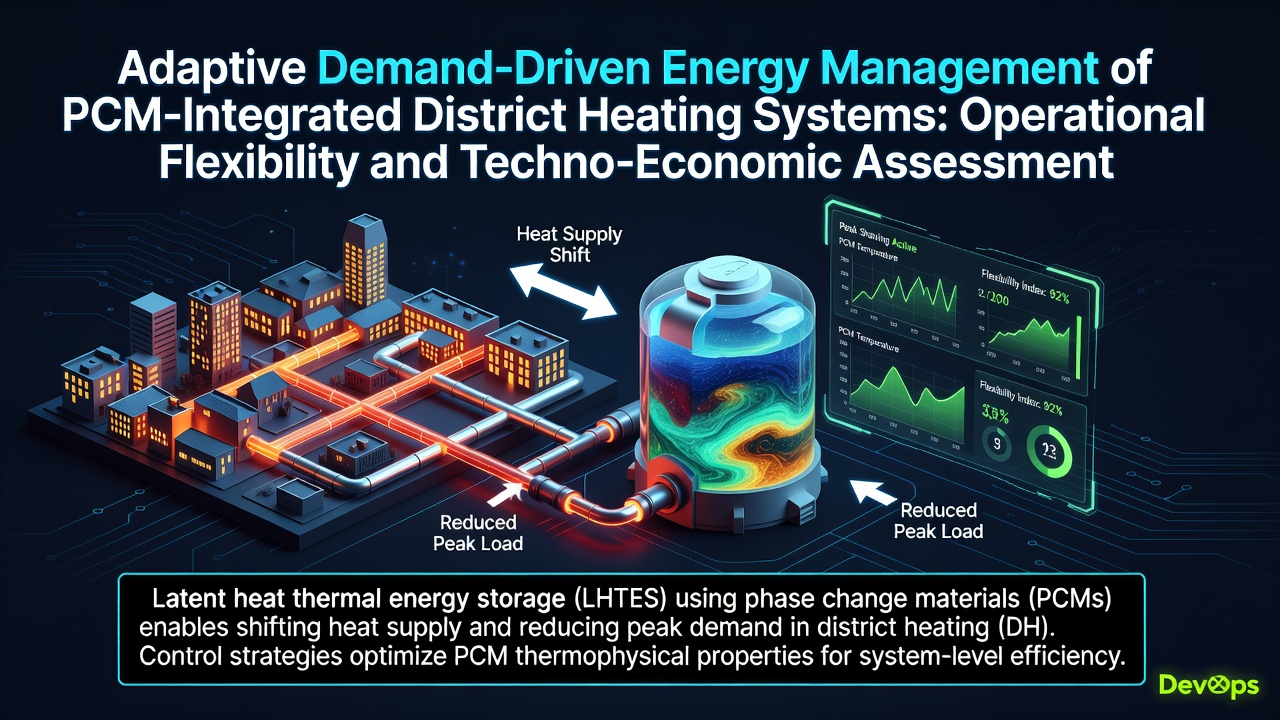
Abstract:Latent heat thermal energy storage (LHTES) using phase change materials (PCMs) is a promising solution to shifting heat supply and reducing peak demand in district heating (DH). However, the combined impacts of PCM thermophysical properties and practical control strategies on DH system-level operational and economic performance remain insufficiently understood. To bridge the research gap, this study investigates a PCM-integrated DH system with heat pump assisted waste heat recovery under an adaptive demand-driven (ADD) control strategy to enhance operational flexibility. A dynamic simulation model was developed and the system performance was evaluated against a baseline case and a rule-based control (RBC) approach based on peak-load reduction, operational cost, heat pump performance, and indoor thermal comfort. Furthermore, sensitivity analyses were conducted to examine the influence of PCM thermophysical properties on system performance. The results showed that the RBC can shift peak demand but tends to generate secondary peaks during charging periods. In contrast, the ADD strategy effectively smoothed the heat demand profile and achieved up to 5.3% peak-load reduction while maintaining thermal comfort. Sensitivity analysis revealed that a phase-change temperature of 80$^\circ$C and thermal conductivity above 2 W/(m$\cdot$K) achieved a higher peak-load reduction and improved economic performance. Despite the enhanced peak-shaving capability achieved by the proposed control strategy, the system exhibited a payback period of 25.3 years, indicating that further cost reductions and supportive market incentives are required. Nevertheless, the proposed approach provides significant potential for enhancing DH flexibility and supporting the transition toward future low-carbon energy systems.
Submission history
From: Chunjun Huang [view email]
[v1]
Thu, 30 Jul 2026 14:30:12 UTC (6,738 KB)
0 Comments
Log in to join the conversation.No comments yet. Be the first to share your thoughts.