
[Submitted on 20 Jul 2026]
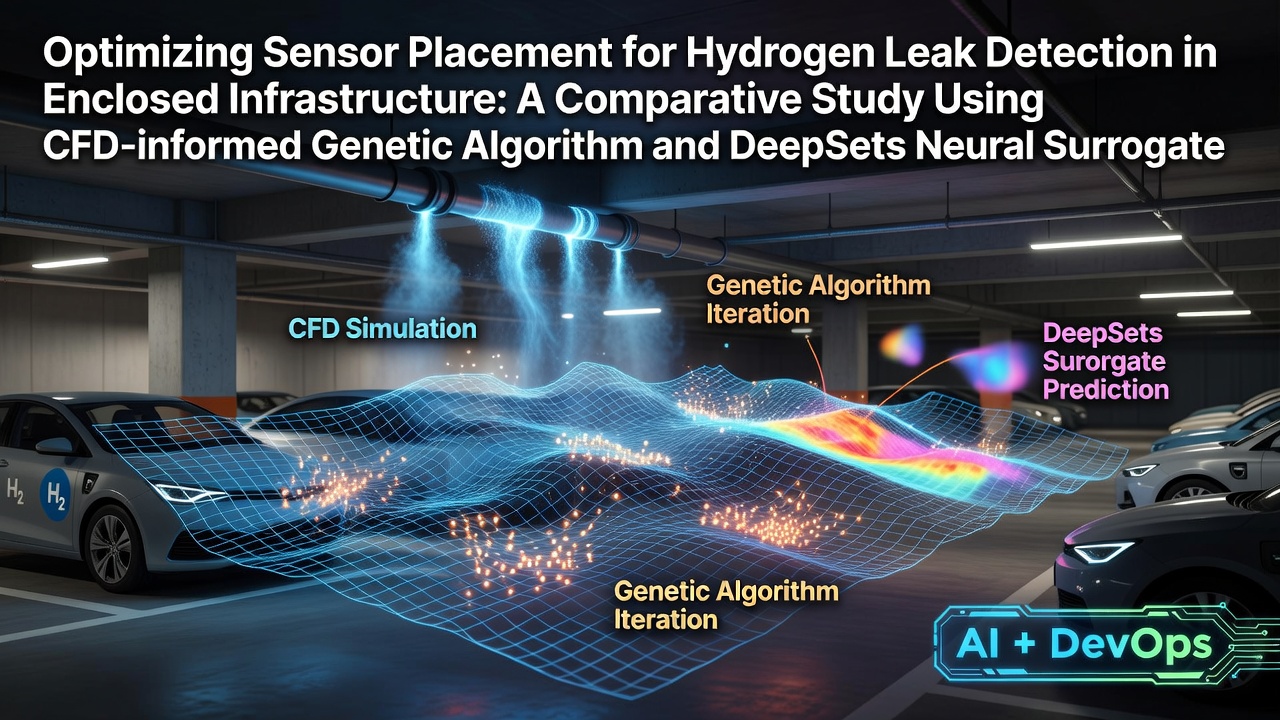
Abstract:Hydrogen infrastructure in enclosed environments, such as parking facilities for fuel cell vehicles, presents significant safety challenges due to hydrogen's low ignition energy and wide flammability range. Current monitoring systems are largely reactive, detecting leaks only after hazardous concentrations have formed. This study develops a computational framework for proactive sensor placement optimization by integrating computational fluid dynamics (CFD), genetic algorithm (GA) optimization, and a DeepSets neural surrogate. A CFD database of 180 scenarios was generated for a representative 50 m x 30 m x 3 m garage, covering multiple leak positions, rates (1-150 g/s), and ventilation conditions (ACH = 3-10 per hour). Sensor placement was optimized using a multi-objective GA and compared with uniform, random, and surrogate-assisted approaches. The GA achieved a detection rate of 96.1% within 60 s and reduced blind areas to 0.12%, corresponding to an approximately 5% improvement in composite fitness over a uniform baseline. The DeepSets surrogate reproduced near-optimal configurations with a fitness gap below 0.01 while reducing CFD evaluations by 89% and computational time by two orders of magnitude. Detection performance and spatial coverage remained comparable to the GA, demonstrating that surrogate-assisted optimization can retain solution quality while enabling rapid design iteration. Overall, the results show that CFD-informed optimization improves detection effectiveness and reduces sensor requirements compared to conventional layouts. The proposed framework supports scalable deployment and provides a foundation for integrating optimized sensor networks with digital twin systems for real-time monitoring and risk assessment.
Submission history
From: Nicholas Tan Jerome [view email]
[v1]
Mon, 20 Jul 2026 07:59:48 UTC (2,016 KB)
0 Comments
Log in to join the conversation.No comments yet. Be the first to share your thoughts.