
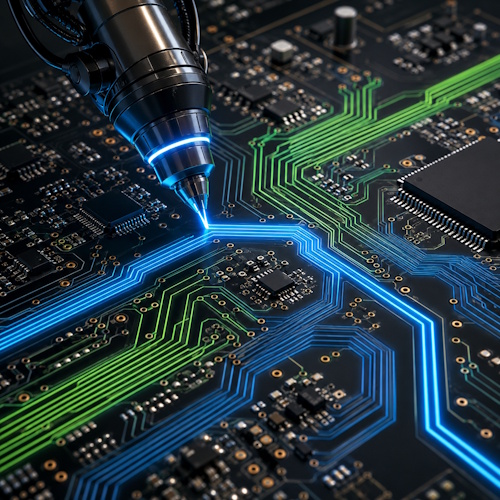
I can’t believe that the Design Automation Conference (DAC) has rolled around once again. Also, I can’t believe that, in conversation, some people remain blissfully unaware that you can pronounce this as “DAC” (to rhyme with “quack”), or spell it out as “D-A-C.” And to top it all off, I can’t believe I’m not there to see the latest and greatest offerings in Electronic Design Automation (EDA), such as DeepPCB’s AI-powered, cloud-native PCB routing software on display at Booth 1561. Ooops… I may have given the game away as to the topic of this column, but what can you do, eh?
I know what you’re thinking. You’re thinking, “Oh dear God, not another AI-based PCB place-and-route (P&R) tool!” Well, yes, it is, but since it’s the one currently doing 2,000+ real-world designs for real-world companies a week, I think it’s worth talking about.
This all came about when my chum Darin ten Bruggencate, who is the principal at The Bureau of Standard Propaganda (“Complicated Products, Difficult Buyers”), asked me if I was familiar with the latest and greatest in AI-powered PCB routing offerings from the folks at DeepPCB.
When I sheepishly admitted that, much to my embarrassment, I wasn’t, Darin kindly set up a video conference call between your humble narrator (I pride myself on my humility… you’d have to go a long way to find someone more humble than me) and Alain-Sam Cohen, who is Head of Products at InstaDeep.
As you may recall, way back in the mists of time that we used to call “2001: A Max Odyssey” (or maybe that’s just me), I was invited to present a paper at a conference in Kauaʻi, which is the westernmost of the big Islands in the Hawaiian chain (and the most beautiful, if you ask me). This is the one that featured in the Jurassic Park movie, and it’s even more awe-inspiring when you’re there.
Prior to that conference, I’m sad to admit that I invariably wore boring attire, like denim jeans coupled with mono-colored shirts… I hang my head in shame. My visit to the islands was a revelation; even the newscasters flaunted brightly colored Hawaiian shirts. I returned home as a convert, and I haven’t worn anything else since (well, apart from trousers and suchlike, of course). So, you can only imagine my surprise and delight to see that the other attendees to our call had also worn Hawaiian shirts in honor of the occasion.
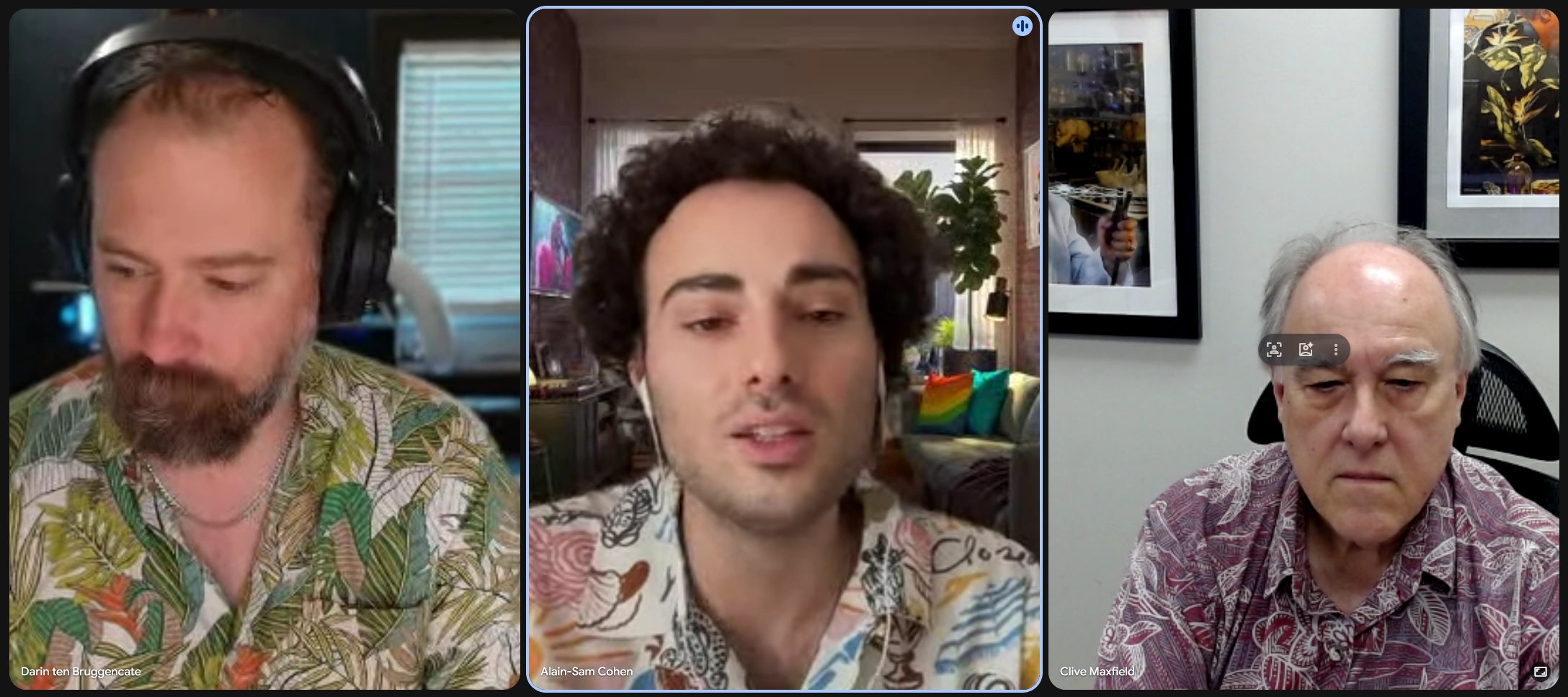
Darin (left), Alain-Sam (center), and yours truly (right)
Before we proceed, I think it’s worth taking a few moments to untangle the corporate family tree because, at first glance, this appears to have been assembled by someone throwing darts at a collection of company brochures.
DeepPCB is an AI-powered PCB placement-and-routing platform. It is one of the principal products created by InstaDeep, an enterprise AI company specializing in machine learning, reinforcement learning, and autonomous decision-making systems. InstaDeep, in turn, was acquired by BioNTech in 2023.
Yes, that BioNTech—the biotechnology company that partnered with Pfizer to develop one of the best-known COVID-19 vaccines. At this point, you may reasonably be wondering what a company devoted to vaccines, cancer treatments, and immunotherapies is doing funding an artificial intelligence capable of routing copper tracks around a printed circuit board.
The answer is that BioNTech didn’t acquire InstaDeep because it had developed a clever PCB router. Instead, it grabbed InstaDeep while the grabbing was good because it needed world-class expertise in artificial intelligence and machine learning, particularly for AI-powered drug discovery, design, and development.
The two companies had already been collaborating since 2019, including establishing a joint AI Innovation Lab in 2020 and completing dozens of projects together. When the acquisition was completed in July 2023, BioNTech said InstaDeep would become the centerpiece of its growing AI and machine-learning activities. Just as important to our story, BioNTech explicitly said that InstaDeep would continue serving its existing customers outside the life sciences.
Now, we’ve seen AI-powered PCB routing tools before, so just to convince ourselves that this isn’t all “smoke-and-mirrors,” let’s feast our orbs on this video showing the recent integration of DeepPCB in KiCad’s schematic capture and PCB design software. All I can say is that this one-click installation brought tears of joy to my eyes.
Developing DeepPCB presented InstaDeep’s researchers with a deliciously difficult problem. PCB routing may appear straightforward, especially to anyone who has never attempted to do it. I mean to say, all you really need to do is connect Point A to Point B… except that you must also connect thousands of other points, avoid obstacles, obey widths and clearances, manage multiple layers, minimize vias, accommodate differential pairs, respect high-speed constraints, and avoid painting yourself into a corner.
Alain-Sam says the team spent around seven years conducting research before the technology was meaningfully commercialized. Every time they thought they had cracked the problem, another class of boards introduced more layers, different component types, differential pairs, USB constraints, or some other fresh opportunity for the universe to laugh at them (I know that feeling well)
This makes DeepPCB much more than an isolated sideline. It is a continuously evolving proving ground for reinforcement learning, constrained optimization, autonomous agents, large-scale cloud deployment, and human-AI collaboration. Advances made while teaching an AI to navigate the combinatorial nightmare of a PCB can inform AI systems that address other optimization and engineering problems—including applications of considerable interest to BioNTech (“I love it when a plan comes together,” as Colonel John “Hannibal” Smith used to say at the end of an episode of the 1980s television series The A-Team).
There is another important consequence of this arrangement. A great many young AI companies are bootstrapping their operations while simultaneously scurrying around in search of their next infusion of investment. DeepPCB has what Alain-Sam laughingly described as an “unfair advantage.” It belongs to an established enterprise AI organization, which in turn belongs to a substantial biotechnology company committed to building world-leading AI capabilities.
This doesn’t mean DeepPCB has a bottomless sack of gold sitting beside the coffee machine (rats!). It does mean the team has had the time, expertise, computing resources, and organizational backing required to properly attack a difficult problem. At the time of our conversation, Alain-Sam said that approximately 25 to 30 people were working full-time on DeepPCB, supplemented by an additional 15 to 25 shared contributors from elsewhere in InstaDeep, as required.
Alain-Sam offered the example of a board that might require an experienced designer or electrical engineer two or three days to route manually. By comparison, DeepPCB may produce its result in approximately three hours, after which the engineer might spend another half hour to an hour cleaning things up. Even allowing for that intervention, three or four hours compares rather favorably with two or three days. “Not only are you saving a ton of time,” Alain-Sam said, “but while the AI is working, you can do something else. You can work on your new ideas if you have some rocket-science things going on in your head.”
This aspect of AI-assisted engineering is frequently overlooked. The prize isn’t simply completing the same task faster. It is returning scarce engineering time to the engineers, allowing them to spend more of it thinking, experimenting, and doing the things that haven’t already been reduced to a repeatable process.
DeepPCB can be used end-to-end, but it can also collaborate with a human designer. An engineer may manually route especially sensitive portions of the board—perhaps power circuitry, high-speed interfaces, or nets requiring a particular topology—and then ask DeepPCB to complete the remainder. Alain-Sam said this hybrid approach is currently common at the more complex end of the designs the platform supports. Simpler boards may be routed autonomously from beginning to end.
At the time of our call, around 2,000+ designs were being submitted every week. This did not mean 2,000+ new users were arriving weekly; many were returning users submitting board after board, which is arguably a more meaningful statistic.
You May Already Be Using DeepPCB!
DeepPCB’s most consequential feature may not be visible on its website at all. Under the hood, the platform is exposed through an application programming interface (API). In fact, Alain-Sam explained that DeepPCB’s own web application is essentially just one interface to this API.
A large enterprise can therefore integrate DeepPCB into its existing schematic-capture, PCB-layout, or product-lifecycle-management workflow. Engineers do not need to abandon familiar tools, upload files manually, or adopt an entirely new design environment.
More intriguingly, other EDA companies can incorporate DeepPCB into their own products. Developing reinforcement-learning-based placement-and-routing technology requires specialized researchers, engineers, training infrastructure, computing resources, time, and money. Many tool vendors have excellent interfaces, established customer bases, and deep domain knowledge, but lack InstaDeep’s AI research capabilities. DeepPCB’s API allows them to add those capabilities without reinventing the underlying technology.
This creates the unusual situation in which companies that might appear to be DeepPCB’s competitors can also be its customers. For contractual reasons, Alain-Sam couldn’t tell me who these partners were. He did observe that some engineers may already be using DeepPCB without realizing it.
The KiCad plugin I showed earlier is the ideal concrete example of the API/integration philosophy. The designer remains in the familiar KiCad environment, presses a button, and watches the routing engine go to work. There is no detour through an unfamiliar design suite and no requirement to discard an established workflow. This is important. An AI capability becomes much more useful when it appears at the point where engineers already work, rather than demanding that they reorganize their lives around the AI.
But Wait! There’s More!
As if an autonomous AI routing engine weren’t enough, the DeepPCB team has created another AI called Cooper (don’t ask about the meaning behind the “Cooper” moniker; I did, and now I’m sorry), which we can loosely visualize as “sitting above” the placement-and-routing engine.
Alain-Sam described Cooper as “an LLM as an interface to discuss your design and your project.” It has been supplied with domain-specific knowledge relating to PCB design, allowing engineers to converse with it about their boards. Cooper can identify suspicious features, explain why they may be troublesome, and suggest improvements. But Cooper isn’t limited to standing beside the board tutting and shaking its virtual head (that’s a job I can do perfectly well myself—and I’m available if you need me, for a modest fee). You can tell it to fix certain problems, in which case it can modify the design on your behalf.
DeepPCB is the specialist AI that performs placement and routing. Cooper is the conversational, agentic layer through which users can inspect, discuss, constrain, and modify the project. One does the heavy lifting; the other allows humans to express their intentions in ordinary language.
I started our conversation expecting to learn about an AI that routes circuit boards. I ended it thinking that PCB routing may be almost incidental to the larger story. DeepPCB demonstrates what happens when a deeply specialized AI is turned into a scalable service, exposed through an API, embedded inside existing engineering tools, and topped with an agent capable of discussing and modifying the design.
Admittedly, producing a beautifully routed PCB in a couple of hours rather than a couple of days is a rather splendid incidental benefit, especially if it leaves you free to contemplate any rocket-science ideas that happen to be bouncing around inside your head.
0 Comments
Log in to join the conversation.No comments yet. Be the first to share your thoughts.