
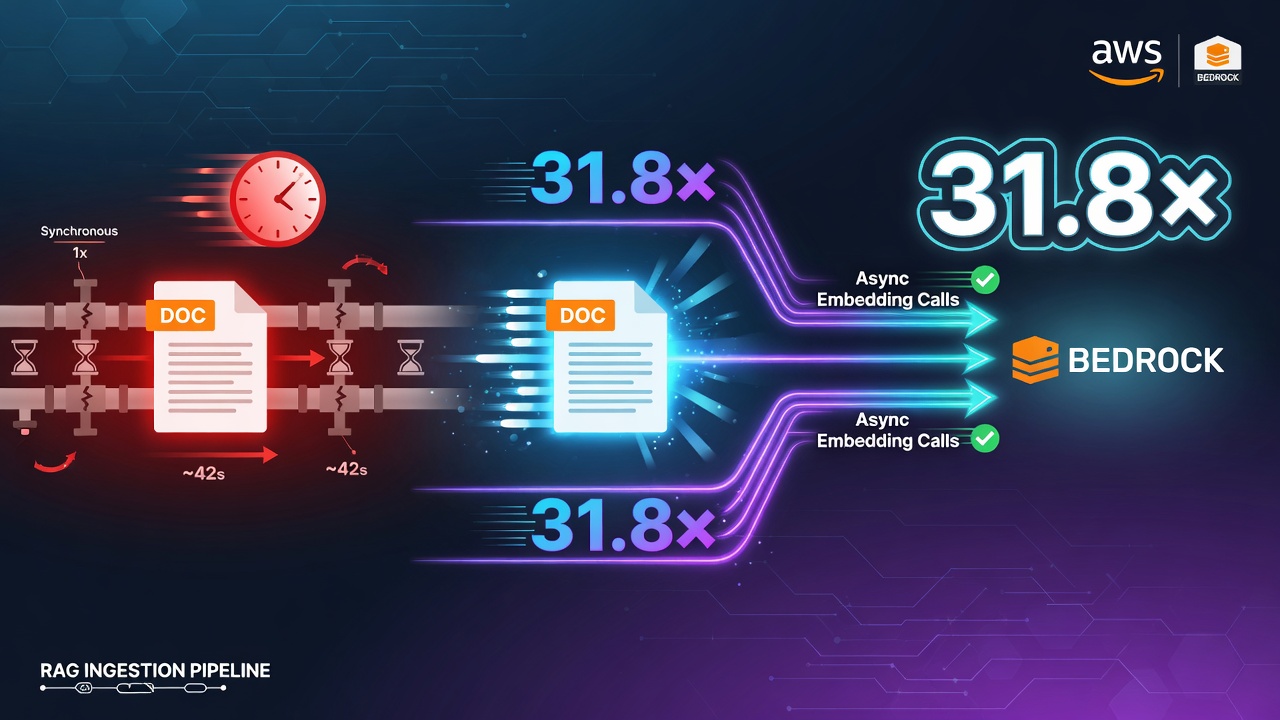

I was testing a RAG ingestion pipeline and noticed something painful: ingesting a single document took nearly 50 seconds.
Checking the metrics revealed that the CPU was doing almost nothing. The app wasn't compute-bound — it was simply sitting idle, waiting for sequential HTTP network round-trips to return.
By converting the blocking embedding module into an asynchronous workflow, processing time dropped from 49.61 seconds to 1.56 seconds with zero infrastructure changes.
Benchmark Setup
- Model: Amazon Titan Text Embeddings V2 (AWS Bedrock)
- Dataset: 33 text chunks from a single document
-
Region:
us-east-1 - Test: Sequential blocking requests vs. concurrent asynchronous requests
Results
| Approach | Time | Difference |
|---|---|---|
Sequential (requests blocking loop) |
49.61s | Baseline |
Concurrent (aiohttp + asyncio.gather) |
1.56s | 31.8× faster |
Why the Gap Was So Massive
Sequential (Blocking I/O)
Each request must complete before the next one starts.
chunk 1 ──> request ──> ⏳ wait (~1.5s) ──> response
chunk 2 ──> request ──> ⏳ wait (~1.5s) ──> response
chunk 3 ──> request ──> ⏳ wait (~1.5s) ──> response
...
Total Time ≈ (33 chunks × ~1.5s) ≈ 49.6s
Enter fullscreen mode Exit fullscreen mode
Since network latency dominates the runtime, the event loop sits completely unused.
Concurrent (Non-blocking Async)
Requests are dispatched concurrently; total time collapses down to the duration of the slowest single request.
chunk 1  ──> request ──────────────> response
chunk 2  ──> request ──────────────> response
chunk 3  ──> request ──────────────> response
...        (in flight concurrently)
Total Time ≈ slowest single request ≈ 1.56s
Enter fullscreen mode Exit fullscreen mode
The Code Change
Before: Sequential Execution
import requests

def generate_embeddings(texts: list[str]) -> list[list[float]]:
    all_embeddings = []
    for text in texts:
        response = requests.post(url, headers=headers, json={"inputText": text})
        vector = response.json().get("embedding", [])
        all_embeddings.append(vector)
    return all_embeddings
Enter fullscreen mode Exit fullscreen mode
After: Concurrent Execution
import asyncio
import aiohttp

async def fetch_embedding(session: aiohttp.ClientSession, text: str) -> list[float]:
    async with session.post(url, headers=headers, json={"inputText": text}) as res:
        data = await res.json()
        return data.get("embedding", [])

async def generate_embeddings_async(texts: list[str]) -> list[list[float]]:
    async with aiohttp.ClientSession() as session:
        tasks = [fetch_embedding(session, text) for text in texts]
        return await asyncio.gather(*tasks)
Enter fullscreen mode Exit fullscreen mode
Note: If you're using boto3 instead of raw HTTP requests, look at aioboto3, or offload the blocking SDK calls with asyncio.to_thread() to get similar non-blocking behaviour.
How It Scales
| Chunks | Sequential (est.) | Concurrent (est.) |
|---|---|---|
| 31 | 49.61s | 1.56s |
| 100 | ~160s (2.7 min) | ~2–3s |
| 500 | ~800s (13 min) | ~3–5s |
| 1,000 | ~1,600s (26 min) | ~5–10s |
The more chunks you ingest, the more the concurrent approach pays off — batch ingestion jobs that took half an hour now finish in seconds.
Key Takeaways
- Check for idle waiting first. Before scaling up infrastructure or adding complex worker queues, verify whether your pipeline is simply blocked on I/O.
-
Mind the service quotas. Bedrock has per-region request-rate limits — as chunk counts grow into the thousands, cap concurrency (e.g.
asyncio.Semaphore) before you hit them. -
Low effort, high impact. Changing just one file (
embedder.py) removed the embedding stage as a bottleneck in the pipeline.
0 Comments
Log in to join the conversation.No comments yet. Be the first to share your thoughts.