
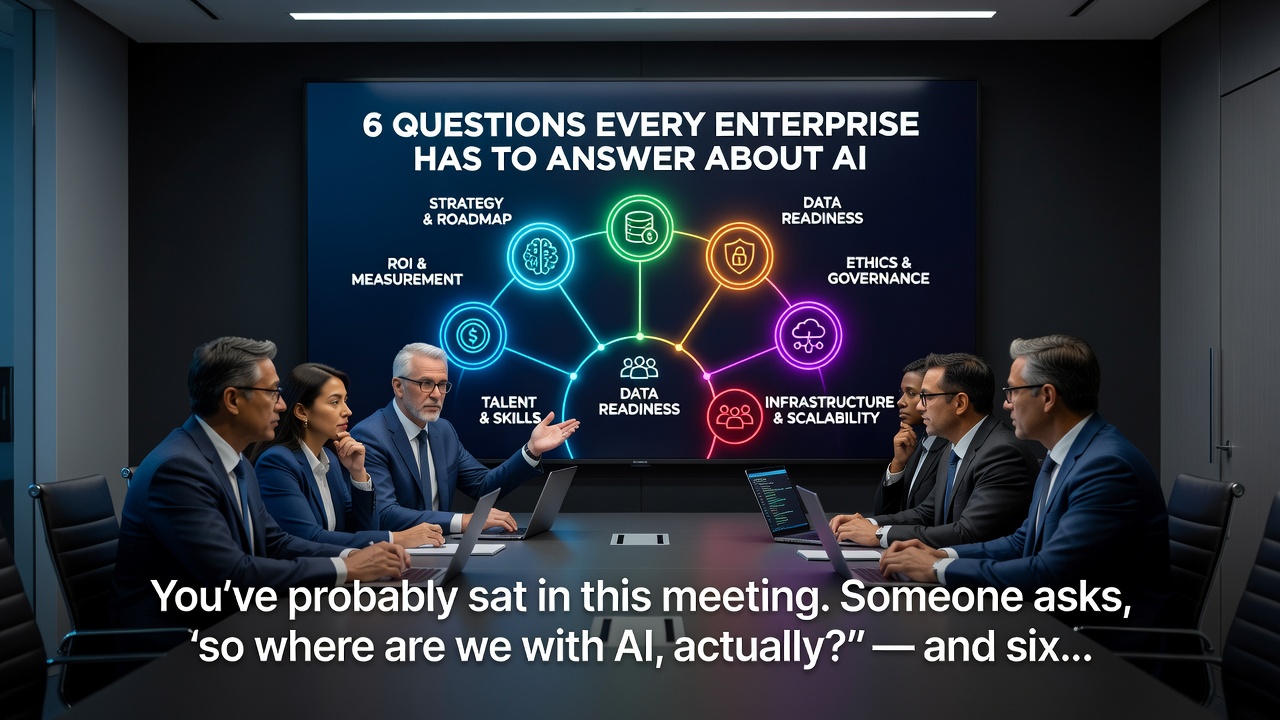
You've probably sat in this meeting.
Someone asks, "so where are we with AI, actually?" — and six people give six different answers.
Last year, the questions were "should we do this?" and "how do we prove ROI?" This year, those questions have mostly disappeared.
What replaced them are harder, more foundational questions. If nobody at your company is asking them yet, that's the thing to worry about.
NLW came back from KPMG's annual Tech and Innovation Symposium with six questions that kept surfacing there. Almost none of them have answers right now. But they're the right questions.
First, the shift itself
The paradigm change already happened: from assisted AI (it helps me work) to agentic AI (it does the work).
Enterprises spent three years anticipating this. Now that it's here, every question has been swapped out — they're all about how to solve the new problems this new way of working creates.
NLW's read: 2026 is the year "AI is not a technology problem, it's a transformation problem" finally came home to roost.
Question 1: Are you redesigning, or bolting on?
The keyword is redesigning.
The strongest warning from KPMG's Steve Chase on the panel was this: bolting an AI strategy onto existing processes and systems is a recipe for trouble.
In the assisted-AI era, bolting on just meant you under-used the potential. In the agentic era, the cost gets much worse.
Question 2: Are you thinking in architectures, or still picking vendors?
When a new challenge arrived, the old corporate reflex was "which vendor solves this best?"
That's no longer sufficient.
Thinking in architectures means three concrete things:
- A multi-model system — different intelligence tiers for different task difficulties
- A routing layer — off-the-shelf or bespoke, getting requests to the right model
- Harness design — which people and functions get which context, data, and system integrations, and what guardrails surround them
Question 3: How do you provision cost across groups?
The third question is about money: who spends what.
Underneath it sits another systems requirement — monitoring and measuring AI usage.
NLW put it vividly: you haven't heard the word "token" this often at an event since the height of the crypto era.
Without visibility into AI cost and its relationship to output, you can't decide which individuals, teams, or projects should get which models, at what magnitude.
Question 4: Enablement is messy work, not cute videos
This is the one I related to most.
The consensus in the room: this will not be a set of nicely-produced corporate training videos.
It's real, messy work — pushing people to use new tools to do new things, then figuring out how to transmit knowledge from the parts of the org that have figured it out to the parts that haven't.
The pattern that kept recurring was pairing: putting AI-redesigned engineering teams and early adopters together with business units.
Note what nobody was saying: that marketing will replace engineers. What they were discussing is how the 10–20% of skills — and more importantly the mindsets — that engineers and PMs carry become part of the essential toolkit for marketing, sales, and back-office people.
Question 5: What about externally? How do business models change?
Everything above is internal transformation. But there's an external dimension too.
Directions discussed on site:
- Moving from input-based pricing (like hourly billing) to outcomes-based pricing
- New categories of products and services
- Re-evaluating what the old product even is — if agents can run an audit persistently, what is an audit?
Most organizations, though, treat themselves as "patient zero": shore up how they work internally first, then decide whether to radically change what they sell.
The hard part is that nobody gets to shut down for six months to figure it out. You do it in real time, while still servicing legacy customers on legacy products through legacy delivery.
Question 6: How do you design for becoming obsolete?
The last question is the most counterintuitive.
If you're building new systems, how do you build dynamism, planned obsolescence, and ephemerality into them from the start?
Harnesses will change. Interaction patterns will change. Customer expectations will change. Markets will change. Policy will change.
So anything you build today has to assume: a few months after it's ready, it will likely need rebuilding.
Almost none of these six questions have answers right now.
But that's exactly what should feel reassuring — people are finally asking the right ones. Last year the room was full of "how do I convince others this is real?" This year it's "how do we redesign for a new era?"
If I compress it to one line: AI isn't a tool you buy and install. It's redesigning the organization around agentic work.
And that stack in questions 2 and 3 — multi-model tiering, routing, token-cost observability — is precisely why we're building Flatkey. Every enterprise is going to need that layer eventually.
Based on The AI Daily Brief (hosted by NLW), "6 Questions Every Enterprise Has to Answer About AI," recorded around KPMG's annual Tech and Innovation Symposium. This is a structured secondary read; views and data per the original podcast.
0 Comments
Log in to join the conversation.No comments yet. Be the first to share your thoughts.