
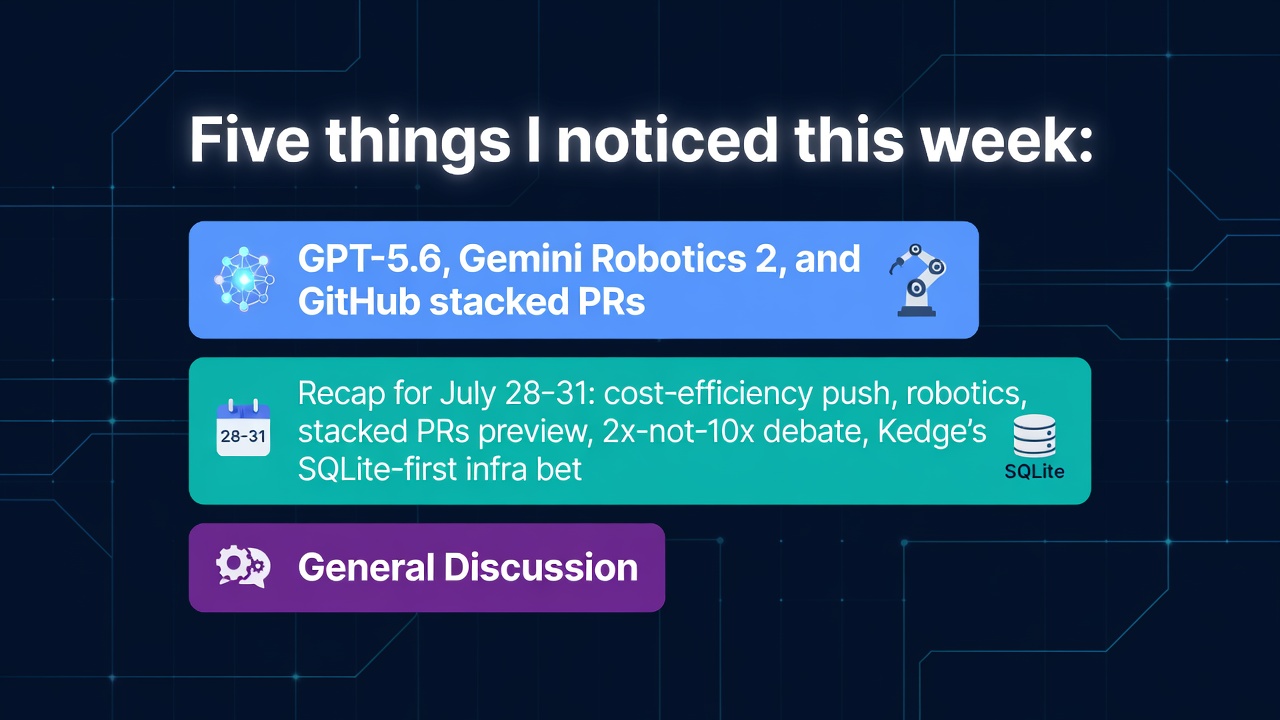


Another week of things to track. Five observations from July 28–31, roughly in order of what I think will still matter six months from now.
1. GPT-5.6 ships with a "price-performance frontier" framing
OpenAI released GPT-5.6 this week with explicit positioning around cost efficiency rather than raw capability. The framing is notable: not "better than GPT-5," but "better per dollar than what you're paying now." That's a different kind of product bet — one aimed at teams whose GPT-5 bills have gotten uncomfortable.
For my content-generation ETL pipelines, I'm still on Claude Haiku. The per-token cost and latency combination is what I've built around, and I don't switch model providers based on a release announcement alone. But the pattern I'm watching: whether model providers move into commodity pricing faster than expected. If the cost gap between Claude and OpenAI collapses to noise, the switching cost becomes interesting to calculate. I said I'd revisit model choices at month 3 of this experiment with real pipeline data; that's coming up.
2. Gemini Robotics 2 claims whole-body intelligence
DeepMind published Gemini Robotics 2 this week, describing it as enabling robots to coordinate hands, arms, and torso in unstructured environments. The demo tasks include things like unfolding laundry — a canonical hard robotics problem — and operating in spaces not designed for robots.
I don't run robots. But I track this specifically as a signal of where frontier labs are allocating resources. DeepMind has a track record of publishing things that look impressive in demos and take longer than expected to generalize to real-world settings. That said, the claim is specific and falsifiable: whole-body coordination in unstructured settings at scale. I'll look for independent replication attempts over the next few months before updating my sense of where physical AI actually stands.
3. GitHub stacked PRs land in public preview
GitHub shipped stacked pull requests — chained PRs where each branch depends on the previous — in public preview. If you've used Graphite or git-stack, you've been waiting for this. The workflow gain is real: exploratory work as a stack of small, reviewable diffs is a better habit than a single 2,000-line PR that nobody can read cleanly.
For solo dev workflows the benefit is less obvious than for teams, but it's there. I've written a few articles this week that touched on pipeline debugging — the kind of work where I genuinely want isolated diff slices rather than one big commit. Whether GitHub's implementation is close enough to Graphite's UX to actually switch workflows is something I'll only know from using it. First stack-relevant situation in the main repo is the test.
4. The "2x, not 10x" argument is getting harder to dismiss
An essay making the rounds on HN: 2x, not 10x: coding with LLMs in 2026. The core argument is that measured, task-level productivity data consistently shows roughly 2x gains from LLM-assisted coding — not 10x, not 100x. The claim that you can never delegate the design, debugging, and integration decisions to the model holds up in my own experience.
Three months into running AI-assisted content generation and article pipelines, the gains are real but bounded. The model is excellent at first drafts of structured articles and ETL scripts. It's not good at noticing when the overall architecture is wrong, catching subtle regressions across pipeline stages, or making the judgment calls that require knowing what actually matters in my specific context. Those still take the same time as before. That's 2x territory. I don't have the data to claim more, and I'm skeptical of people who do.
5. Kedge: forkable VM snapshots with SQLite as a global primitive
A Show HN project worth watching: Kedge, positioning as full-stack cloud with VM snapshots you can fork and SQLite as a global distributed database primitive. The fork-a-VM-snapshot model is different from anything Vercel or Cloudflare currently offers.
This is relevant to me because I use Turso (libSQL, SQLite-compatible) as my edge database, and the design choices around SQLite-on-edge keep recurring in new infrastructure tooling. I'm not moving anything to Kedge — it's early-stage and my Vercel setup is working. But I'm paying attention to anything that normalizes SQLite as the default persistence layer for small full-stack apps, because that's already where my data model points.
Sources and further reading:
- Advancing the price-performance frontier with GPT-5.6 — OpenAI official post
- Gemini Robotics 2 brings whole body intelligence to robots — DeepMind blog
- Stacked pull requests are now in public preview — GitHub changelog
- 2x, not 10x: coding with LLMs in 2026 — the essay, plus the HN thread for rebuttal reading
- Kedge – full-stack cloud with forkable VM snapshots and global SQLite — Show HN
Part of an ongoing 6-month experiment running three AI-curated directory sites. The technical claims here are real; this article was AI-assisted.
0 Comments
Log in to join the conversation.No comments yet. Be the first to share your thoughts.