
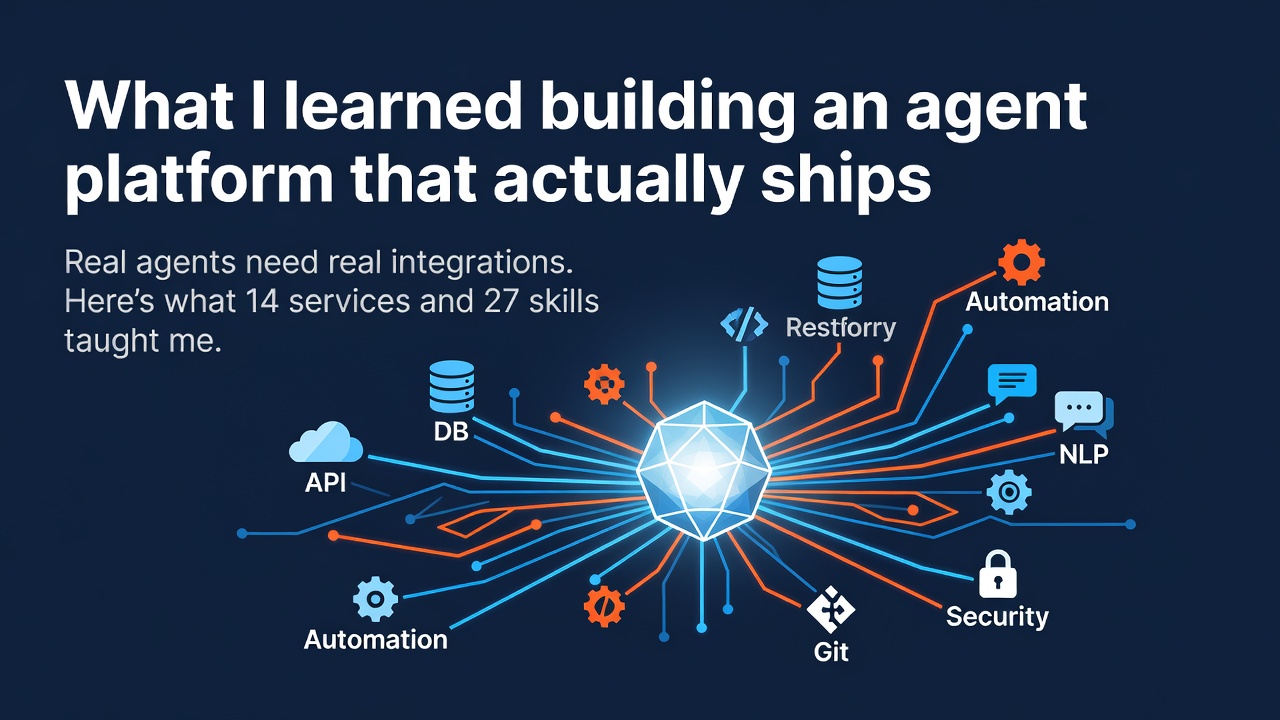

I built an agent platform. Not a demo — an actual platform where every tool call is governed, audited, and scoped to a workspace.
Here's what I learned.
Every skill is a first-class citizen
The platform has 27 skills across 7 groups — platform ops, publishing (dev.to, LinkedIn), testing (a full TEA suite with risk matrices, baseline characterization, NFR audits), communication (Slack, Telegram, Gmail), knowledge (RAG + persistent memory), development, and scraping.
Skills aren't just prompts. Each one has a governed lifecycle: create, validate, version, insert into workspaces. No stray scripts.
14 integrated services, one audit trail
- GitHub (issues/PRs), Jira (tickets), Slack & Telegram (messaging)
- Gmail, Google Calendar, Google Drive (OAuth2)
- LinkedIn (profile + post publishing), Dev.to (blog)
- Knowledge Base (RAG retrieval), Memory (persistent cross-session)
- Web Search, Transcribe (Whisper)
Every outbound call goes through a platform_cli dispatch op or a service_call adapter — same audit pipe, same trace ID.
The CLI is the source of truth
You don't edit config files and hope. You verify with loop_list, policy_show, skill_list, service_list, workflow_catalog. If you can't see it there, it doesn't exist.
Testing isn't an afterthought
The TEA (Test Engineering Architecture) suite ships 6 workflows: test design (risk-matrix), baseline characterization (golden-master diffing), NFR evidence audits, automated test generation, test review, and requirement-to-coverage tracing. All output is committed JSON or markdown — no proprietary formats.
The honest part
Not everything is production-ready. 4 of 27 skills are blocked (missing services or out of workspace scope). The model is deepseek-chat with deepseek-reasoner fallback — pragmatic, not exotic. Workspace scratch files TTL at 24 hours. Risky commands (kubectl delete, helm uninstall) are pattern-blocked.
But the core idea works: governed agent tools, scoped to a workspace, with real integrations, real memory, and real audit. That's more than most agent frameworks deliver.
If you're building agents that need to touch real APIs (not just generate text), consider: every integration should be a governed skill, every call should be traced, and you should be able to verify state by reading back from the platform — not by guessing.
0 Comments
Log in to join the conversation.No comments yet. Be the first to share your thoughts.