
[Submitted on 23 Jul 2026]
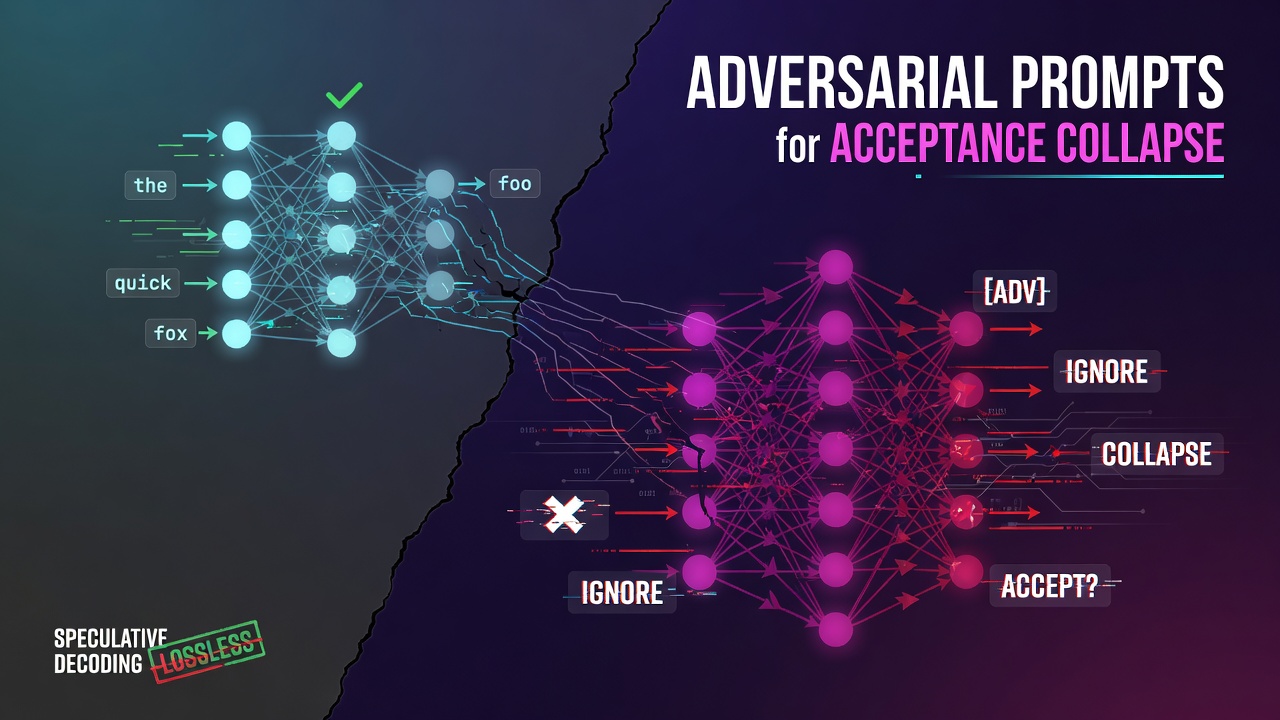
Abstract:Lossless acceleration schemes, such as speculative decoding, promise significant inference speedups by relying on dynamic token-level alignment between a draft and a target model. However, this guarantee of semantic equivalence masks a severe operational vulnerability: draft-target alignment can be systematically attacked. In this paper, we introduce ADSD, which, to the best of our knowledge, is the first prompt-suffix attack that collapses verifier acceptance by pushing draft probability mass toward tokens the target is unlikely to accept. ADSD uses Soft-Collapse, a verifier-aligned surrogate derived from the asymmetric speculative acceptance rule, together with a target-preservation objective that discourages obvious task corruption. ADSD successfully generates highly effective adversarial suffixes. On the GSM8K dataset, our attack increases the mean sample time by 62.3% while preserving the task quality. We further show that this vulnerability exists across different domains, speculative decoding strategies, and model architectures.
Submission history
From: Run Wang [view email]
[v1]
Thu, 23 Jul 2026 20:42:41 UTC (659 KB)
0 Comments
Log in to join the conversation.No comments yet. Be the first to share your thoughts.