
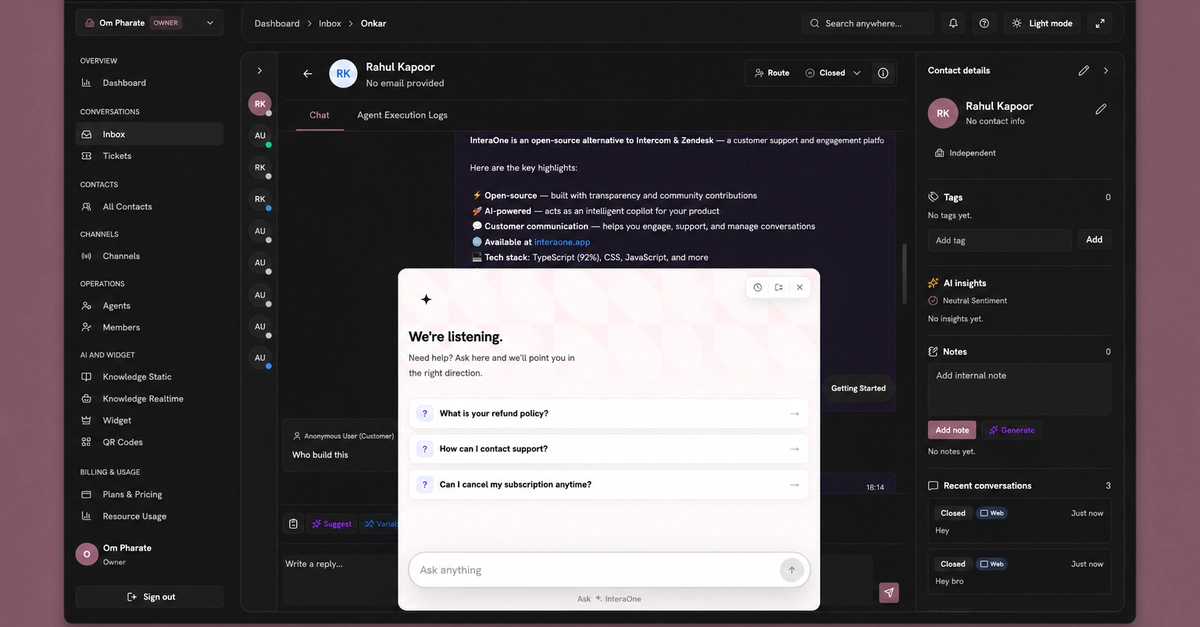


Most modern SaaS products eventually need the same thing:
A way for users to ask questions and get help without leaving the product.
The traditional solution is a customer-support widget connected to a support team.
But with LLMs, I started wondering:
What if the support widget itself could understand your product, answer questions, and handle repetitive support requests?
That idea became InteraOne.
What is InteraOne?
InteraOne is an open-source AI assistant that you can embed directly into your web application.
The goal is simple:
Give developers an open-source infrastructure for building AI-powered customer interactions inside their products.
Instead of building the entire system yourself — chat UI, AI orchestration, knowledge retrieval, conversations, integrations, and infrastructure — InteraOne aims to provide these pieces as one platform.
Think of the direction as:
Intercom / Zendesk-style support + AI assistant + open-source developer infrastructure.
Why am I building this?
There are already excellent customer-support platforms.
But many of them are primarily SaaS products.
That creates a few problems for developers who want more control.
You might want to:
- self-host your infrastructure
- control where your customer data lives
- customize the AI pipeline
- integrate your own models
- modify the widget
- build workflows specific to your product
- avoid being locked into one vendor
I wanted something developers could actually own and extend.
So I started building InteraOne in the open.
The developer experience I want
Eventually, integrating an AI assistant into your application should feel almost trivial.
Something like:
<script
  src="https://your-interaone-instance.com/widget.js"
  data-public-key="YOUR_PUBLIC_KEY"
  async>
</script>
Enter fullscreen mode Exit fullscreen mode
And suddenly your application has an AI assistant connected to your InteraOne backend.
From there, developers should be able to configure knowledge sources, AI behavior, conversations, integrations, and automation.
The complicated infrastructure stays behind the abstraction.
Why open source?
Because AI customer support is becoming infrastructure.
And infrastructure becomes much more interesting when developers can inspect it, modify it, self-host it, and build on top of it.
I don't want InteraOne to become just another closed AI chatbot.
I want it to become a platform developers can hack on.
There are many interesting engineering problems behind something like this:
RAG.
LLM orchestration.
Real-time messaging.
Embeddable widgets.
Multi-tenancy.
Integrations.
Observability.
AI agents.
Scalable backend infrastructure.
That's also why I'm building the project publicly.
Where InteraOne is going
The broader vision is to make InteraOne an open-source AI interaction layer for modern web applications.
Today the primary use case is an AI support assistant.
But the architecture can eventually enable much more:
AI support agents → product assistants → automated workflows → human + AI collaboration.
There is still a lot to build.
And that's exactly what makes the project interesting.
Want to follow the build?
InteraOne is being actively developed on GitHub:
https://github.com/InteraOne/InteraOne
If you find the idea interesting, drop the repository a ⭐.
It genuinely helps an early-stage open-source project get discovered by more developers.
And if you're interested in AI infrastructure, agents, RAG, real-time systems, or developer tooling, contributions and ideas are welcome.
I'm also curious:
What would an open-source Intercom/Zendesk alternative need before you would actually use it in production?
I'd love to hear what developers think.
0 Comments
Log in to join the conversation.No comments yet. Be the first to share your thoughts.