
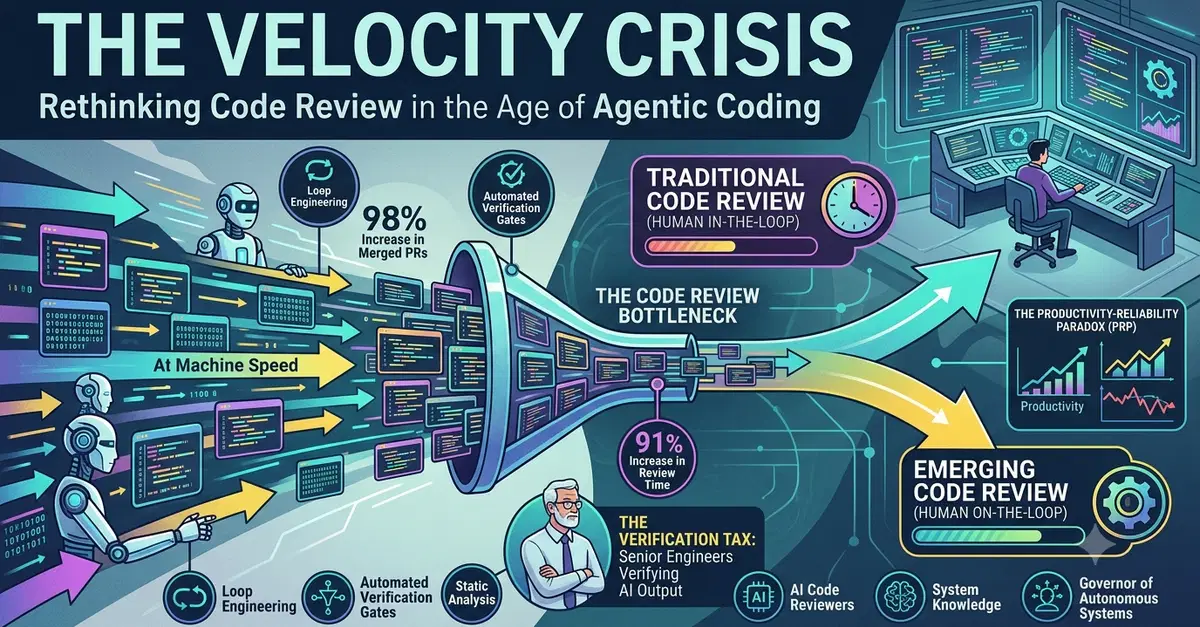


The Velocity Crisis - Rethinking Code Review in the Age of Agentic Coding
The Bottleneck has Shifted: For decades, the primary constraint in software development was the speed at which a human could type code into a terminal. To manage the errors inherent in human fallibility, such as a subtle race condition introduced late on a Friday, code review evolved from informal peer checking into the structured pull request (PR) workflows we use today. Its core purpose was simple: provide a "second pair of eyes" to catch what tired humans miss and ensure shared accountability for the output.
The Arrival of the Productivity-Reliability Paradox: In 2026, that historical constraint has vanished. With the rise of agentic coding, where AI agents operate on high-level goals rather than just autocompleting lines, code production velocity has reached machine speed. However, this has created what researchers call the Productivity-Reliability Paradox (PRP). While individual developers might see productivity gains of over 50%, system-level dependability often suffers. Organisations are seeing a "code review bottleneck": a 98% increase in merged PRs is matched by a 91% increase in review time.
From "In-the-Loop" to "On-the-Loop": The traditional manual, line-by-line review is no longer sustainable; it has become a fracture point that either slows down agents or leads humans to "rubber-stamp" code they don't truly understand. We are now seeing a paradigm shift from human-in-the-loop (involved in every review cycle) to human-on-the-loop (overseeing the process at a meta-level).
Rethinking the Workflow: To survive this era, our approach to review must change:
Loop Engineering: Instead of prompting agents directly, engineers are now "designing loops" that orchestrate agents to find, implement, and verify work autonomously.
Automated Verification Gates: We must distinguish between static analysis (deterministic rules) and AI code reviewers that can comment on logic and edge cases like a human teammate.
The Verification Tax: We must account for the fact that senior developers often spend more time verifying AI-generated output than they would have spent writing it themselves, a cost that scales with codebase maturity.
In this new era, code is disposable, but system knowledge is not. The role of the engineer is evolving from an executor of lines to a governor of autonomous systems.
0 Comments
Log in to join the conversation.No comments yet. Be the first to share your thoughts.