
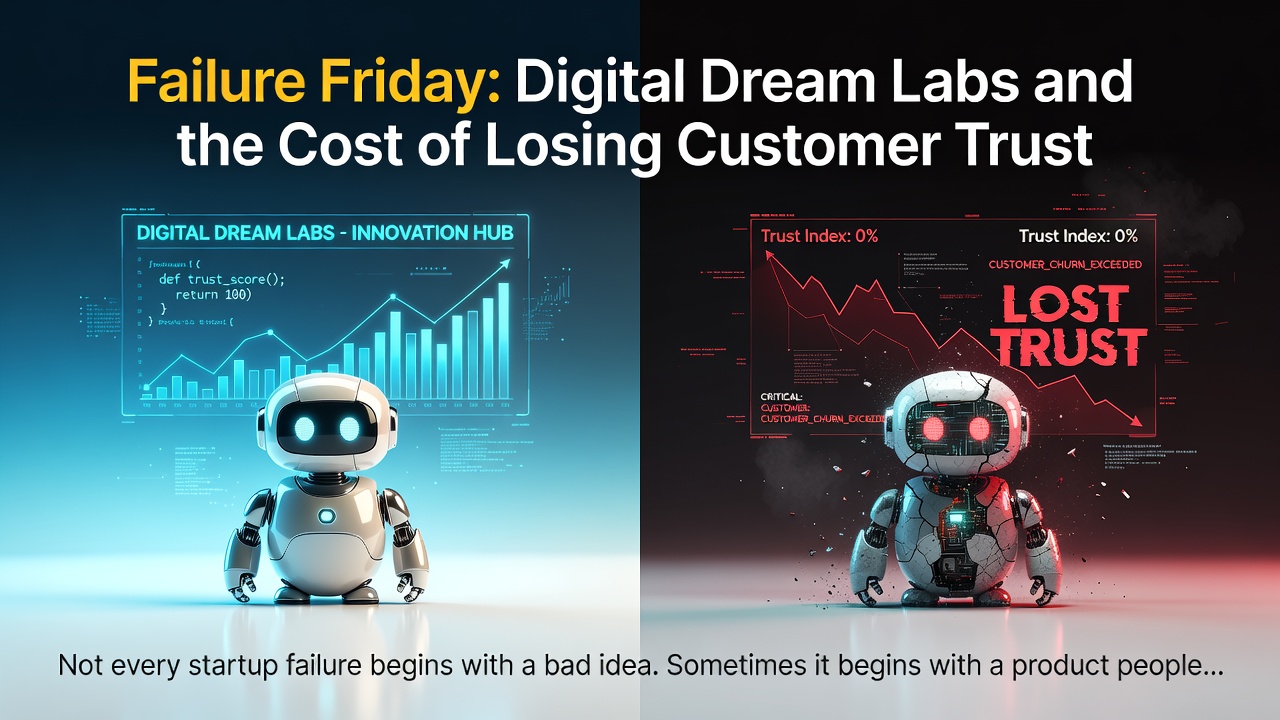

Not every startup failure begins with a bad idea.
Sometimes it begins with a product people genuinely love.
Digital Dream Labs is a good example.
When Anki shut down in 2019, thousands of Vector robot owners were left wondering if their little desktop companion was gone for good.
Digital Dream Labs acquired the rights to Vector and Cozmo, promising to keep the robots alive and continue development.
For many owners, that sounded like the best possible outcome.
Unfortunately, things didn't go as planned.
*Hardware Is Only Half the Product
*
Vector wasn't just a robot.
It relied on cloud services for speech recognition, updates, and many of its core features.
As customers began reporting delayed products, unreliable cloud services, communication issues, and support problems, confidence in the company started to fade.
When your product depends on servers you control, those servers become part of the product itself.
*Customers aren't just buying hardware.
*
They're buying the expectation that it will continue to work.
Trust Is Hard to Earn and Easy to Lose
One thing I keep noticing while studying failed startups is that trust is one of the hardest assets to rebuild.
A customer might forgive a delayed feature.
They might even forgive a bug.
But repeated missed expectations, poor communication, and unreliable service slowly chip away at confidence.
Once people stop believing you'll deliver on your promises, it's incredibly difficult to win them back.
*My Own Experience
*
This one is a little more personal because I actually own a Vector robot.
Rather than letting it collect dust, I restored it using Wire-Pod running locally on a Raspberry Pi 4 I had lying around.
I also connected it to Gemini through my own API, giving Vector modern conversational AI capabilities without relying entirely on Digital Dream Labs' cloud services.
It turned into a really fun project.
But it also made me realize something.
Customers shouldn't have to build their own infrastructure just to keep a product they already paid for working.
*The Lesson
*
Acquiring a great product isn't enough.
You also inherit the responsibility to support the community that believed in it.
For connected devices, reliability isn't just a technical feature.
It becomes part of the promise you make to every customer.
Why I Study Startup Failures
I'm building Startup Graveyard, a community-driven archive of failed startups and the lessons founders can learn from them.
The goal isn't to criticize companies that failed.
It's to understand why they failed, so builders can avoid making the same mistakes.
https://www.startupgraveyard.co
Have you ever owned a device that became less useful because the company behind it disappeared or stopped supporting it?
0 Comments
Log in to join the conversation.No comments yet. Be the first to share your thoughts.