
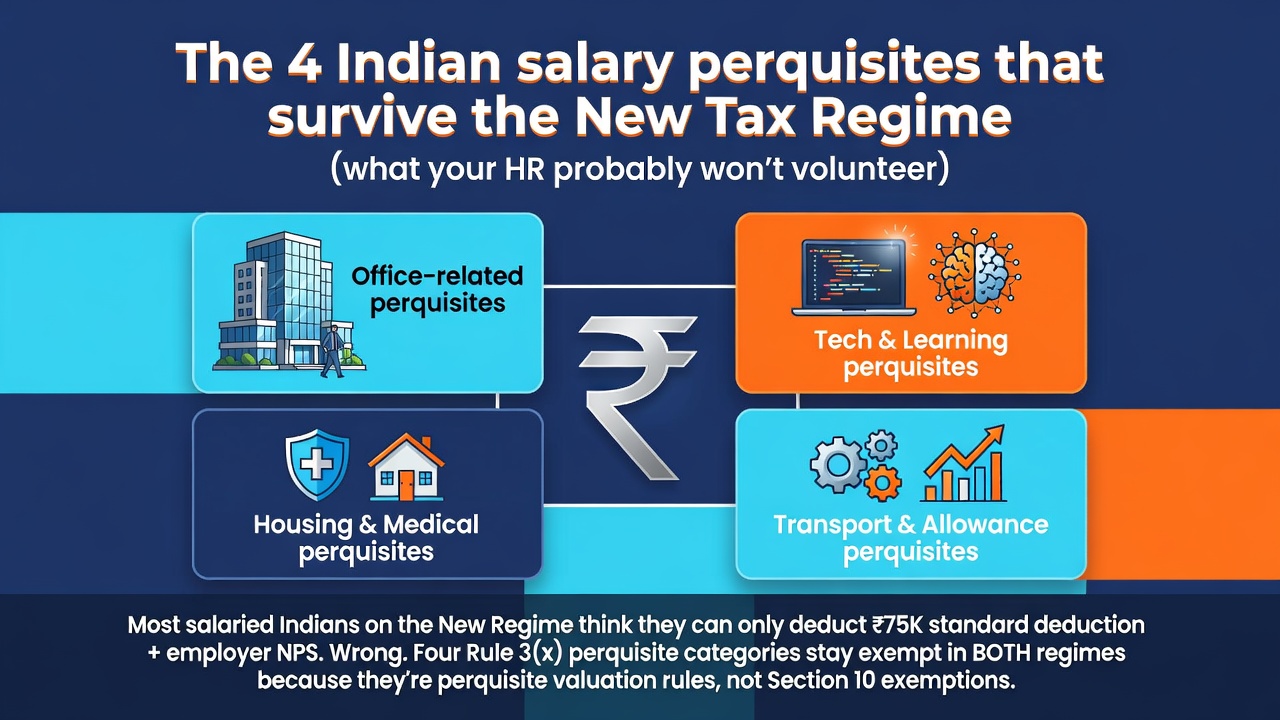
If you're a salaried developer in India, this is money left on the table because nobody frames it right.
The FY 2026-27 conventional wisdom: on the New Regime you can only claim the ₹75,000 standard deduction + employer NPS. Everything else — HRA, LTA, 80C, 80D — is disabled. Which is why so many mid-senior developers who took the New Regime for the higher ₹12L Section 87A rebate think their tax bill is just: gross minus standard deduction, slab math, done.
That framing misses four employer-provided benefits that stay exempt in BOTH regimes because they aren't Section 10 exemptions — they're Rule 3 perquisite valuations. The New Regime dropped Section 10; it did NOT touch Rule 3.
Combined tax savings at 30% + 4% cess bracket: typically ₹36,000 to ₹1,20,000/year depending on which your employer offers.
The rule that survived: Rule 3
Section 10 of the Income Tax Act defines which benefits are exempt from income. Rule 3 of the Income Tax Rules 1962 defines how much of an employer-provided benefit is taxable. These are different things.
The Budget 2020 New Regime (Section 115BAC) removed most Section 10 exemptions — HRA, LTA, most 10(14) allowances. It did not modify Rule 3. So any perquisite whose taxability is defined by a Rule 3 sub-rule is valued identically in both regimes.
Four Rule 3 sub-rules matter for the salaried developer:
1. Rule 3(7)(iii) — meal coupons
Cap: ₹26,400/year (₹50/meal × 2 meals × ~22 working days × 12 months).
Sodexo, Zeta, Zaggle. Your employer issues vouchers OR pays a food-court vendor directly. Fully exempt within cap.
What's NOT covered: a cash "meal allowance" in your salary. Fully taxable regardless of what you spend it on. The exemption is conditional on the payment mechanism, not the intent.
Tax saved at 30% + cess: ~₹8,240/year at full utilisation. Most tech companies already have this on their CTC menu — check your CTC statement for a "meal card" or "food coupon" line.
2. Rule 3(7)(iv) — gift voucher
Cap: ₹5,000/year cumulative across ALL employer gifts in that FY.
The full-or-nothing trap: if aggregate gift-card issuance in the FY crosses ₹5,000 (₹3,000 Diwali + ₹3,000 work anniversary = ₹6,000), CBDT interpretation is the entire amount becomes taxable, not just the ₹1,000 excess. Track this cumulatively.
Tax saved: ~₹1,560/year at full utilisation.
3. Rule 3(7)(ix) — telephone + internet reimbursement
Cap: NO monetary cap. Actual reimbursement against bills is fully exempt.
Conditions:
- Bills must be in the employee's name
- Employer actually pays or reimburses (not a cash allowance)
- Mixed personal + official use is fine — no split proof required
What's NOT covered: a lump-sum "telephone allowance" paid as cash. Fully taxable regardless of your actual bills. The distinction between reimbursement-against-bills vs cash-allowance is the entire game.
Practical example: mobile ₹1,500 + broadband ₹2,500 = ₹4,000/month = ₹48,000/year reimbursed = ~₹14,976/year tax saved at 30% bracket. High-earning devs with premium ISP plans routinely see ₹75,000+ reimbursement = ~₹23,400 in savings.
This one is heavily under-used because tech companies default to "we pay you cash for phone" instead of "you submit bills, we reimburse." Ask HR to restructure — no cost to the employer, direct saving to you.
4. Rule 3(2) — company car (fuel + maintenance + driver)
The biggest lever, most under-used.
For a car provided by the employer used for both office and personal purposes, the taxable perquisite is a fixed monthly amount regardless of what the car actually costs the company.
| Component | Small engine (≤1,600cc) | Large engine (>1,600cc) |
|---|---|---|
| Fuel + maintenance + insurance | ₹1,800/month = ₹21,600/year | ₹2,400/month = ₹28,800/year |
| Driver (if provided) | +₹900/month = +₹10,800/year | +₹900/month = +₹10,800/year |
Numeric example: employer's actual outgoing on a 1,500cc car ≈ ₹60,000/year in fuel + insurance + maintenance. Employee's taxable perquisite = ₹21,600/year. Effective tax-free portion = ₹38,400/year. Tax saved at 30% + cess ≈ ₹11,981/year.
What's NOT Rule 3(2):
- Cash fuel/petrol allowance (fully taxable)
- Personal car with fuel reimbursement (fully taxable — different Section 10(14) framework, rare post-2018)
- Car used ONLY for personal purposes (full running cost taxable)
- Car used ONLY for office purposes (no perquisite; no benefit)
The sweet spot is "mixed use" — the reality for most senior devs commuting + weekend usage.
Combined example — ₹25 lakh CTC dev
Salary ₹25 lakh, marginal 30% + 4% cess, all four levers utilised:
| Perquisite | Amount exempt | Tax saved |
|---|---|---|
| Meal coupons | ₹26,400 | ~₹8,240 |
| Gift voucher (Diwali) | ₹5,000 | ~₹1,560 |
| Telephone + internet (bills) | ₹48,000 | ~₹14,976 |
| Company car 1,500cc | employer cost ~₹60K → only ₹21,600 taxable | ~₹11,981 |
| Total | ~₹36,757/year |
On top of standard deduction, 80C, and everything else. And this stays the same in the New Regime.
Why HR usually doesn't volunteer this
Two reasons:
- Legacy CTC templates. Older CTC structures encode a "cash phone allowance" as a taxable component because it was easier to run in payroll. Switching to reimbursement-against-bills is a payroll config change that requires HR's finance team to be aware — many aren't.
- The 5,000 gift trap is easy to trip. HR issues a Diwali gift + a work-anniversary voucher without tracking cumulative → the employee ends up taxed on the full amount. Some companies just skip the exemption path and pay it as taxable.
How to actually get these
The framing that works with HR:
"I'd like to restructure a portion of my fixed CTC into (a) meal coupons up to ₹26,400/year, (b) telephone + internet reimbursement against actual bills, and (c) if the company offers a car benefit, I'd like to opt into that. These are all standard perquisite structures — no incremental cost to the company, but they lower my taxable perquisite value."
Most large employers have these on their CTC menu. Smaller firms may need walking through the Rule 3 framework — the CTC restructuring itself is standard HR practice, so it's not a novel ask.
Common misconceptions
- ❌ "My cash fuel allowance is exempt because Rule 3(2) exists." No. Cash allowances are fully taxable. Rule 3(2) applies to actual company-provided car benefits.
- ❌ "I'll claim ₹10,000/month telephone reimbursement even though my bill is ₹1,500." No. Only actual bills up to the amount reimbursed count.
- ❌ "Gift card exemption is per gift, not per year." No. Cumulative ₹5,000 across all employer gifts in the FY.
- ❌ "These deductions are Old-Regime only, like 80C." No. Rule 3(x) perquisite valuations survive the New Regime — they're computational rules, not Section 10 exemptions.
Why I built a calculator for this
I built SmartTaxCalc — a browser-based Indian tax calculator — because tools that let you enter these perquisite values and see the exempt-vs-taxable split are rare. Most calculators just take gross salary and apply slab math. The homepage calculator now accepts all four of these perquisite categories individually and shows the New-Regime vs Old-Regime impact side by side.
Full statutory framing + numeric examples + FAQ + HR-friendly script: smarttaxcalc.in/blog/ctc-exempt-allowances-fy-2026-27/ — CA-reviewed.
If you're on the New Regime and have never asked HR about restructuring these categories, that's the highest-ROI 15-minute conversation of your year.
The author builds SmartTaxCalc.in — free browser-based Indian tax calculator suite. Blazor WebAssembly, CA-reviewed by ICAI 644575, no signup, no backend. Previously wrote about Blazor WASM trim mode surprises and a PowerShell backlink rel verifier.
0 Comments
Log in to join the conversation.No comments yet. Be the first to share your thoughts.