
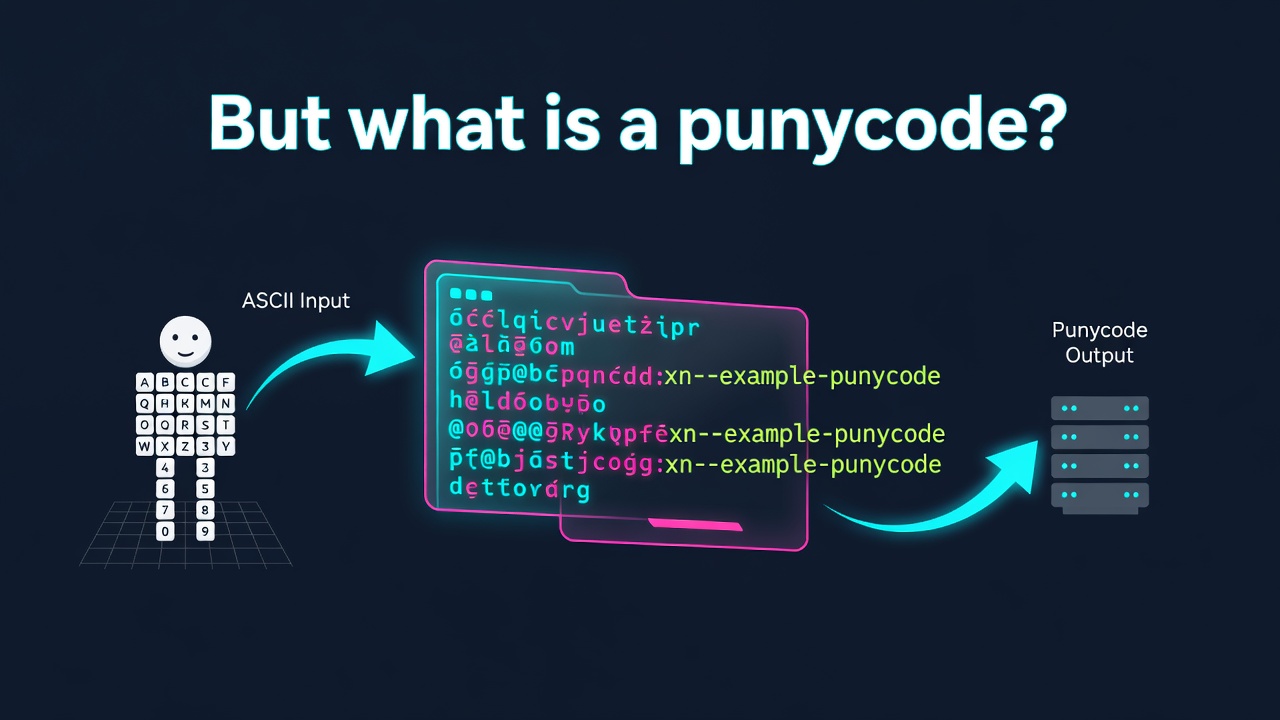
Imagine you have a friend who only understands the 26 English letters (A-Z), numbers (0-9), and a dash (-).
Now imagine another friend wants to write their name as "José" or "你好" or "🍕".
The first friend doesn't understand those special letters or emojis.
So, you use a secret translator that changes them into something the first friend can understand.
That's what Punycode does.
A simple example
Suppose someone wants a website with the domain:
münchen.com
The internet's basic domain name system can't directly understand the ü.
So Punycode converts it into something like:
xn--mnchen-3ya.com
Both mean the same website.
What you see: münchen.com
What computers use: xn--mnchen-3ya.com
The xn-- at the beginning tells computers:
"Hey! This is Punycode. Decode it back into the real name."
Think of it like nicknames
Imagine your teacher can't pronounce your name, Tolúwàní.
She writes it in a way she can pronounce, but everyone knows it's still you.
Punycode does the same thing for website names.
Why is it needed?
Without Punycode, websites could only use simple English letters like:
google.com ✅
example.com ✅
With Punycode, people can have websites in their own languages, such as:
café.com
mañana.com
中国.com
Ελλάδα.gr
Behind the scenes, those are converted into Punycode so the internet can route them correctly.
One thing to be careful about
Sometimes bad people create fake websites that look almost identical to real ones by using letters from other alphabets.
For example:
apple.com (real)
аpple.com (the first "a" is actually a Cyrillic letter, not the English "a")
Although they look almost the same, they're different domains. Browsers often show the Punycode version (starting with xn--) instead, helping users spot suspicious domains.
In one sentence
Punycode is a translator that lets the internet use website names with letters from any language while still speaking the simple alphabet that computers expect.
0 Comments
Log in to join the conversation.No comments yet. Be the first to share your thoughts.