
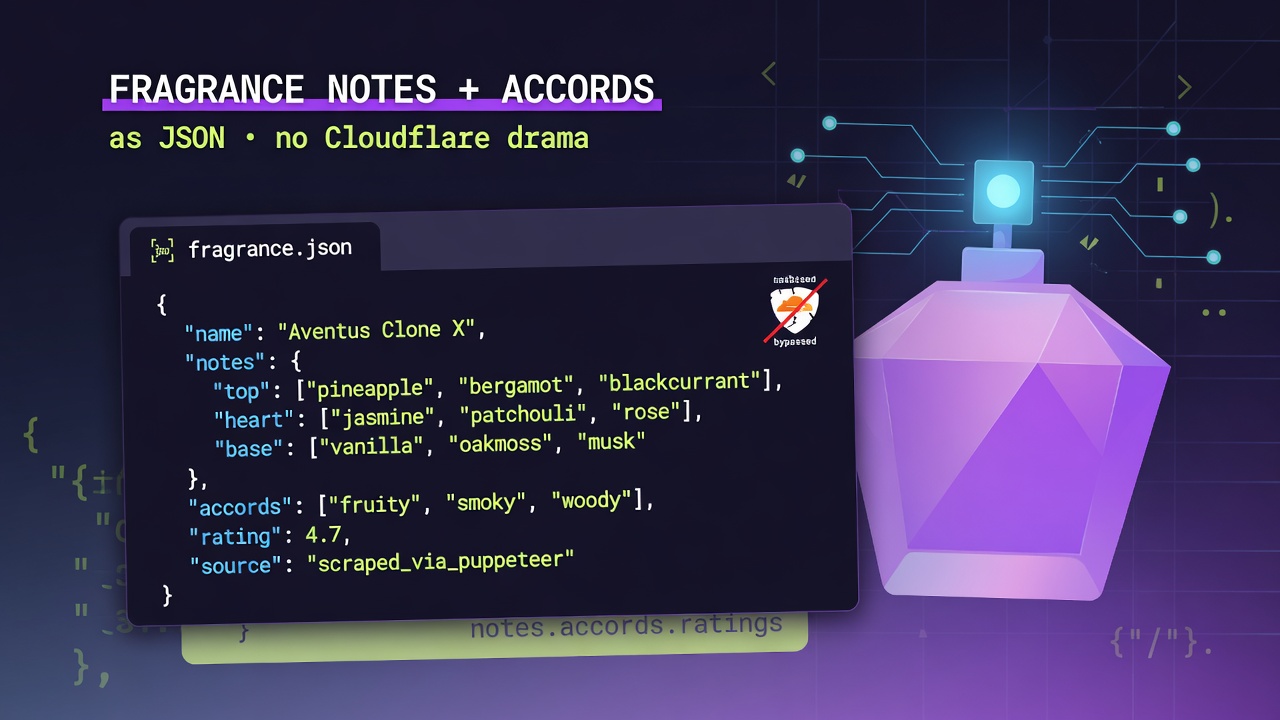

Anything you build around perfume data — a dupe/clone finder, a fragrance shop's product
enrichment, a rating tracker, a recommendation engine based on notes — needs the same raw
material: structured notes, accords, and ratings per fragrance, not prose reviews. The
demand for this data is well proven — Fragrantica scrapers on Apify have 1,700+ combined
runs — but the actual sourcing has gotten harder, and that's worth understanding before
you pick a source.
Why the obvious source (Fragrantica) is the wrong first pick
Fragrantica is the biggest fragrance database, so it's the first thing everyone scrapes.
But it now sits behind Cloudflare, and most of the scrapers built against it are
fighting that wall — you'll find a handful on Apify, several with visibly stale runs or
low success rates, because the site actively blocks plain requests. You end up paying in
proxy cost, retries, and broken runs for data that's conceptually simple: notes, accords,
a rating.
Parfumo is the other large, community-driven fragrance encyclopedia — comparable scale
and depth of data (notes, accords, per-dimension community ratings, perfumer credits) — and
it still serves plain, uncached HTML with no Cloudflare challenge. It had zero dedicated
scrapers on Apify as of this writing, which is the interesting part: the demand signal
for this class of data is proven (1,700+ runs on the Fragrantica side alone), but almost
all of that tooling is pointed at the one source that's actively fighting back.
What the source data looks like, cleaned up
One record per fragrance, real output for Dior Sauvage EDT:
{
  "name": "Sauvage",
  "brand": "Dior",
  "releaseYear": 2015,
  "concentration": "Eau de Toilette",
  "gender": "men",
  "rating": { "value": 7.5, "best": 10, "ratingCount": 6514, "reviewCount": 365 },
  "perfumers": ["François Demachy"],
  "accords": ["Fresh", "Spicy", "Synthetic", "Citrus", "Woody"],
  "notes": ["Ambrox", "Sichuan pepper", "Calabrian bergamot", "Pink pepper", "..."],
  "communityRatings": {
    "scent":     { "average": 7.30, "votes": 6514 },
    "longevity": { "average": 7.79, "votes": 6129 },
    "sillage":   { "average": 7.73, "votes": 6106 },
    "bottle":    { "average": 7.72, "votes": 6164 },
    "value":     { "average": 7.40, "votes": 4561 }
  }
}
Enter fullscreen mode Exit fullscreen mode
When a page groups notes into a pyramid (most designer releases do), you also get:
"notesPyramid": {
  "top":   ["Bergamot", "Apple", "Blackcurrant", "Lemon", "Pink pepper"],
  "heart": ["Pineapple", "Indonesian patchouli", "Jasmine"],
  "base":  ["Birch", "Cedarwood", "Musk", "Oakmoss", "Ambergris"]
}
Enter fullscreen mode Exit fullscreen mode
That pyramid — not just a flat note list — is what a dupe/clone finder actually needs: two
fragrances can share a base note and read completely differently because their top notes
diverge, so comparing pyramids beats comparing flat sets.
Getting it without hand-copying spec pages
Parfumo Fragrance Scraper
on Apify takes a list of perfume URLs (or Brand/slug pairs) and returns one clean record
per fragrance:
curl -s -X POST "https://api.apify.com/v2/acts/minty_modesty~parfumo-perfume-data-scraper/runs?token=$APIFY_TOKEN" \
  -H 'content-type: application/json' \
  -d '{"perfumeUrls":["Dior/sauvage","Creed/aventus","Chanel/No_5"],"includeCommunityRatings":true}'
Enter fullscreen mode Exit fullscreen mode
It reads only public /Perfumes/ pages — allowed by Parfumo's robots.txt, no login, no
CAPTCHA, no Cloudflare challenge to route around — so a run doesn't turn into a proxy bill.
URLs that don't resolve come back as {"url": "...", "error": "not_found"} instead of
silently dropping the line item, so a batch of a few hundred references doesn't need
babysitting.
When this is (and isn't) the right layer
If you already have a working Fragrantica pipeline and it isn't breaking, there's no reason
to switch sources mid-project. But if you're starting a new dupe-finder, enrichment job, or
rating tracker from scratch, the 1,700+ runs on the Fragrantica side tell you the data is
worth having — they don't tell you Fragrantica is the only place to get it. Parfumo is the
same class of data from a source that isn't actively trying to block you from reading it.
0 Comments
Log in to join the conversation.No comments yet. Be the first to share your thoughts.