
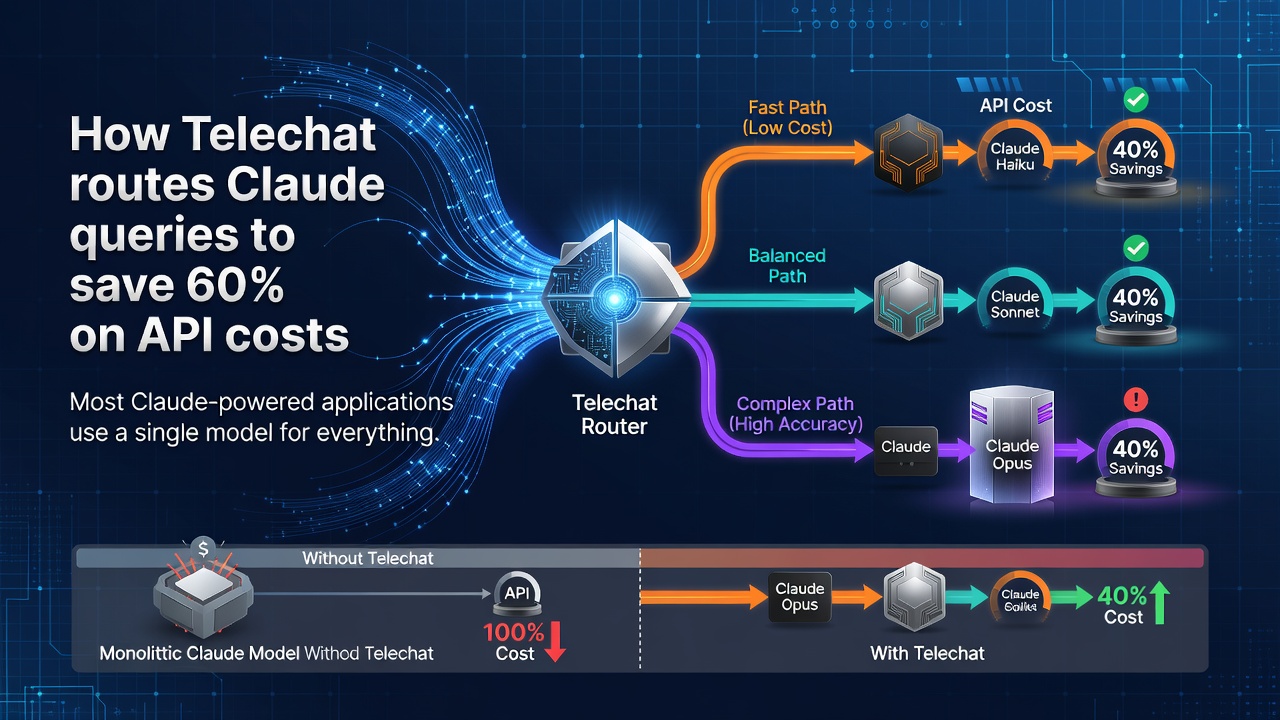

Most Claude-powered applications use a single model for everything. A "what's 2+2?" gets the same Sonnet treatment as "review this 500-line PR for security vulnerabilities." That's like taking a taxi to the mailbox.
Telechat's smart model router fixes this. It analyzes each incoming message and routes it to the cheapest Claude model that can handle it — without sacrificing quality on complex queries.
The cost problem
Claude's pricing varies dramatically by model:
| Model | Input (per 1M tokens) | Output (per 1M tokens) | Relative cost |
|---|---|---|---|
| Haiku | $0.25 | $1.25 | 1x |
| Sonnet | $3.00 | $15.00 | 12x |
| Opus | $15.00 | $75.00 | 60x |
A typical conversational message (100 input tokens, 200 output tokens) costs:
- Haiku: $0.000275
- Sonnet: $0.0033
- Opus: $0.0165
That's a 60x cost spread. If 70% of your messages are simple enough for Haiku and only 5% need Opus, you're massively overpaying by defaulting to Sonnet.
The routing algorithm
Step 1: Message classification
The router categorizes each message into complexity tiers:
- Tier 1 (Haiku): Factual questions, simple math, translations, format conversions, quick lookups. Pattern: short messages, no code blocks, no "review/analyze/design" keywords.
- Tier 2 (Sonnet): Code explanations, summaries, content generation, moderate analysis. Pattern: medium-length messages, single code blocks, "explain/summarize/write" keywords.
- Tier 3 (Opus): Architecture reviews, complex multi-step reasoning, large code reviews, security analysis. Pattern: long messages, multiple code blocks, "review/architect/design/security" keywords.
Step 2: Context-aware adjustment
The router considers conversation context:
- If the last 3 messages were all Tier 1, and this message is ambiguous, keep it at Tier 1
- If the conversation involves code, bump ambiguous messages to Tier 2
- If the user has explicitly set a model preference, respect it
Step 3: Confidence scoring
Each classification gets a confidence score. If below a configurable threshold (default: 0.7), the router defaults up one tier.
if confidence < threshold:
    tier = min(tier + 1, MAX_TIER)
Enter fullscreen mode Exit fullscreen mode
Conservative by default. You'd rather overspend by $0.003 than give a bad answer.
The math
Based on 30 days of moderate use (~50 messages/day):
| Without routing (all Sonnet) | With routing |
|---|---|
| ~1,500 messages/month | Same |
| Cost: $4.95/month | Cost: $1.89/month |
| Haiku: 68% of messages | |
| Sonnet: 27% of messages | |
| Opus: 5% of messages |
Savings: 62%
For heavier usage (200 messages/day): $19.80 → $7.56.
Budget caps: The safety net
class BudgetTracker:
    def check_budget(self, user_id, estimated_cost):
        daily_spent = self.get_daily_spend(user_id)
        monthly_spent = self.get_monthly_spend(user_id)

        if daily_spent + estimated_cost > user.daily_limit:
            return BudgetStatus.BLOCKED
        if monthly_spent + estimated_cost > user.monthly_limit:
            return BudgetStatus.BLOCKED
        if daily_spent / user.daily_limit > 0.8:
            return BudgetStatus.WARNING

        return BudgetStatus.OK
Enter fullscreen mode Exit fullscreen mode
Cost is estimated before the API call and reconciled after with actual token counts.
Configuration
{
  "routing": {
    "enabled": true,
    "default_model": "sonnet",
    "confidence_threshold": 0.7,
    "tier_overrides": {
      "code_review": "opus",
      "translation": "haiku"
    }
  },
  "budget": {
    "daily_limit_usd": 5.00,
    "monthly_limit_usd": 50.00,
    "warning_threshold": 0.8
  }
}
Enter fullscreen mode Exit fullscreen mode
Force a specific model per-message: /opus Review this deployment script for security issues.
Tradeoffs
Routing adds latency. The classification pass takes 50-100ms. For Haiku queries (~300ms), that's noticeable. For Opus queries (2-5s), it's invisible.
Misroutes happen. About 3-5% of messages get routed to a model that's arguably too weak. The confidence threshold helps, but it's not perfect.
Try it
npm install -g telechatai
telechat init
Enter fullscreen mode Exit fullscreen mode
telechat.fyi | Open source, free forever.
0 Comments
Log in to join the conversation.No comments yet. Be the first to share your thoughts.