
[Submitted on 30 Jul 2026]
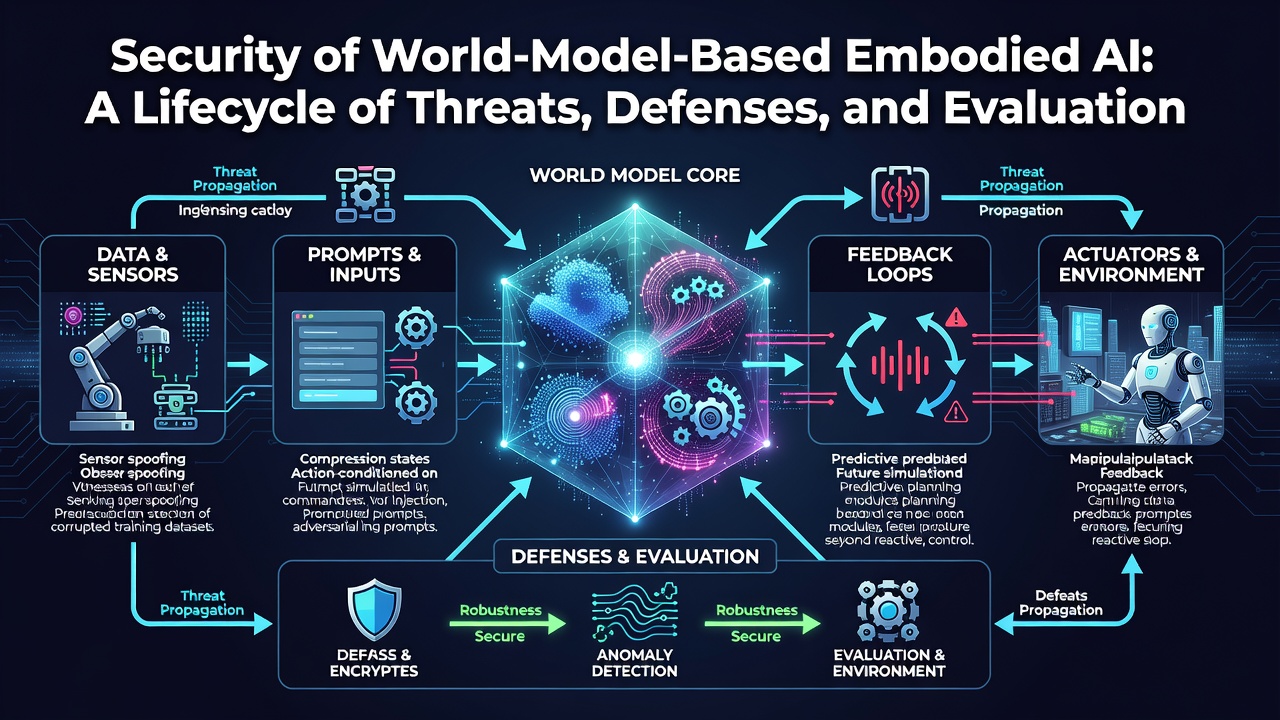
Abstract:World models give embodied AI a predictive core: they compress observations into states, simulate action-conditioned futures, and enable planning beyond reactive control. This predictive layer, however, opens a new security boundary-compromise can propagate from data, sensors, prompts, or feedback into physical action. Rather than treating world models as an isolated component, this survey traces threats across their entire lifecycle-from data construction and representation learning, through state grounding and imagination, to trajectory evaluation, execution, and long-term adaptation via memory and tools. We show that familiar attack families: poisoning, backdoors, adversarial examples, sensor spoofing, prompt injection, trajectory manipulation, and supply-chain attacks take on distinct meanings when they corrupt world states, learned dynamics, affordance estimates, or safety costs. We also highlight a duality: world models can serve as runtime safety shields, yet when compromised or over-trusted they generate predictive safety illusions. The survey offers a lifecycle taxonomy, maps existing attacks to world-model security properties, outlines evaluation protocols for safety failures, and structures defenses across provenance, robust grounding, uncertainty-aware prediction, trajectory gating, feedback auditing, and deployment assurance.
Submission history
From: Fazhong Liu [view email]
[v1]
Thu, 30 Jul 2026 13:58:33 UTC (114 KB)
0 Comments
Log in to join the conversation.No comments yet. Be the first to share your thoughts.