
[Submitted on 30 Jul 2026]
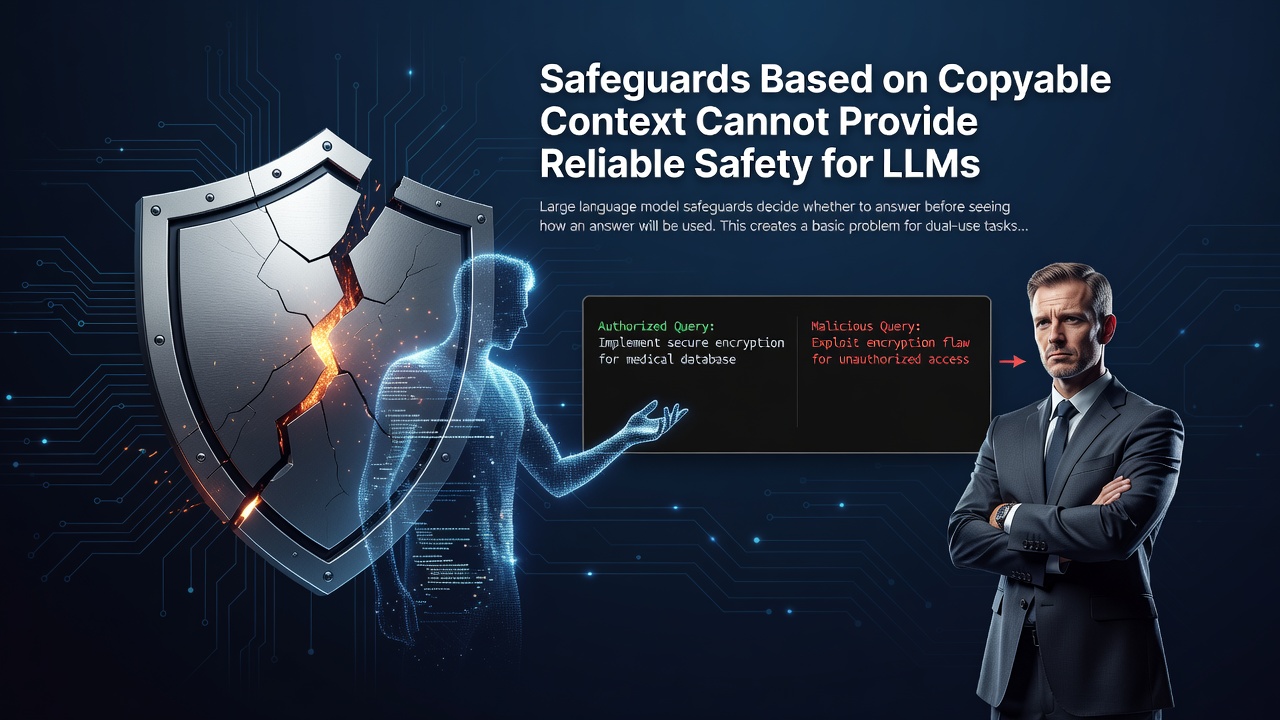
Abstract:Large language model safeguards decide whether to answer before seeing how an answer will be used. This creates a basic problem for dual-use tasks: the same answer can help an authorized professional or an attacker, while an attacker can imitate a benign request and interaction history. We separate the capability released by the model from the evidence available about downstream use. When that evidence is copyable, we derive the exact worst-case floor on attacker assistance while preserving useful answers. The result yields a safety trilemma: Useful Capability, Reliable Safety, and Open Access cannot coexist. We then show how a trusted credential can complement existing safeguards by adding hard-to-copy information that predicts actual downstream use, and identify the stronger condition needed to eliminate the floor. Evidence from dual-use evaluations, adaptive attacks, and deployed trusted-access programs supports the practical relevance of these conditions.
Submission history
From: Pingyu Wu [view email]
[v1]
Thu, 30 Jul 2026 09:59:08 UTC (249 KB)
0 Comments
Log in to join the conversation.No comments yet. Be the first to share your thoughts.