
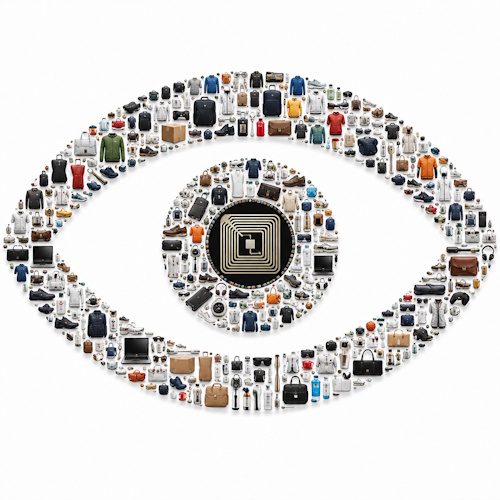
I must admit that I was tempted to title this column “It’s RAINing RFID! Hallelujah!”
But then I thought you’d probably spend the rest of the day with the Weather Girls song rattling around in your head, so I decided against it. You’re welcome.
I flatter myself that I know as much about RFID (Radio-Frequency Identification) as the next man (or woman). Unfortunately, that really isn’t saying much, because most people don’t have much of a clue about what RFID is, what it does, or how it does it. This is a shame, because the world of RFID is evolving in ways that could make it one of the most impactful (albeit unsung) technologies of the 21st century.
I have a sneaking suspicion that if I accosted 100 people in the street, I’d be arrested, but that’s not important now. If I somehow managed to ask them about RFID, perhaps 50-70% would say they’ve heard the term, but I’m guessing that only 10-20% could give a reasonably accurate 30,000-foot explanation along the lines of “It’s a tiny wireless tag that can be read without touching it.”
Interestingly, almost everyone uses RFID daily without realizing it. They tap an employee badge to open a door, unlock a hotel room with a key card, zip through a toll booth, tap a transit card, or carry an RFID-enabled passport. Also, the contactless chips embedded in many credit and debit cards use NFC (Near Field Communication), which is a specialized form of RFID.
The important point is that RFID has been quietly spreading into every corner of our lives for decades. Its adoption has grown exponentially, largely unnoticed by the public. And now, thanks to RAIN RFID, that growth is about to accelerate even further.
Of course, this leads us to the obvious question: “What exactly is RAIN RFID, and why is it generating so much excitement?” I’m so glad you asked; otherwise, I would have been obliged to concoct some outrageously contrived segue to weave it into the conversation, and nobody wants that.
Actually, now I come to think about it, I fear I may have led you astray. This story isn’t really about RFID, and it’s not even about RAIN RFID. It’s about making the physical world digitally visible. Allow me to expound, explicate, and elucidate (don’t worry; I’m a professional).
Let’s start by noting that we’ve spent the past few years talking about artificial intelligence (AI) as though it exists in splendid isolation. But AI has a problem. It may be astonishingly good at reasoning about data, yet it knows absolutely nothing about the physical world unless someone—or something—tells it what’s going on. If a warehouse contains a million shirts, a hundred thousand boxes, fifty thousand pairs of shoes, and twenty thousand parcels, AI can’t magically see any of them. Before AI can make intelligent decisions about the real world, the real world must first become digital.
Making the Physical World Talk
Although the roots of RFID stretch back to World War II radar and the “friend or foe” transponders carried by military aircraft, the passive RFID tags we know today emerged through decades of research during the 1960s, 1970s, and 1980s before becoming standardized in the 1990s
These traditional passive RFID tags are simple (but cunning) little devices. Each one consists of a tiny “endpoint” integrated circuit (IC) connected to an equally tiny antenna. Together these form an RFID inlay, which can then be incorporated into a wide variety of RFID tags—from adhesive labels and airline baggage tags to clothing care labels and even tags embedded inside products.
There’s no battery, no switch, and no maintenance. Instead, a nearby reader transmits a radio-frequency signal that energizes the tag. The antenna harvests just enough of that energy to wake up the IC, which promptly responds by sending back its unique identity using a clever technique called backscatter.
The tags cost only pennies, can last for decades because there’s no battery to wear out, and are small enough to disappear into clothing labels, airline baggage tags, medicine bottles, cardboard cartons, shoes, spectacles, and thousands of other everyday objects.
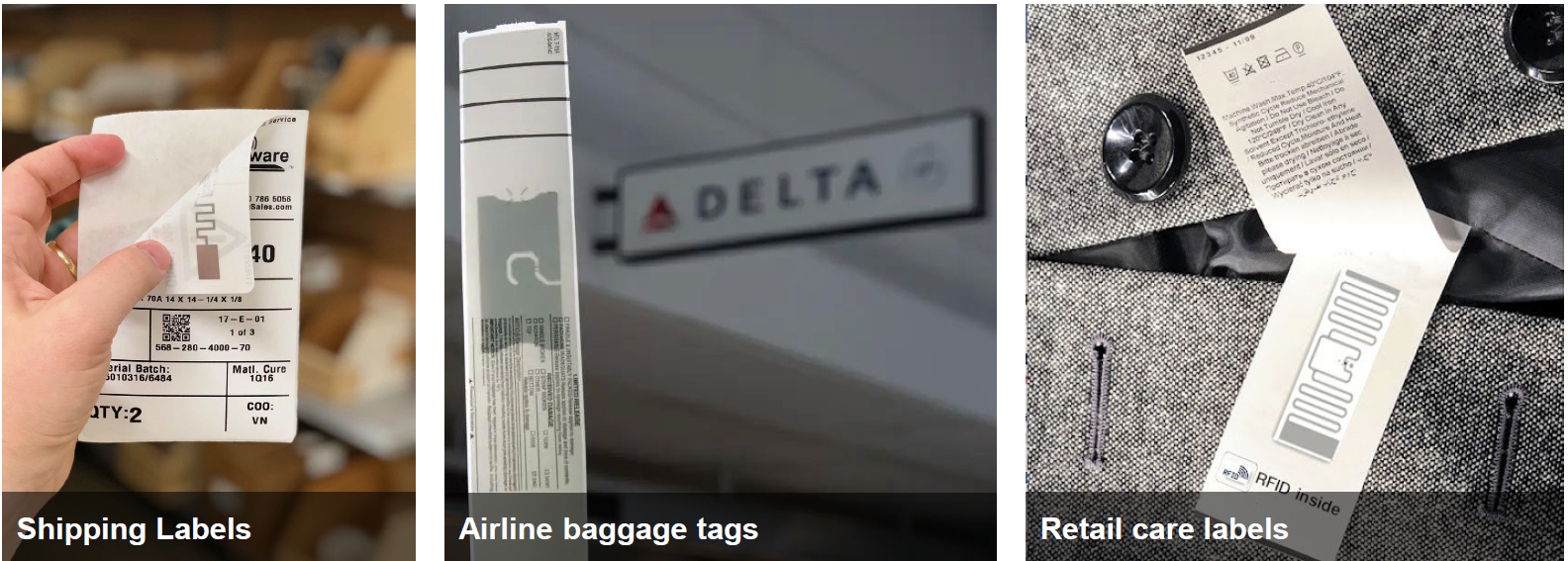
Tag examples (Source: Impinj)
Long before anyone coined the phrase “Internet of Things” (IoT), RFID was quietly connecting physical objects to enterprise software. The difference is that early IoT discussions focused on connecting devices—thermostats, cameras, smart watches, industrial sensors, and so forth. RFID turns that idea on its head by connecting the things those devices interact with: the shirts hanging on store racks, the parcels moving through distribution centers, the luggage disappearing behind the check-in desk, the eyeglasses sitting on display stands, and eventually even individual food items.
The implications of all this are profound. Connecting tens of billions of IoT devices is impressive. Connecting hundreds of billions—ultimately perhaps trillions—of ordinary physical objects will be transformative.
Enter Impinj
All of which brings us to Impinj, which has spent the better part of the past quarter-century helping to transform that vision into reality. Founded 26 years ago, the company has played a central role in developing what is now known as the RAIN RFID ecosystem, providing the semiconductor technology, readers, software, and cloud infrastructure that allow enterprises to identify, locate, authenticate, and track physical items throughout their entire lifecycle.
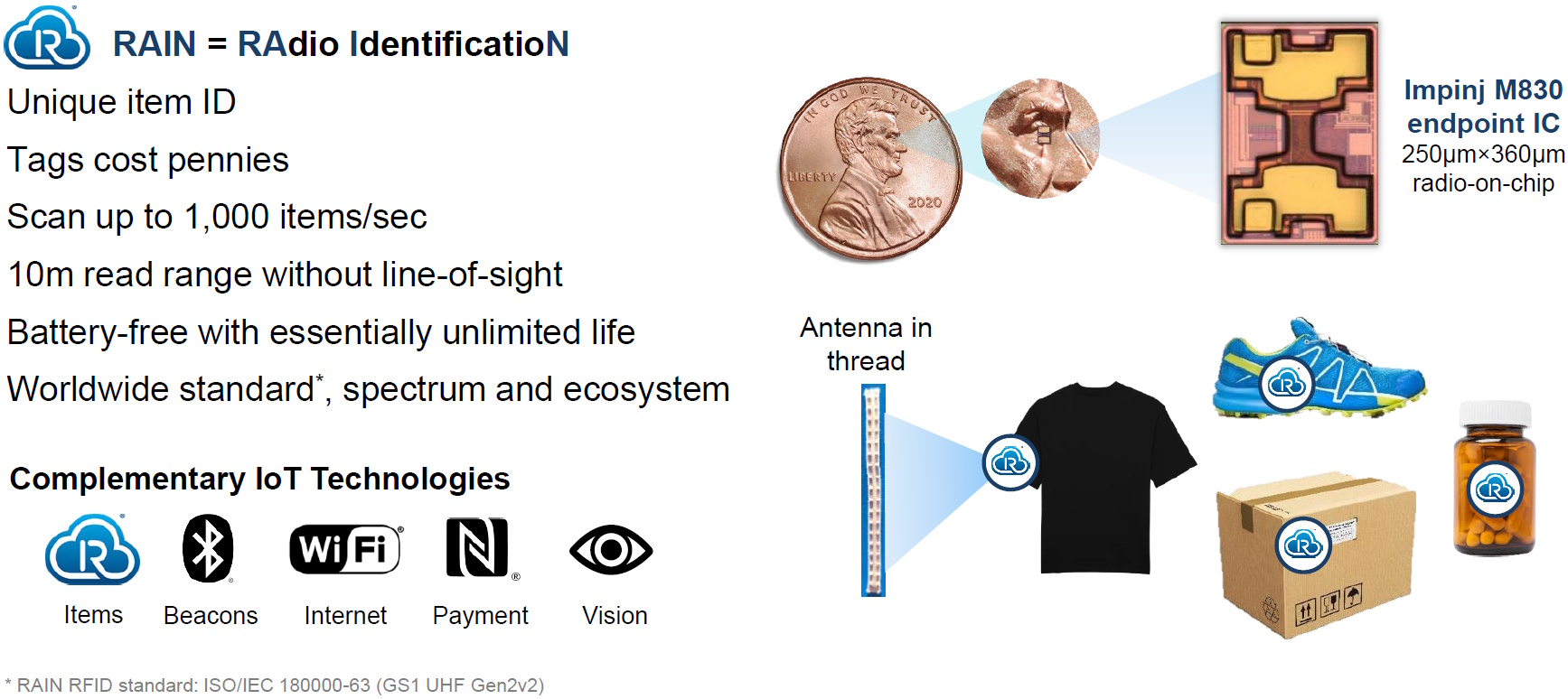
Amazing RAIN RFID technology (Source: Impinj)
As an aside (you knew that one was coming), the technology that we now call RAIN RFID predates the name. It grew out of passive UHF RFID and the development of the EPCglobal Gen2 air-interface protocol in the early-to-mid 2000s, which later became the international ISO/IEC 18000-63 standard.
The term RAIN was adopted in 2014. Several companies working in passive UHF RFID—including Impinj, Google, Intel, and Smartrac, together with AIM Global—felt that the term RFID had become too broad because it was being used to describe many different wireless identification technologies. They wanted a simple name, much like Wi-Fi or Bluetooth, specifically for standards-based passive UHF RFID. The acronym RAIN comes from RAdio IdentificatioN and also alludes to the cloud, emphasizing the connection between physical objects and internet-based applications.
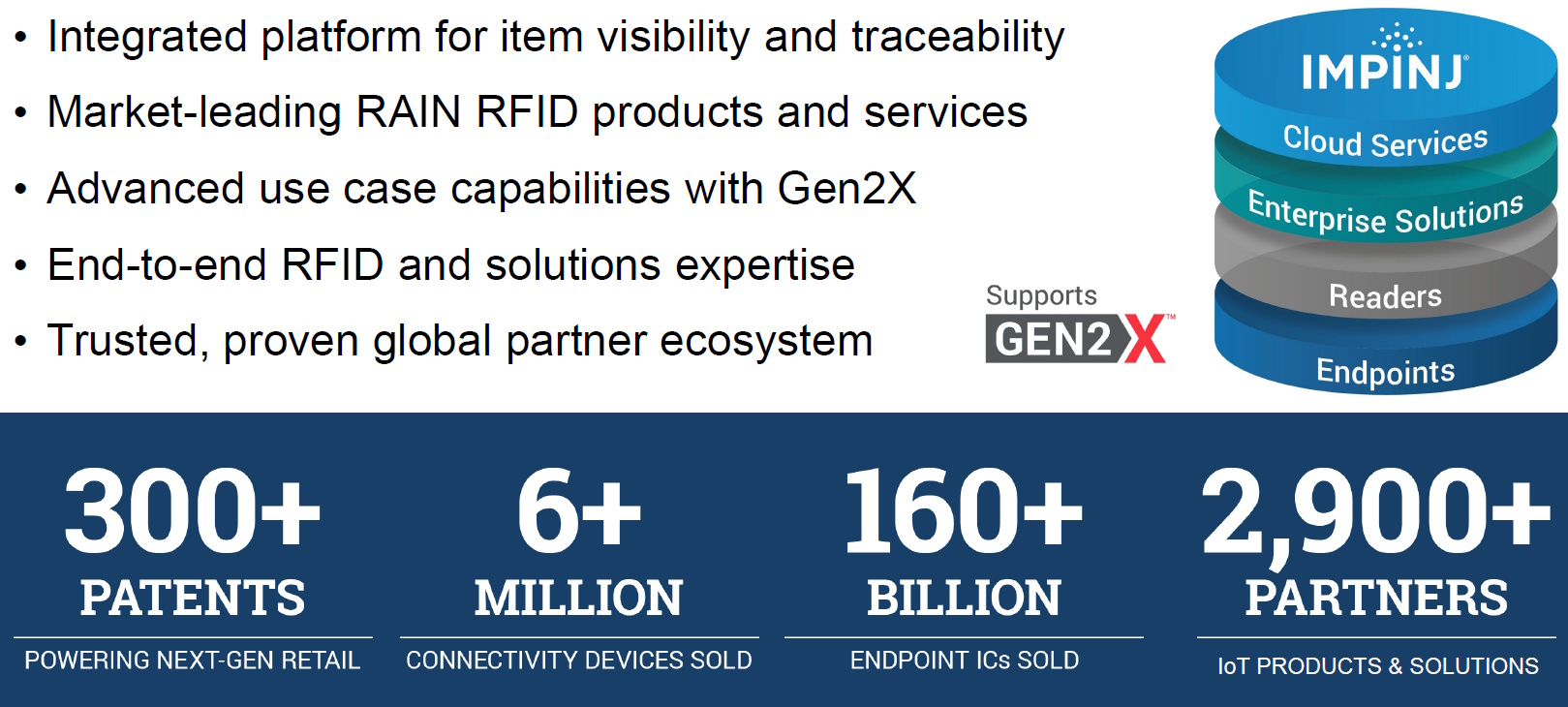
Two decades of Impinj RAIN RFID leadership (Source: Impinj)
The reason I know all this is that I recently got to chat with Impinj’s Matt Branda, VP of Product and Solution Marketing, and George Dyche, VP of Endpoint IC Product Management. One thing I learned from our discussion is that Impinj isn’t simply another chip company. Many companies build RFID tags. Others manufacture labels. Still others build readers or enterprise software. Impinj spans almost the entire stack, from the endpoint ICs embedded in tags, through reader ICs and readers, all the way to cloud services and enterprise solutions.
More Than Just Faster RFID
At this point, you may be wondering what distinguishes RAIN RFID from the RFID systems we’ve grown to know and love over the years. Well, quite a lot, as it turns out.
Traditional RFID often conjures images of someone holding a scanner a few inches from a tag, reading one item at a time. RAIN RFID operates very differently. Working in the UHF portion of the radio spectrum, it can read tags from distances of up to ten meters without requiring line of sight. More importantly, it can identify hundreds—even thousands—of tagged items every second while they’re moving on conveyors, passing through dock doors, or sitting inside cartons.
That ability fundamentally changes what enterprises can do. Imagine a warehouse receiving a pallet containing hundreds of cartons. Instead of opening every box and scanning every barcode individually, the entire pallet can be verified automatically as it passes through a loading bay. Likewise, retailers can inventory entire departments in minutes rather than hours, while airlines can monitor every checked bag throughout its journey from check-in to baggage reclaim.
Physical Intelligence
This brings us to perhaps the most interesting phrase I encountered while researching this article: physical intelligence. Think about the information AI needs to make good decisions:
- Where is this parcel?
- Which shelves are running empty?
- Has this medicine reached the correct hospital?
- Is this luxury handbag genuine?
- Has this suitcase actually been loaded onto the aircraft?
AI can’t answer any of those questions unless somebody first tells it what’s happening in the physical world. RAIN RFID provides that missing information.
In Impinj’s words, the goal is to create a digital twin for every physical object, allowing enterprises to see the real world, track it in real time, and trust that what they’re seeing is genuine. Once those digital twins exist, AI systems suddenly have reliable data upon which to base predictions, automate workflows, and optimize operations.
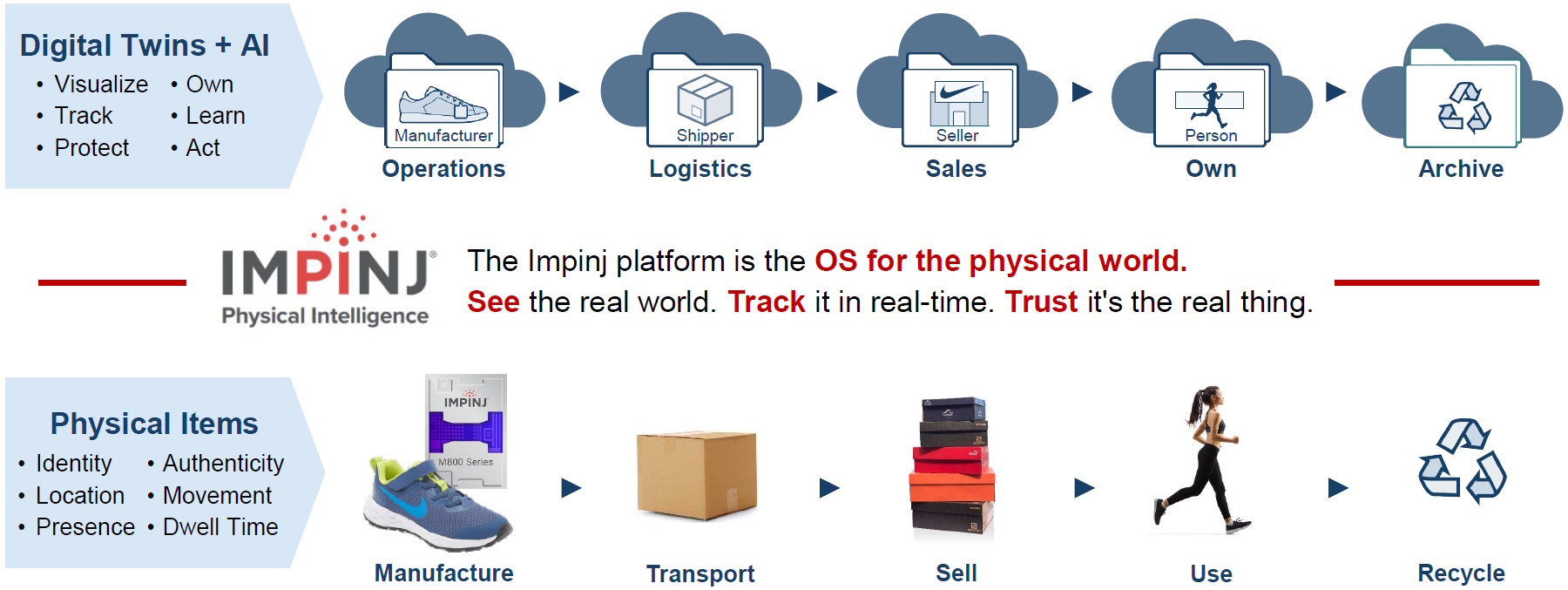
The vision: full-lifecycle item visibility and traceability for every item enterprises manufacture, ship, and sell (Source: Impinj)
Without physical intelligence, enterprise AI is forced to make decisions based on incomplete or outdated information. RAIN RFID changes that by providing a continuous stream of trustworthy data from the physical world.
This vision extends beyond how the data is used—it also influences how the tags themselves are deployed. The industry is increasingly moving beyond simply sticking RFID labels onto products. Instead, RFID inlays are being embedded directly into the products themselves. They can be woven into clothing, molded into eyeglass frames, or incorporated into product packaging. In a delicious irony, the technology is becoming increasingly invisible even as it makes the physical world ever more visible.
Gen2X vs Generation Jones
Apropos of nothing at all, I’m a proud card-carrying member of Generation Jones, but that’s totally irrelevant to what we’re talking about here (once again, you’re welcome). What is relevant is that one of the themes Matt and George were particularly keen to discuss was Gen2X, which they describe as a standards-compatible toolbox of enhancements built on top of the existing RAIN RFID standard.
Rather than replacing today’s infrastructure, Gen2X extends it with capabilities enterprises increasingly need, including improved read performance for tiny tags, better discrimination between wanted and unwanted tags, stronger authentication to combat counterfeiting, enhanced consumer privacy, and improved robustness against communication errors.
That’s important because RAIN RFID is moving beyond simply replacing barcodes. Tomorrow’s applications include autonomous warehouses, frictionless retail, healthcare, food tracking, smart packaging, and countless AI-driven enterprise workflows. Those applications demand more than simply identifying an object; they require confidence that the information being received is accurate, secure, and trustworthy.
Perhaps the best indication that this vision is already becoming reality comes not from technology demonstrations but from real-world deployments. Airlines now track luggage throughout its journey. Retailers such as Walmart and Inditex use RAIN RFID to dramatically improve inventory accuracy. UPS is using the technology to reduce costly package misloads while providing more detailed tracking information. These aren’t pilot projects. They’re large-scale operational systems delivering measurable business value.
Ask Not for Whom the Bell Tolls
All of which brings us back to today. As we’ve already discussed, Impinj was founded 26 years ago and spent much of that time building technology that quietly disappeared into labels, packages, clothing, and countless other everyday objects.
Ten years ago, the company marked another milestone by going public. Today, literally as this column appears on the interweb, CEO Chris Diorio will once again stand at the Nasdaq podium—this time to ring the opening bell celebrating the tenth anniversary of Impinj’s IPO. It’s an appropriate moment to reflect on how far both the company and the technology have come.
Perhaps the most striking observation comes from Chris’s prepared remarks. Despite enabling connectivity for more than 160 billion items over the years, he notes that less than one percent of everyday objects are currently connected.
If that’s true, and I have no reason to doubt it, then today’s bell-ringing isn’t celebrating the end of the RFID story; rather, it’s celebrating the end of the beginning.
0 Comments
Log in to join the conversation.No comments yet. Be the first to share your thoughts.