
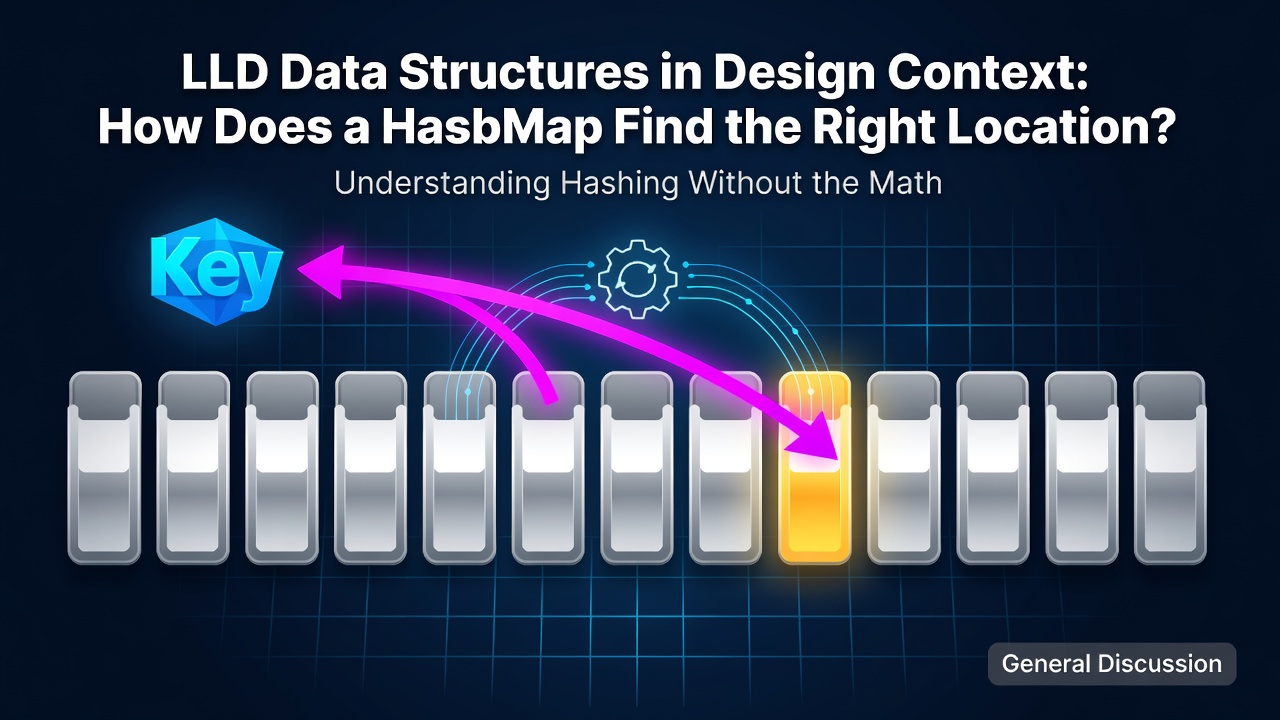
"The real magic of a HashMap isn't that it stores data. It's that it knows where to start looking."
In the previous article, we learned that a HashMap organises information around unique keys.
Instead of searching every stored object one by one, it uses the key to retrieve information quickly.
That naturally raises another question.
"If millions of objects are stored inside a HashMap, how does it know where to begin?"
Surely it isn't remembering the location of every object individually.
The answer lies in one of the most important ideas in computer science:
Hashing.
Don't worry if the word sounds intimidating.
Despite its name, the idea behind hashing is surprisingly simple.
Imagine a Huge Apartment Building
Suppose you're visiting a friend who lives in a building with 5,000 apartments.
If nobody told you the apartment number, what would you do?
Probably something like this.
Apartment 1

↓

Apartment 2

↓

Apartment 3

↓

...

↓

Friend's Apartment
Enter fullscreen mode Exit fullscreen mode
That would take a long time.
Now imagine your friend simply tells you:
Apartment 1842
Suddenly, you don't search the building.
You walk directly to Apartment 1842.
The apartment number isn't your friend.
It simply tells you where to begin.
Hashing works in exactly the same way.
Keys Need Locations
Suppose our application stores customers.
Customer ID → Customer

1001 → Alice

1002 → Bob

1003 → Charlie

1004 → David
Enter fullscreen mode Exit fullscreen mode
The system needs a way to answer one question.
"Where should Customer 1002 be stored?"
Searching every location first would defeat the purpose of using a HashMap.
Instead, the system calculates where that key should go.
Notice something important.
It doesn't compare Customer 1002 against every other customer.
It calculates a location directly.
Think of a School Locker System
Imagine a school with thousands of students.
Every student receives a locker.
Student ID

↓

Locker Number

↓

Locker
Enter fullscreen mode Exit fullscreen mode
Students don't spend every morning searching hundreds of lockers.
Their Student ID determines where they should go.
The locker number isn't the student.
It's simply a way of reaching the student quickly.
Hashing follows exactly the same philosophy.
What Is Hashing?
Hashing is simply the process of converting a key into a location.
Think of it like a translator.
Key

↓

Hash Function

↓

Location
Enter fullscreen mode Exit fullscreen mode
The HashMap then stores or retrieves information from that location.
Notice that the HashMap isn't randomly choosing places.
Every key always follows the same rule.
If the same key appears again later, the calculation produces the same location.
That consistency is what makes retrieval possible.
The Hash Function Is Like a Rule Book
Imagine someone gives you this simple rule.
"Take the last digit of every employee ID."
Now consider these employees.
Employee ID

1231

8745

9008

7612
Enter fullscreen mode Exit fullscreen mode
Applying the rule gives:
1231 → 1

8745 → 5

9008 → 8

7612 → 2
Enter fullscreen mode Exit fullscreen mode
These numbers are not the employees.
They simply tell us where to begin looking.
Real HashMaps use much more sophisticated calculations.
But the underlying idea remains identical.
A key goes in.
A location comes out.
Why Not Store Everything Sequentially?
Imagine an online shopping application.
Product 1

Product 2

Product 3

...

Product 5,000,000
Enter fullscreen mode Exit fullscreen mode
A customer requests:
Product ID = 4872318
Enter fullscreen mode Exit fullscreen mode
Without hashing, the application might need to inspect many products before finding the correct one.
With hashing, the Product ID immediately points toward the correct location.
The amount of unnecessary searching drops dramatically.
That's the real benefit.
The HashMap Doesn't Understand the Key
This is another common misconception.
The HashMap doesn't know what a Customer ID means.
It doesn't know whether the key represents:
- a Product
- a Customer
- a Session
- a Driver
- an Employee
To the HashMap, every key is simply an input.
Its job is to transform that input into a storage location.
Business meaning belongs to your application.
Location calculation belongs to the HashMap.
Keeping these responsibilities separate makes the design both simpler and more flexible.
Real-World Examples
Authentication
Session ID

↓

Hash Function

↓

Location

↓

Session Information
Enter fullscreen mode Exit fullscreen mode
Banking
Account Number

↓

Hash Function

↓

Location

↓

Account Details
Enter fullscreen mode Exit fullscreen mode
Ride Sharing
Driver ID

↓

Hash Function

↓

Location

↓

Driver Information
Enter fullscreen mode Exit fullscreen mode
Hospital
Patient ID

↓

Hash Function

↓

Location

↓

Medical Record
Enter fullscreen mode Exit fullscreen mode
Different industries.
Exactly the same engineering idea.
Why Consistency Matters
Imagine today's calculation sends Customer 1001 to Location 8.
Tomorrow the same key suddenly points to Location 42.
Retrieval would become impossible.
That's why hash functions must always behave consistently.
The same key should always produce the same location.
Without consistency, a HashMap couldn't retrieve previously stored information.
Weak Thinking vs Strong Thinking
Weak Thinking
HashMaps somehow magically know where data is.
Enter fullscreen mode Exit fullscreen mode
Strong Thinking
Every key is transformed into a predictable location.

The HashMap begins searching from there.
Enter fullscreen mode Exit fullscreen mode
Weak Thinking
The HashMap understands Customer IDs.
Enter fullscreen mode Exit fullscreen mode
Strong Thinking
The HashMap only understands keys and locations.

Business meaning belongs to the application.
Enter fullscreen mode Exit fullscreen mode
Common Beginner Mistakes
Mistake 1 — Thinking the key itself is the location
The key and the storage location are different things.
Hashing connects the two.
Mistake 2 — Assuming HashMaps memorise every object's address
They don't.
They calculate where information should be located whenever the key is used.
Mistake 3 — Treating hashing as complicated mathematics
Although real hash functions involve sophisticated algorithms, the core idea is remarkably simple.
Input a key.
Receive a location.
Mistake 4 — Ignoring consistency
A HashMap depends on predictable calculations.
The same key must always produce the same location.
Otherwise retrieval breaks completely.
Interview Perspective
Suppose an interviewer asks:
"How does a HashMap know where an object is stored?"
A beginner might answer:
"It searches very quickly."
A stronger answer would be:
"A HashMap doesn't search every stored object. It applies a hash function to the key, which calculates a predictable location. That location becomes the starting point for storing and retrieving information."
Notice that this explanation focuses on the idea rather than implementation details.
That's exactly what interviewers look for.
The Most Important Insight
Hashing isn't about making data smaller.
It isn't about encryption.
It isn't about hiding information.
Its purpose is much simpler.
It transforms a key into a predictable location so the system can avoid unnecessary searching.
That single idea is what makes HashMaps so powerful.
One-Line Takeaway
A HashMap finds information quickly because every key is consistently transformed into a predictable storage location before the search even begins.
0 Comments
Log in to join the conversation.No comments yet. Be the first to share your thoughts.