
Image via D-Cell Games/Playstack
Editor's note: This column contains major spoilers for UNBEATABLE and insights from co-director RJ Lake that may shape your interpretation of the story and themes.
Editor's note part 2: Game Developer generally does not stylize all-caps game names. The author requested an exception for this piece.
UNBEATABLE rules.
If you've caught me at DICE, GDC, or other small events this year, you've probably heard me repeat those two words over and over again. The rhythm adventure game from D-Cell Games and Balatro publisher Playstack landed in late 2025 and I have never seen a game that brings together such tight rhythm mechanics with so raw a story.
It's a shining example of how games smuggle meaningful tales across 10+ hours of gameplay for the benefit of players who want to jam to 2000s-inspired rock-punk tunes. Games can be meaningful, and they can be stupid fun. That’s what UNBEATABLE hits you over the head with at 182 BPM.
Related:Analyzing Mouse: P.I. For Hire's audacious worldbuilding - Narrative Notebook #4
It's hard to pin down that meaningfulness in the written word. The game's antagonist, Sforzando, explains why in an ironically dark monologue: "Music doesn't make us feel things. Music IS feeling. Art IS feeling." In many other games, that would be a heartfelt lesson or plea from the main character. Here, it's the explanation for a dark secret at the heart of the story.
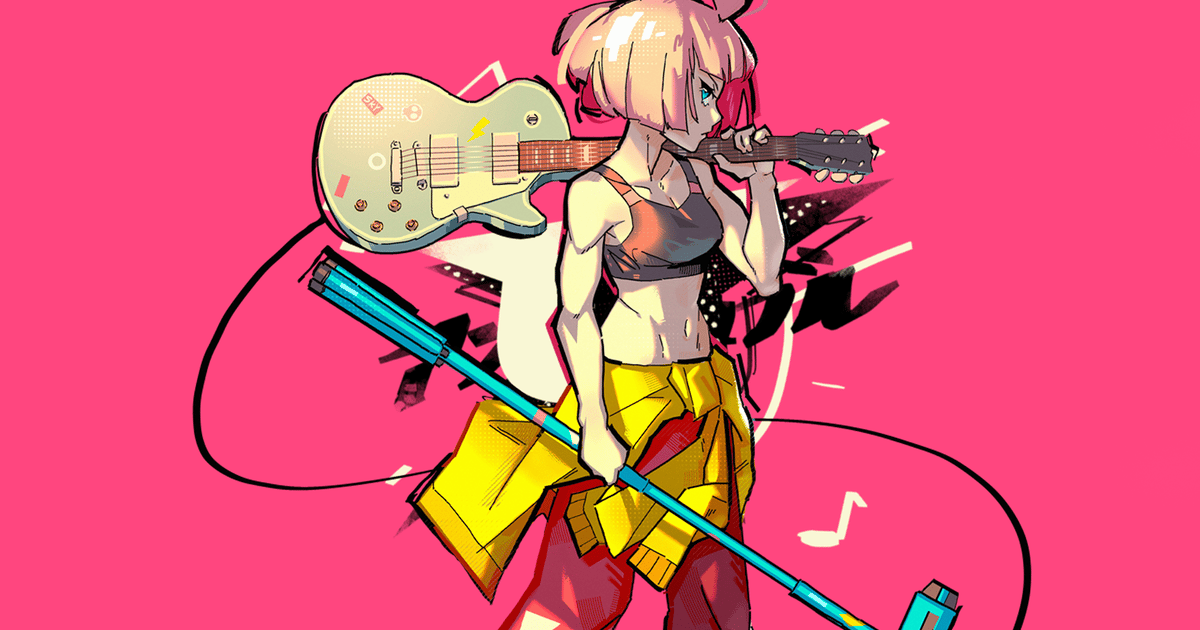
That tale is set in a dystopian sci-fi world where music is illegal. Player character Beat falls into it while dealing with an intense emotional crisis in our own. Her feelings of self-loathing dog her while she fights the cops, learns the secrets of the mysterious creatures that arrive whenever music appears, and puts together a band with fellow outlaw musicians Quaver, Treble, and Clef.
But those secrets? The rules of the world? How Beat made the journey from our world to this dystopian place? This is where UNBEATABLE displays its most impeccable craft. Almost none of those facts are explicitly spelled out for the player—a direct defiance of the "instructional" element of game writing that most games employ.
Why is UNBEATABLE so successful at being so obtuse? We're diving into that topic in today's Narrative Notebook—with a little help from co-director and game writer RJ Lake.
UNBEATABLE demands its audience rise to the occasion
Ask Lake about the craft of writing UNBEATABLE and you'll find he'd prefer to let the game "speak for itself." "Once you say too much, you risk robbing someone of their own experience. You can, as a creator, risk rewriting the feeling in their head with what 'the right answer' is," he said when discussing the topic.
He nodded to David Lynch's famous refusal to explain any of his esoteric art with the phrase "the film is the thing," an insistence that the audience take on the task of interpreting the work. Or to quote his own character—"art is feeling."
But still, Lake was willing to speak to the high-level process of telling such a challenging story. "I don't like stories pre-digested and I don't like games where I'm being patted on the head or told I did such a good job."
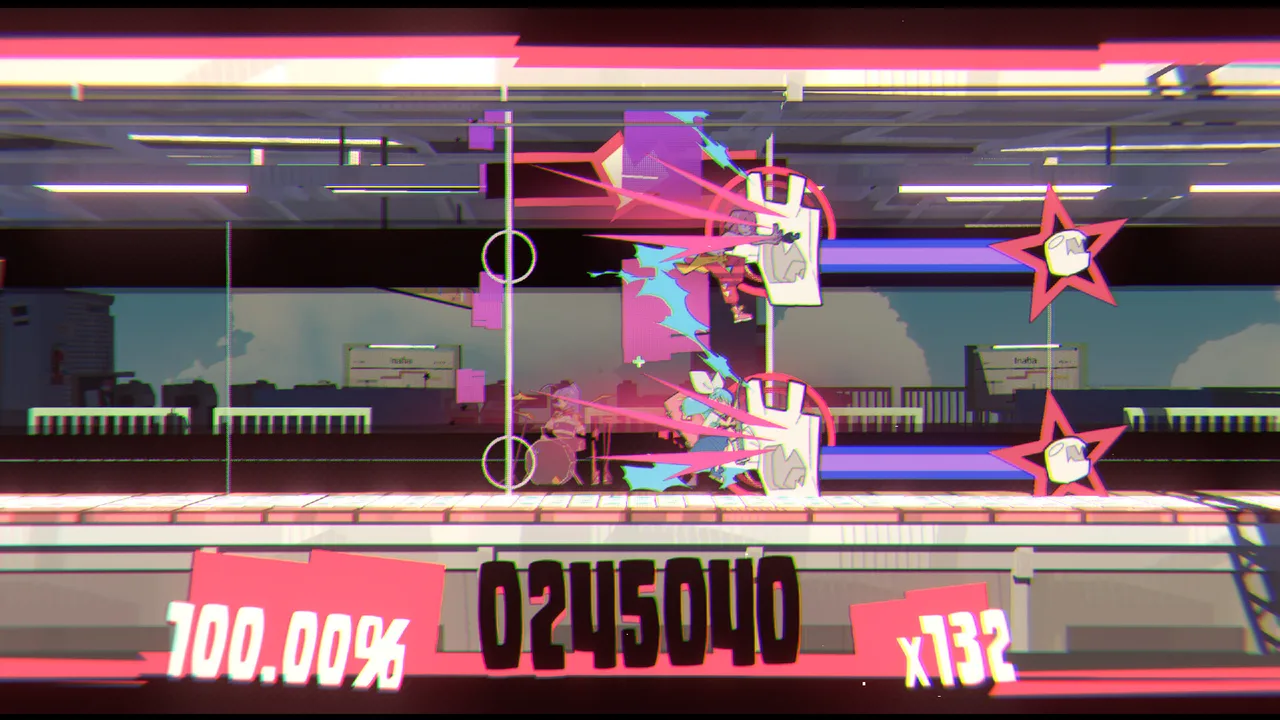
Image via D-Cell Games/Playstack
That distaste extends to stories where characters are too surprised and overwhelmed by the circumstances they're in—he's not opposed to that confusion, but he said it needs to be done in an "honest" way. "You can't make a story cynically, you can't force a thing from a fake foundation."
To be clear, UNBEATABLE isn't Lynch-level confusing. It'd be more accurate to say it's told "out of order" in a way that reframes how characters' inner states are shared with the player. And all that happens in a music-first environment where the big action beats rise with the emotions and play out with the same energy as an over-the-top 2000s music video.
Music videos, needle drops, and trailers
In my time with UNBEATABLE, I kept coming back to the idea that this game is a 10-hour music video, and how it shares the embrace of "artificial reality" that you see in so many classic music videos.
Related:Cairn's prickly protagonist serves a powerful purpose - Narrative Notebook #1
By "artificial reality" I don't just mean the sense that this is fiction. I mean it in the way that the world is presented without much setup or premise. Vanessa Carlton literally sings A Thousand Miles on a piano driving around Los Angeles and the Angeles National Forest, and absolutely zero time is dedicated to explaining how it's happening.
UNBEATABLE embodies that same energy. The story opens with a sequence that might seem to belong in any music game, with the lead singer of a rock band getting ready to go on stage. But she's not the hero of the story—that's Beat. As the chorus swells, the game cuts to Beat lying in a field, where she meets Quaver, and the adventure begins.
No transition. No scene of Beat falling from our world into Quaver's. Just a change in sound and setting and a sense of "all right, here we go." Like Carlton stepping into the garage and into the driving piano.
Was the D-Cell team inspired by the art of the music video? Not necessarily. Lake told Game Developer that he and fellow co-director Andrew Tsai were more influenced by needle drops in movies and title sequences in movies cutting (he said he's obsessed with The Art of the Title).
But the question as to whether it's needle drops or music videos that influenced UNBEATABLE pales in comparison to a broader issue: when collaborators insist on doing things formulaically
Today, Lake finally got it right
It's one thing to proclaim game writers should feel free to tell ambitious, challenging stories—but if your development partners don't trust your process, it can do more than degrade the game, it can hurt your mental health too.
That's a painful lesson that Lake shared an essay in the inkle-published Game Writing Kaleidoscope. Earlier in UNBEATABLE's development cycle, Lake was directed to repeatedly rewrite the game's story at the guidance of someone who believed "if you can't jump into a scene of a movie in the middle and know everything about the story, it's a bad movie."
(Editor's note: Senior Editor Bryant Francis also published an essay in The Game Writing Kaleidoscope)
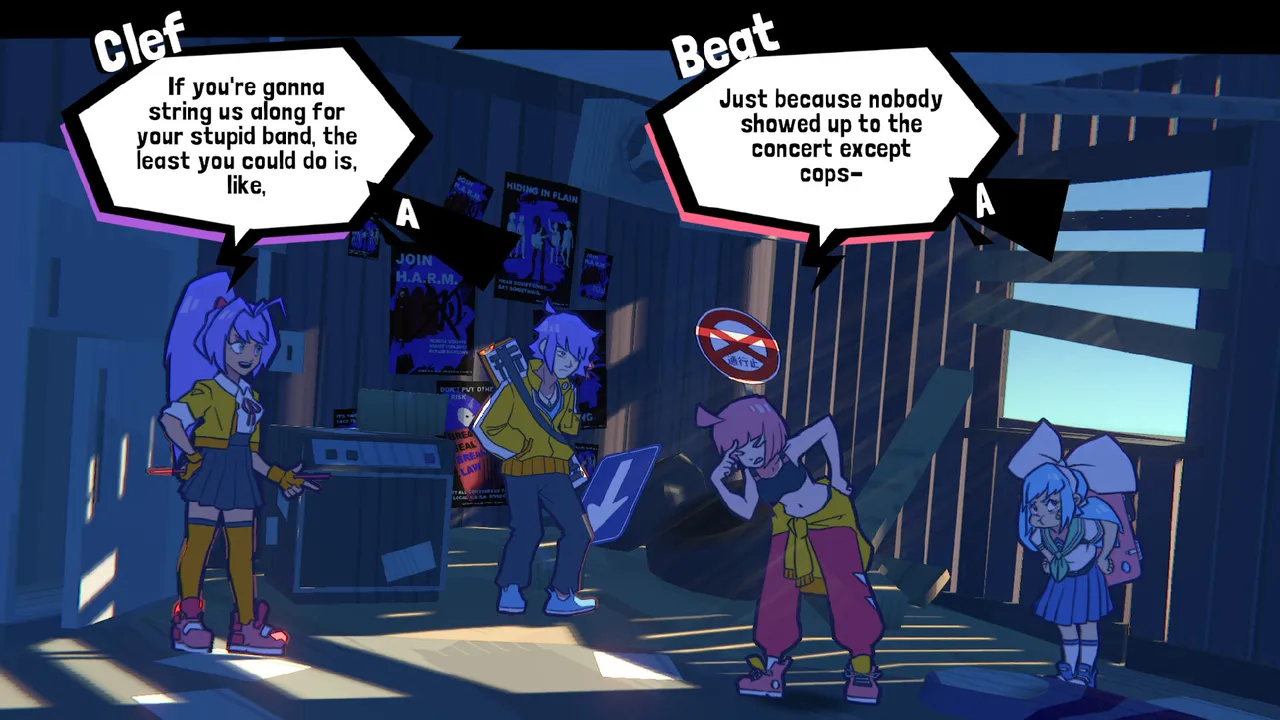
Image via D-Cell Games/Playstack
In other words, the opposite of UNBEATABLE. "It's obviously liberating to fully get to do it right after such a bad experience," Lake said to Game Developer. "But the problem is I had a trauma response to writing because of that bad experience.
"There was this very real palpable anxiety that brewed inside me during that period that I wouldn't ever be able to get this story right. It really ate at me because I knew that if the thing got out there mangled that nobody would care about it."
It's frustrating to hear that this kind of narrative pressure be placed on an indie developer. Game writer gatherings are often filled with tales of terrible notes from leads and executives at larger companies, and the indie development scene is supposedly where developers are free pursue their vision.
But if your partners won't trust you—or at least support you—to try something ambitious, how will you say something that could never have said before?
When music says what you can't
I keep coming back to that line: "Music is feeling. Art is feeling." Sometimes when a villain's line is so strong, it's easy to misinterpret that as the theme of your work (see Kylo Ren and Star Wars Episode VIII: The Last Jedi). But it still feels like the only words that can explain why UNBEATABLE feels so powerful.
I've mentioned before how I've always been an unconsciously visual thinker, and how visualization can help me in trying times. It's absolutely something I needed in my teenage years, when high school made me miserable and I'd ride the bus home with an iPod loaded up with Disturbed, Papa Roach, and…U2. It was the end of a golden age for music videos, before they became rewritten for the social media era.
Like millions of teenagers (and nearly all of my high school friends), music was an escape. But so many stories dedicated to capturing that escape land hollow for me because they're so literal about something so abstract. Stories about the best music from the '90s or stories about getting the band together may be stories about feeling that feeling…but they aren't that feeling.
UNBEATABLE is that feeling. It feels like the music that Beat would listen to while going through her struggles we see in the real world. Her rebellious sci-fi adventure feels like it might be playing out in her own head, but because we're the ones playing it, we get to connect with the characters and world in a way that wouldn't work if it were just a literal Isekai-style adventure.
Like I said up top. UNBEATABLE rules.
July inspirations: memorable music videos and game-changing trailers
This "inspirations" section was originally going to be a quick list of exceptional music videos but I had to cut a section from this column where Lake describes D-Cell Games as a "trailer-first" game studio.
"Making trailers forces you to articulate [what you're making] better than even words can, because it forces you to examine it from a completely merciless standpoint of 'how am I going to make this exciting to someone instantly," he said.
So let's mix the two together to help you make an exceptional game.
Missy Elliot: Work It
You can't talk music videos without talking about Missy Elliot. Director Dave Meyers deserves credit for the still-iconic visuals, but in a 2002 MTV interview he made clear it was Elliott driving the ship: "She's a visual connoisseur. She doesn't know how to make the visuals happen, but she knows how to appreciate them. I like to take her to another place. It keeps our relationship fresh. And if I repeat myself once, she'll catch it and go on to the next guy."
Cloud Atlas: Extended Look
I've watched Cloud Atlas three times, and each time I've fallen more out of love with it because the Wachowski's belief that race-bending makeup could capture the magic of souls twirling through time just doesn't work. But I always remember what made me originally fall in love with this movie: the 5-minute extended trailer that…honestly could just stand in for the movie itself.
DJ Lake, Lil Jon: Turn Down For What
You probably know by now that directing duo the Daniels shot this before making Swiss Army Man and Everything Everywhere All At Once. But cast those movies out of your mind and just soak in the vibes of this thing. If music is feeling, and music videos create artificial reality, then this thing is the most feeling in the most artificial reality you could experience.
District 9 – Official Trailer
Talk about an unveiling. Neill Blomkamp already made waves in the video game world for his Halo 3 promotional shorts (that were supposed to tee up a feature film) but when that fell apart, we got District 9. Even before the alien craft shows up, you know something's off about how people are referring to this mysterious "them."
Disturbed – Land of Confusion
This video is FOUNDATIONAL for me. And yet no one really talks about it! It was my introduction to Disturbed (who most people know for Down With The Sickness), my introduction to Genesis (whose original song also came with a landmark music video), and it landed right as I was turning 15, becoming obsessed with V for Vendetta, and growing to understand the awfulness of Bush-era politics.
Looking back, I think it's MacFarlane's superhero sensibilities that tied into cartoons of the 1990s that made this one click for me. It's like I already spoke the language, and this video was giving me new words to use them for.
Us – Official Trailer
Let's close out with a trailer that's also an amazing needle drop. Jordan Peele's second film Us. By 2019 we were well into the era of "slowed-down, moody version of a song" accompanying movie and game trailers (thanks Gears of War), but when it works, it works. This trailer drops Luniz' I Got Five On It just a few seconds in, then slows it down and warps it into the theme of the movie. And it plays immediately into the tone of the film with Lupita Nyong'o being unable to keep beat with the song.
That's it for July. Embrace your inner teenager. Imbue your games with feeling.
About the Author

Senior Editor, GameDeveloper.com
Bryant Francis is a writer, journalist, and narrative designer based in Boston, MA. He currently writes for Game Developer, a leading B2B publication for the video game industry. His credits include Proxy Studios' 4X strategy game Zephon, Iron Anchor Studios' Down With The Ship, and Amplitude Studio's 2017 game Endless Space 2.
0 Comments
Log in to join the conversation.No comments yet. Be the first to share your thoughts.