
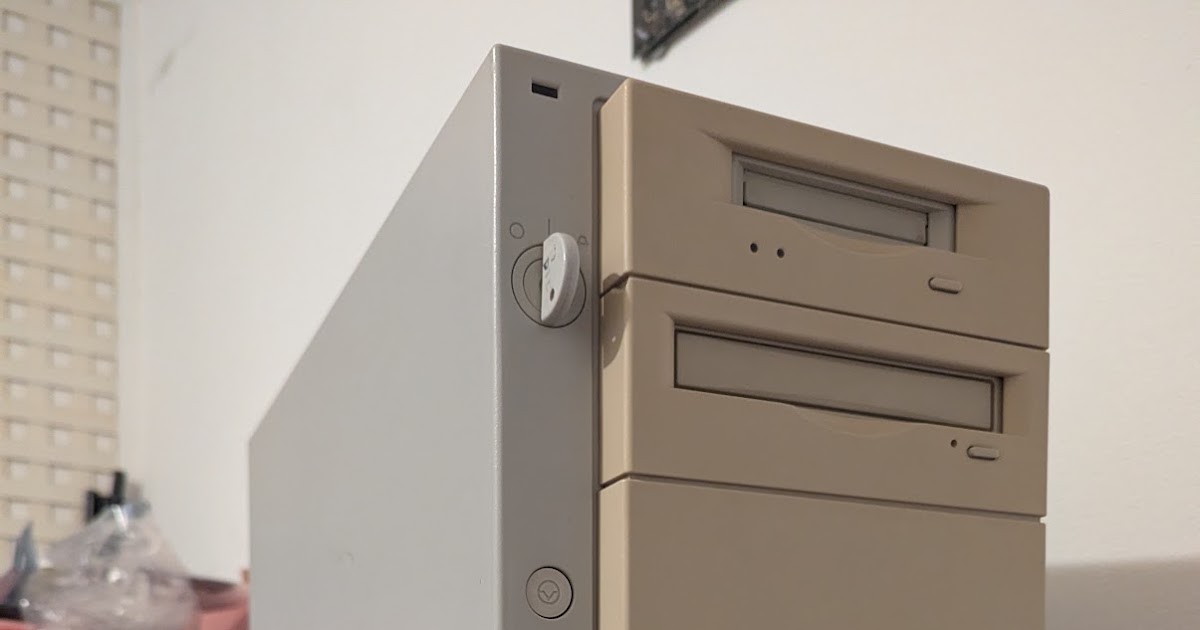
As is typical here in the Floodgap lab, it all started so innocently: rebuilding a flaky Apple Workgroup Server 9150, the odd duck of the Workgroup Server line and older cousin to our beloved Apple Network Server. And then I just had to pimp it out for MkLinux.

Before the sui generis IBM AIX-based Apple Network Server, one of our favourite machines here at Floodgap, there were the WGSes, the Workgroup Servers, Apple's well-intentioned but conflictingly received line of Macintosh rebadges hopped up with high-spec options and special server software. While certain users had long repurposed desktop Macs as ad-hoc servers, these computers were the first Apple systems explicitly positioned and sold as such, and the first generation was even advertised with A/UX, Apple's own hybrid System V UNIX implementation.

A/UX ultimately didn't survive the 1994 68K transition to PowerPC, but in 1996 Apple publicly offered another option: run Linux, using the Mach microkernel. Although MkLinux emerged after the 9150's discontinuation, it's still just an overgrown NuBus Power Mac, so between more RAM, a beefier CPU upgrade and various video cards, by the end of this article we ought to have a configuration that gives us the best of two worlds — classic MacOS and MkLinux — in one server.
But first we're going to have to rebuild it. And these plastics definitely don't want to stay in one piece.
Rebuilding the Green Giant
Before we get into that, however, I've previously talked at length about Apple's early 1990s server strategy as it pertained to how the Apple Network Server ended up running IBM AIX, though not much about why CEO John Sculley's Apple embarked on a server line in the first place. Likewise, we've said very little about the parallel evolution of the Workgroup Servers and their relationship to the core Macintosh product line. Let's consider those topics now.

As an upstart in the age of microcomputers, Apple never had a history of making big iron, and the emergence of its server line can actually be traced back almost directly to the failed Macintosh Office concept. In January 1985, Apple's infamous "Lemmings" ad led its new hardware and peripherals announcement, including the AppleTalk Personal Network (what we now call LocalTalk) to set up multidrop serial links between computers and networked devices, the new LaserWriter printer, and a revamped Lisa 2/10 with more RAM and hard disk space newly subsumed into the Mac fold as the Macintosh XL. For a not completely eye-watering amount of money, Macintoshes could talk amongst themselves and send jobs to a high-quality shared printer, with network file storage on the XL's 10MB "Widget" hard disk to come shortly and support for suitably equipped PCs to follow. Steve Jobs, then both chairman of the board and veep of the Macintosh division, confidently predicted 10,000 Macintosh Office networks by the end of the year.
While the LaserWriter started at $6995 [$21,750 in 2026 dollars], the refreshed Lisa, er, Macintosh XL now started at a surprisingly competitive $3995 [$12,450], some $6000 less. However, the dirty little secret was that the Macintosh XL was only supposed to be a stopgap, a way to both slowly wind down the hardware and also buy time pending the real Macintosh Office centrepiece: Jobs' new leap forward, the "Big Mac." Big Mac had many vague ideas associated with it, though most of them converged on it being a file server or high-end workstation running some sort of Unix, possibly with the Macintosh interface layered on top. As such, being the most powerful machine in the constellation, it couldn't help but be fated for a central role in the new Macintosh Office. Later in design it was also internally known as the "3M" project, because it would generate at least a megapixel display (its most famous surviving mockup even put it in portrait orientation), provide at least a megabyte of memory, and run at least a million instructions per second on the new 68020.
Unfortunately for John Sculley, the company grossly underestimated the XL's appeal at its new lower price. What Apple expected to sell in eighteen months sold in three, emptying the parts inventory so rapidly that Sculley was forced to end its availability in April with Big Mac and its software still stuck in development. ("Apple's strategy may have been too good," mused InfoWorld.) Neither could Apple keep up with demand for the LaserWriter, becoming deeply backordered from manufacturing delays and only shipping 2,500 printers by June. Third-party products ended up filling the gaps, including networking hardware from 3Com and the Centram TOPS file sharing suite. Meanwhile, the Apple board, increasingly concerned about Jobs' excesses in his dual role, ordered Sculley to contain him, after which Jobs was cashiered in May and departed in September. Now in practical ruins, even though Apple promised all shipping products would remain available, the Macintosh Office initiative was officially shut down the same month.

Big Mac sensu stricto was so identified with Jobs internally that it became a political liability in the wake of his precipitous exit. For his part, new Mac product manager Jean-Louis Gassée considered it a "toy" and wasted little time officially canning it, instead promoting the Milwaukee project which had been quietly launched without Jobs' knowledge to create the future Macintosh II. Consequently, Apple's image began to suffer with corporate consumers as they lost confidence in the company's suitability for large office deployments. Sculley addressed this perception head-on at the 1986 introduction of the Macintosh Plus, telling attendees, "I know the real commitment from business customers must be earned by meeting customer needs, by living up to expectations and by keeping promises. We intend to do all of that."
The legacy of Big Mac nevertheless persisted in the Macintosh II's development, which at one point was even codenamed "Little Big Mac," and AppleShare's tardy arrival in January 1987 finally made a basic server platform possible. At launch AppleShare was targeted at any Macintosh Plus with sufficient external storage, though in initial versions a machine chosen for server duty had to be all but completely dedicated to the task. Introduced in March, the Mac II, compatible with the new AppleShare as well, would subsequently go on to largely achieve the 3M project's aims.

Another idea also originally intended for Big Mac emerged as a beta test later that year: Apple's own Unix, christened A/UX, based on UNIX System V Release 2.2 with extensions from 4.2BSD and 4.3BSD. For this work Apple contracted with UniSoft, then on the other side of the Bay in Emeryville, and well-known in the industry for their Unix ports such as the initial operating system of the Sun-1. After the kernel and userland were largely complete, development returned to Apple to graft on the Toolbox layer, a complex undertaking that suffered from months of delays fixing bugs. A/UX 1.0 (amusingly codenamed "Pigs in Space" after the Muppets sketch) finally emerged at Uniforum in February 1988 and was immediately available as a special Macintosh II configuration ($8597, approximately $24,250 in 2026 dollars) or on a pre-configured 80MB hard disk with a PMMU chip and extra RAM (up to $4979, or $14,050 in 2026 dollars), plus another $650 [$1835] for the book manuals.
Although A/UX 1.0's Toolbox had no MultiFinder support and could only run one GUI application at a time — and only about five to ten percent of existing Macintosh applications — the new operating system still achieved its greater purpose: credible entry to the high-end workstation market and new interest from government and educational customers who needed a Unix-based option, yet still keeping much of the Mac's secret sauce. "In terms of broadening the Unix platform," Sculley intoned at its introduction, "useability is probably even more important." Users generally agreed, though it was necessary to reboot back into System 6 to run most Mac applications, and developers objected to the A/UX Toolbox's front-end limitations and un-Mac-like programming interface when building hybrid apps. While System 7's impending development continued in the background, Apple added X11 support as an option in part to address these and other deficiencies in the graphical interface. "Our first goal was to do a solid Unix," argued Michael J. Homer, technical markets director.
A/UX 2.0, introduced in 1990 before System 7's rollout, made good on the majority of Apple's promises: most 32-bit clean applications could now run under a new compatibility layer, MultiFinder was supported, and Macintosh, command line and X11 applications were finally able to coexist on one screen. It was exceptionally well-received by reviewers and users alike, with MacUser approvingly calling it "the most interesting and impressive software to have come out of Apple since HyperCard." Subsequently in July 1991, after System 7's May launch, Apple and IBM announced their new partnership around the PowerPC and a future AIX incorporating the Mac Toolbox. In November this idea was broadened into the future A/UX 4.0, with Apple introducing the System 7-based A/UX 3.0 at the same time. (Another, less-well-known alternative also emerged around this period, but we'll talk about that later when we discuss the history of MkLinux.)

Despite these positive moves on the server software side, there had yet to be any corresponding server hardware, and Macs pressed into server duty in those days were otherwise just Macs. One I particularly remember as an undergraduate at the University of California San Diego was an SE/30 (
userserve.ucsd.edu) down in the AP&M B337 lab, running AppleShare version something-or-other and an unknown Gopher server that we all accessed for software resources. I was fortunately able to save its contents before it was decommissioned, since it could still be accessed off-campus at the time.
As such, Apple management concluded their persistent lack of a turnkey server configuration was harming additional institutional uptake. At Mactivity '92, the Enterprise Services Division (what would become Apple's Server Group) quizzed attendees for desired features; respondents nearly unanimously favoured high-end hardware on a Unix platform. Fortunately, Apple now credibly had one. In March 1993 the company announced the first Macintoshes to officially be called servers: the Workgroup Server 60, Workgroup Server 80 (collectively codenamed "Blugu") and Workgroup Server 95 ("Chinook").

Of course, these machines at their core were also "just" Macs, or more specifically they were "just" Quadras: the AWS 95, the first one out of the gate in April, was a rebadged Quadra 950 (complete with the same keyswitch that debuted in the Q900), the Workgroup Server 80 was a rebadged Quadra 800, and the Workgroup Server 60 was a Centris 610 (that later became the Quadra 610). The main difference from the consumer models was that all three systems shipped with full 68040s plus extra base RAM and larger hard disks up to a full gigabyte, and true to their word, all three systems were A/UX-capable.
But the AWS 95 did the other two one better: it came with A/UX 3.0.1, a requirement of the included high-performance PDS SCSI and L2 cache (128K to 512K) card, plus an optional 200-seat AppleShare Pro license for file and print services (a separate configuration targeted databases, with Oracle 7 specifically mentioned). In fact, when the demo machine reportedly got stolen shortly before Mactivity93, product manager Marv Su had to "make one" out of a Quadra 950 and a spare card to show to attendees. An optional tray could carry up to five internal hard disks, sitting on top of the system's drive shelf. While the AWS 95 could still run System 7, the PDS SCSI/L2 card was only fully supported in A/UX, and blocked one of the five NuBus slots when installed.
The other two systems came with a 50-seat AppleShare 4.0 license and System 7.1, and both the AWS 95 and the AWS 80 had optional built-in DDS (DAT) tape backup. The 60 and 80 launched two months after the 95 in June; Apple started the three systems at $3079, $6399 and $7589 [$7150, $14,850 and $17,600] respectively. The most expensive AWS 95 loadout had 48MB of RAM, a 230MB and a 1GB disk drive, DDS-1 tape and 512K of L2 cache, and sold for $12,929 [$30,000].

All three servers were generally well-reviewed, though the value proposition of the two lower-end models was somewhat questionable, and their sales were correspondingly tepid. On the other hand, in certain stratospheric market niches the AWS 95 became especially prized as both a high-end Mac workstation as well as a server. With institutional customers clamouring for an even higher-performance version, Apple wanted to keep that momentum going through the transition to PowerPC.
Meanwhile, Sculley himself exceeded the Apple corporate board's collective patience (particularly over Newton, cratering sales, various failed merger talks and Apple's biggest loss in any fiscal quarter to date) and was replaced as CEO by Michael Spindler in June 1993. Spindler's initial layoff moves were tough to swallow, but PowerPC had serious street cred and an obvious role driving Apple's next server generation. Officially Apple promised it would be helmed by an AWS 95 successor, incorporating its generous case and oodles of options, maybe even 64-bit with the any-day-now top-tier PowerPC 620, and of course running A/UX 4.0 powered by the Mach-based OSF/1 on top of the common PowerOpen platform.
Unofficially, just about none of that came true except the case, and even the case was to endure notable modifications. The 620 was intended to be the first 64-bit PowerPC implementation, capping the original 1991 roadmap above the 601, 603 and 604, but by late 1993 IBM was still working bugs out of the design and even the 603 and 604 weren't yet in production. Although the 601 was shaping up to be a powerful CPU for the era, for this high-end server's release to be at all timely its CPU could only practically differ from a desktop Power Mac in terms of clock speed and L2 cache. Likewise, on the operating system side PowerOpen-A/UX and the various Pink and Taligent projects the new server might have run remained victims of scope creep and slow development, while PowerOpen-AIX still didn't have its promised compatible Mac Toolbox, leaving only the same System 7 that every other upcoming Power Mac was going to run. Although System 7 software on PowerPC used the same PowerOpen ABI that A/UX was planned to, which would hopefully smooth out any later transition to A/UX 4 or AIX, the new A/UX wasn't even close to a beta.
Spindler's solution was an unexpected partnership with Novell to port what was then called Portable NetWare, an implementation of the NetWare 3 server platform running atop a separate host operating system, instead of the traditional architecture where NetWare itself was the operating system. This port was variously codenamed "Wormhole" and/or "Deep Space Nine," borrowing code from the existing IBM AIX port of Portable NetWare — AIX was PowerOpen too, after all — but modified to run via System 7; Wormhole would then run on the new high-end server, codenamed "Green Giant," using the fastest PowerPC 601 then available in a Quadra 950-style case. Novell NetWare was, of course, the premier network operating system of the early 1990s, but many believed it was already on a slow decline, and the overwhelmingly negative reaction Wormhole provoked from testers who still preferred Unix caught the Enterprise Services Division off guard. Spindler remained doggedly convinced NetWare was the way forward, but as it was imperative the PowerPC server reach market with or shortly after the desktop Power Macintosh, at least initially Green Giant would have to be System 7 — any other options could come later. (As we'll discuss.)

To supplement the line the Power Macintosh 6100 and 8100, in nearly the same form factors as the Quadra 610 and 800/AWS 60 and 80, were retrofitted as the Workgroup Servers 6150 and 8150, collectively codenamed "Starbucks." Both these systems had CD-ROMs, however, and there was only one drive bay in the Q950/AWS 95 case which was used for the DDS tape drive, a previously popular option which Apple now intended to provide standard with the 8150 and Green Giant. The 8150 still had a bay available for it, but Green Giant required the aforementioned case modification: the floppy drive, formerly at the top of the Q950/AWS 95, was moved down to the bottom half of the front and the top reworked into a new bay for the DAT/DDS so the CD-ROM could go in below it. This made Green Giant the first, and ultimately the only, Macintosh in history to come with a low-mounted floppy, and the only Workgroup Server that didn't correspond to any existing desktop Mac. Green Giant also kept the AWS 95's five-drive tray, but got a new name to go with the new case: the Workgroup Server 9150. (There was never a "Power Macintosh 9100," for the record.)
As shipped, in hardware terms the WGS 6150 was nearly identical to the 6100/60, with the same 60MHz 601, the same processor direct slot convertible to NuBus, and the same 8MB of motherboard RAM, plus a 256K L2 cache and 500MB hard disk for $4219 [$9535]; the WGS 8150 was in turn based on the 8100/80, with an 80MHz 601, three NuBus slots and a PDS, but 8MB or 16MB of total RAM, 256K L2 cache, DDS tape and a 500MB or 1GB hard disk. The WGS 9150 (also seen as the "WS 9150" in various Apple documentation) used the same 80MHz 601 and added an extra NuBus slot, plus 512K of L2 cache and one or two 1GB drives, but you could also buy the biggest $10,269 [$23,200] configuration with two 2GB drives and 24MB of RAM. You could also get a 9150 logic board to install in a Quadra 900 or Quadra 950 or, for that matter, an AWS 95, and it would fit your physical case if not your use case (if you were using A/UX).

Apple still kept the AWS 95 (and at least initially the AWS 60 and AWS 80) in the product line for users who wanted A/UX 3. To otherwise entice new users and soften the blow of its absence, the new PowerPC servers included software RAID 0 and 1 and the new PowerPC-compatible AppleShare 4.0.2, plus AppleSearch, Apple Internet Router and Apple Remote Access 2.0, and the DAT-equipped 8150 and 9150 also got Dantz Retrospect Remote for backups. The new PowerPC Workgroup Servers emerged in April 1994, just a month after the Power Macintosh 6100, 7100 and 8100 in March.
The machine we'll be rebuilding and then retrofitting is one of these original WGS 9150 machines, originally shipped in 1994. I had a 9150 a number of years prior but stripped it for parts, a shame I wear to this day, so this project was as much for penance as it was for pleasure (of sorts). This one was an eBay grab way back when, though it came somewhat stripped also, with its hard disk wiped, one NuBus slot cover missing, no RAM at all (just the 8MB soldered to the logic board), none of the pack-in software, and no cache stick. I suppose I should be glad it still had its special pre-terminated internal SCSI cable, the ROM SIMM and the PDS terminator, because these systems didn't come with a PDS video card standard and the PDS terminator is required if you'll be using motherboard video. I loaded it up with 128MB SIMMs (to equal 136MB), a couple hard disks and a 256K cache from a 7100. Its name is Brinton, after Brinton Baker, the server group's senior director of product marketing.
The rebuild came when it started getting flaky last year and intermittently crashing, but the RAM tested good and replacing the boot disk didn't make it better. Since these early 601s can run a little warm, I next redid the heat grease with proper modern compound to see if that would help, and it didn't. While my personal experience has been that these systems don't universally have the bad capacitors that '030 Macintoshes and their contemporaries (e.g., the Macintosh Portable) do, others have reported bad caps on their own early Power Macs, so that was the last thing to try. I sent the board off to Garrett Bunge for a professional recap, who reported there might have been a tiny bit of leakage, but either way it came back looking great.
We'll come back to the history when we get to our choices of operating system. Let's first get it back together, starting with the bare case.

Like most of its generation, these units have a metal skeleton with plastic on top and inside.

Unfortunately, that plastic is Spindlerplastic, typically ABS plastic where the plasticizer (probably a phthalate of some sort) has since evaporated with age and left the now-brittle polymer. There is no way to rehabilitate the plastic short of remelting it and adding new plasticizer; modern plasticizers are much less volatile. The Quadra 900 and its descendant designs (Q950, AWS 95, WGS 9150) are tower systems, so the logic board sits vertical and is supposed to stay in place with those snaps and tabs, which becomes a significant problem when the tabs and snaps snap. We're going to deal with that very issue later on, so take a good look at the image since it's the last time you'll see most of the pieces intact. The same root problem afflicts Amelioplastic, such as in the PowerBook 1400.

The exterior door is plastic, but backed with metal. It has guides for the cards.

It also shows how to properly loop and secure the cabling, though we're going to modify this somewhat since we'll be upgrading the unit to a single ZuluSCSI as part of the rebuild (keeping the original CD-ROM and DAT drives). However, note the slim cable coming from the top bay: this is actually a floppy cable, not Molex power or SCSI, because the diagram is really for the AWS 95 and the door is the same. The same incorrect diagram likewise appears in the 9150's administration manual, probably to save time writing it.

Although the backplate label shows model number M3125, the actual serial number is located next to the card slots. This unit is serial# XC44600P36R, manufactured 46th week 1994 ("446") by Apple at their Elk Grove, CA facility (factory code XC; this post explains how Apple's serial numbers worked at the time).

The Quadra 900 introduced a wafer lock keyswitch which controls both power and security. If the key is turned all the way to the left "off" position, the server is powered down (or is powered down immediately) and will not start up, even if the reset key is pressed on a connected keyboard. If turned to the middle "on" position, the server operates normally. If turned to the rightmost "secure" position, the server powers on (and stays on), automatically powers on after an outage, and also locks out the floppy drive and connected ADB devices. The Quadra 950 inherited this case and keylock as did the AWS 95 and the WGS 9150. The same wafer lock keyswitch is also used on the Apple Network Server for setting the operating system mode and locking its front door, but its three settings behave differently, and the ANS also has a separate two-position rear lock of similar type.

The keys have a small three-digit code engraved in the metal. Not all of the keyswitches still have their corresponding tag, but if they do, the tag's code should match the key's. These keys are otherwise straightforward to duplicate with a blank of similar size and any good locksmith should be able to fashion a copy.

Giving it a good scrub before we put the logic board in.

Our freshly recapped logic board. Despite the case serial, and the board serial (SS42704F3B6) which indicates 27th week 1994, at least one chip has a 1995 copyright date and the CPU is also from 1995 (I'll show you in a second), so either this board was repaired or final assembly was done later. The WGS 9150 logic board is the same size and has nearly the same port and slot configuration as the Q950/AWS 95's because it had to fit that case as well, but the 9150 requires less board space to do its job, so consequentially a fair bit of it is empty.
Still, there are various landmarks. In the northwest/top left corner is the 8MB of motherboard RAM, which would be frustrating if any of it failed since replacement obviously entails desoldering. Left/west of it are the interrupt and reset switches, which we will be revisiting later more than we would like to; above/north of it is the header for the keyswitch, which you can use to short it if you don't have a key; and to the upper right/northeast of it is the power LED, which is refracted by a light pipe to the front. Below/south of the soldered motherboard RAM are eight 72-pin SIMM slots. RAM must be installed in matched pairs to a maximum of 256MB in the SIMM slots, equaling 264MB.
Below/south of the SIMM slots are other various internal connectors, including the low-mounted floppy (J19), internal SCSI port (J23, I'll talk about this a little more momentarily), CD audio input (J18), PRAM battery (BT1), and way at the bottom, the internal speaker header (J17).
The NuBus slots, the CPU, and their satellite electronics dominate most of the rest of the logic board. The CPU is under the large heat sink, which I will demount for show in the next series of photos, with an unpopulated debugging header at the very top/north at J28. Around it, clockwise from lower left/southwest, are (U19) the 343S0148-01 Fat AMIC "Apple Memory-Mapped I/O Controller" unique to the WGS and used for DMA to its full set of NuBus slots (3-slot NuBus Macs use the regular AMIC), also providing DMA for on-board Ethernet, sound, SCSI, floppy, and serial I/O; (U24) a 343S0802-A HMC "High-speed Memory Controller" used in at least all first-generation NuBus Power Macs; (U62) a 343S0137-A SWIM III floppy controller with DMA despite the floppy connector being low; (U37 and U36) twin 343S1144-01 Data Paths for buffering the bus and routing video data, and also used in at least all first-gen NuBus Power Macs; and (U35) a 343S1124-04 BART NuBus controller. Note also the same slots for the cache stick and ROM stick, plus the power supply connector and Processor Direct Slot. Right/east of the second Data Path at U36 is a smaller chip, the 343S1069-B "Ariel" video chip at U13. This is the same video chip used for motherboard video on the other first-generation NuBus Power Macs, but the 9150 uses a more typical Macintosh DA-15 video port like the Quadras — remember, it has to fit their cases — instead of its contemporaries' oddball HDI-45. Right/east of the BART at U35 is an AMD AM79C950KC "Super Combo" CURIO chip at U10, containing the equivalent of an NCR 53C96 SCSI controller (for the external port), an AMD 85C30 serial chip and an AMD 79C940 Media Access Controller for Ethernet (MACE).
The CURIO, however, only services the external SCSI port — the internal SCSI controller is southwest/to the lower left of the Fat AMIC at U47, a MESH "Macintosh Enhanced SCSI Hardware" NCR 53CF96 which provides support for SCSI-2 and is the chip closest to the explicitly-marked "INT SCSI" 50-pin connector at J23. However, next to the 25-pin external SCSI connector at J8 (above/north of the serial port at J4) is an additional 50-pin header at J9 with no markings. This port is yet another holdover from the Quadra 900, the first Macintosh to implement a separate internal SCSI bus, and later duplicated on the Q950 and AWS 95. On these machines the internal SCSI is a separate second bus from the external SCSI, but there are internal headers for both busses so that internal devices can be on either bus. The 9150 still has this feature and thus still has a port in the same place to handle upgrading machine configurations that need it, but it was officially undocumented and its use otherwise discouraged, and any internal devices connected to J9 will be on the slower CURIO. We won't be using it here.

As for the CPU, here are some pictures from when I demounted the heat sink. The heat transfer compound Apple used was "fine" at the time but 30 years later has turned to heat transfer brick mortar. Some folks have reported erratic behaviour from the CPU overheating which was fixed by cleaning it off and applying better thermal paste, so I tried doing that first. Apple used this heat sink or a close variation for all their 601 processors, even the one in the Power Macintosh upgrade card, with four metal claws to clamp the heatsink tightly on the die by gripping corresponding holes in the logic board. The tips of the claws can be gently released from the other side using a spudger or gloved finger.

After some careful cleaning with 91% isopropyl alcohol and a handful of Q-tips, this is our CPU and die (under the heat spreader), produced 4th week 1995. Only IBM was making the 601, and only at their Burlington, VT and East Fishkill, NY facilities at the time, so since the East Fishkill plant was fully CMOS by 1995 and used for manufacturing higher-value and server grade chips, I suspect this one came from there. The PowerPC 601 was packaged in a 304-pin ceramic QFP which, in most Power Macs using it except for the 7500's daughter card, is permanently soldered to the logic board as shown here. Fortunately most 601-based Macs have some sort of upgrade pathway, either through their CPU slot or (in this case) as a PDS card, with the notorious exception of the Power Macintosh 7200, 8200 and Workgroup Server 7250 for which Sonnet eventually produced a PCI card to carry a G3.

The first-generation PowerPC 601 was produced in speeds from 50MHz to 80MHz, though Apple never used the 50MHz part in a shipping Power Mac. It was fabricated on a 600nm CMOS-4s process by IBM with four layers of metal, producing a 2.8 million transistor die measuring 121mm². The CPU has a 32K unified L1 I+D cache, which for the era was considered generous, and overall the chip could meet or exceed contemporary Intel Pentium performance. The 603 and 604 have more typical split caches.
For comparison I have placed it next to a non-functional 90MHz PowerPC 601v (also known as the PowerPC 601+) that I use as a display piece, which shrunk the die to 74mm² using a 500nm CMOS-5 process. Introduced in late 1994, the process shrink enabled the CPU to run from 90MHz to 120MHz, though with a corresponding increase in heat. Apple used the top-end 120MHz part in the 9150's only model upgrade, which I'll talk about once we have this one reassembled, and later for upgraded models in the 7200 family as well. These fastest systems require an active Peltier thermocooler to keep the chip's temperatures down.

Another point of comparison is this 200MHz PowerPC 604e from an Apple Network Server processor card I was trying to refurbish. (It's dead, Jim, even after a recap and replacing the sludged-over heat grease.) Although the heat spreader is larger than the 601, the die is smaller at 47mm², containing 5.1 million transistors fabricated on a 250nm CMOS process by IBM with five layers of metal.

Reapplying a more modern heat compound to the 601.

Getting the CPU heatsink back on a 601 needs to be done a little more carefully than taking it off. The ceramic QFP is sheathed in glass and this glass can crack (people have done it!) if the heatsink exerts uneven or excessive pressure, so it's important to get the claws through the holes without grinding too hard on the CPU package's top layer.

We place the board into the case and line the notches up with the snaps and guides.

Then we push it back into the openings for the ports. In theory a large plastic clip in front will keep it in position along with the smaller snaps and clips, but this big clip also snapped. There is no point in repairing these because they're just plain weak and they'd fracture somewhere else. We'll explore an alternative for keeping the board in position later on.

Ensuring the ports are all lined up. From top to bottom, identical to the Quadra 900 and progeny, they are DA-15 ("DB-15") video, AAUI Ethernet, 25-pin SCSI, modem and printer serial ports, ADB, separate right and left audio input channels as BNC jacks (intended as line-level inputs), audio input as a 1/8" stereo jack (intended for microphones), and 1/8" stereo output. The audio features made sense on the Q900 and Q950 as high-end workstations, and the AWS 95 probably got pressed into that role from time to time, but it seems the sole reason they persist on the 9150's board is once again to fit in those cases.

We don't have the original 512K cache stick, but we do have its ROM DIMM (top) and PDS terminator (bottom). The PDS terminator is theoretically required for all first-generation Power Macs when nothing is installed in the Processor Direct Slot, but the AV Power Macs ship with an AV PDS card there, and non-AV 7100 and 8100 systems (but not the WGS 8150) have the High-Performance Video card instead. We will explore both these cards a little later. The situation is a little different with the 6100 family: many of those computers will have an PDS-to-HDV or PDS-to-NuBus adapter in that slot, especially those that are or originated as 6100AVs, and our own Performa 6116CD ran just fine with nothing installed at all. In fact, according to Apple's own tech note, the PDS terminator was only ever intended and shipped with the WGS 8150 and 9150, and it cautions these systems will not work without one if the Processor Direct Slot is empty.

The CACHE/ROM slots have exactly the same pinout on these early Power Macs and you can put the cache stick or the ROM stick in either one (but a note from the future: put the ROM in the top slot, not bottom as I did here initially, because the top slot tends to get blocked by the power supply and makes accessing a cache DIMM there difficult). The PDS terminator goes in the PDS connector.

Since the last rebuild I had accumulated a big stock of 72-pin RAM SIMMs, so this time I loaded it up with a full 256MB. This will come back to bite us too.

The AWS 95 supported a five-drive carrier as an option (it would also fit in the Q900 and Q950), but for the 9150 it came standard. Accordingly a special extra-long (but otherwise "regular") SCSI cable with its own internal terminator was used for these drives as well as the CD-ROM and DAT.

With the long SCSI cable on, plus CD audio, the keyswitch and the floppy cable.

The floppy drive's metal frame attaches with a couple screws.

Now the power supply. This monstrous metal-encased hunk was also introduced with the Q900 and provides both power and ventilation. While it can be substituted for between the Q900, Q950, AWS 95 and WGS 9150, the upgraded 601+ 9150's power supply also has a fan for its Peltier-effect thermocooler. This additional fan is attached both to the power supply using a clip and to the logic board for power.
The power supply, besides providing the system's 292 watts (nominal maximum at 10A; up to 424 watts and 18A for "a period of 12 seconds maximum"), is a major structural element. Unlike the logic board, even a brand new ABS plastic frame could not have possibly supported its weight, so it is secured to the metal casing with screws. Unfortunately, not only is it bulky and heavy, but it also prevents easy access to the RAM SIMMs, floppy drive and the top CACHE/ROM slot when installed. The drive carrier and top device bays rest on it, though we must also make sure the CD audio and keyswitch cables can exit to the top behind the power supply in the channel provided for that purpose.

Next the bezels for the DAT and CD-ROM. These have already lost pieces but fortunately enough tabs persist so that the other bezel and the speaker panel can keep them in place.

0 Comments
Log in to join the conversation.No comments yet. Be the first to share your thoughts.