
Eliminating Stale Data Silos & Complex Invalidation Loops in Flutter Apps
Key Takeaway: When separate
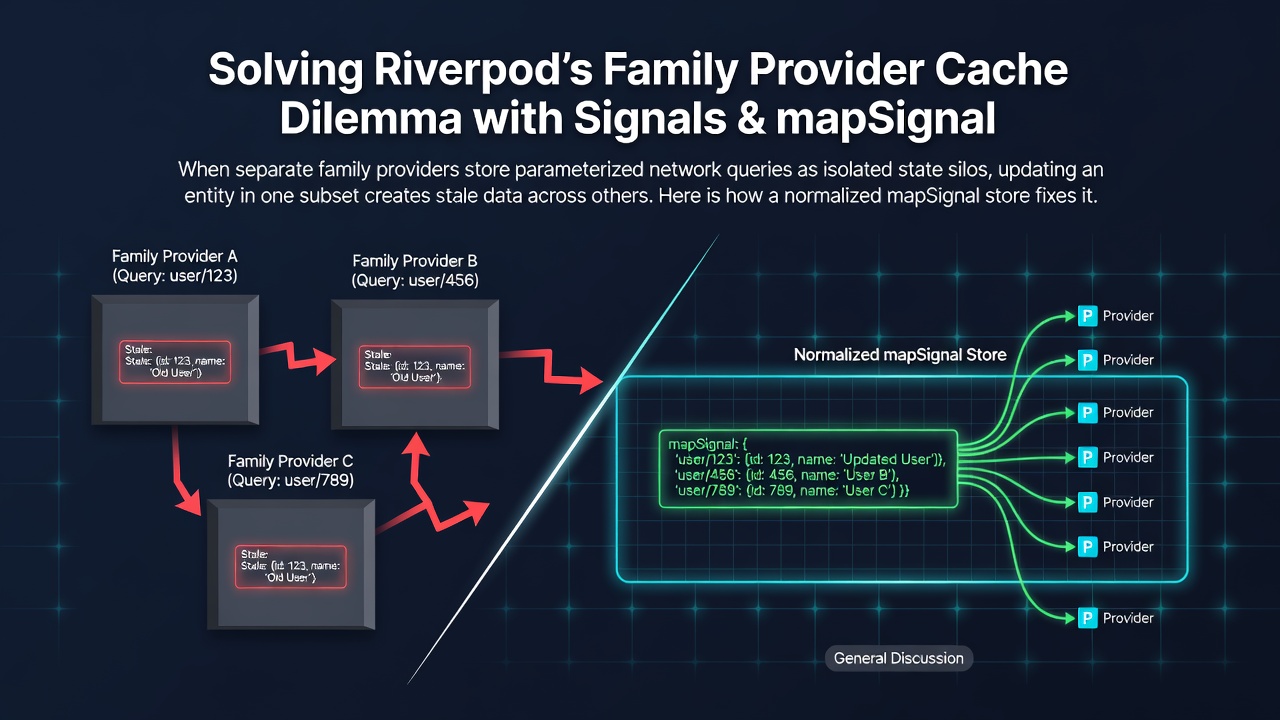
familyproviders store parameterized network queries as isolated state silos, updating an entity in one subset creates stale data across others. By shifting to a normalized entity store (mapSignal) and reactive projections (computed), cache invalidations, duplicate network calls, and stale relational data disappear completely.
1. The Real-World Dilemma
In a popular Stack Overflow question (#79988023), a developer encountered a common architectural bottleneck when using Riverpod 3 family providers alongside a backend REST API (e.g. FastAPI/Pydantic):
Column 1 (Planned & In Progress)  ---> ref.watch(tasksProvider(Filter([planned, inProgress])))
Column 2 (In Progress & Done)     ---> ref.watch(tasksProvider(Filter([inProgress, done])))
Enter fullscreen mode Exit fullscreen mode
Notice that Task B (inProgress) is displayed in both columns simultaneously.
The Two Core Pain Points
-
Overlapping Subset Inconsistency:
If a user moves Task B frominProgresstodone, callingpatchTask(Task B)modifies the entity on the backend. But on the frontend, which family provider should be updated?- Updating only Column 2 leaves Column 1 showing stale data.
- Calling
ref.invalidate(tasksProvider)across all families forces a full re-fetch of every filtered list from the server, causing redundant network traffic and UI flashes.
Stale Relational Data:
EachTaskembeds alastEditorUserobject (User lastEditor). If user Robert renames himself to Bob, Task A in memory still displays "Robert" because its embedded snapshot is disconnected from user state updates. Refetching every task query just to reflect a single user name change is inefficient and fragile.
2. Root Cause: Parameterized Fetchers as Isolated Silos
The root cause of this problem is not unique to Riverpod—it happens in standard BLoC, Redux, or Provider whenever parameterized fetchers double as local state containers.
[ Family Key: Filter A ]  --->  Stores [ Task A, Task B ]  (Isolated Silo 1)
[ Family Key: Filter B ]  --->  Stores [ Task B, Task C ]  (Isolated Silo 2)
Enter fullscreen mode Exit fullscreen mode
Because Task B exists as two separate, duplicated objects across two isolated provider instances:
- Modifying instance B1 inside Silo 1 does not update instance B2 in Silo 2.
- Neither provider knows about the other.
- The developer is forced to choose between complex multi-provider mutation loops or blunt-force global cache invalidation.
3. The Signal Solution: Normalization + Fine-Grained Reactivity
By shifting from parameterized state silos to a Reactive Signals Architecture (using package:signals and BlocSignal), the problem simplifies dramatically.
Instead of each family provider managing its own list of entities, we establish two core principles:
-
Normalized Single Source of Truth: All entities live in key-value entity maps (
mapSignal). -
Derived Projections: Filtered views become lightweight
computedsignals that derive their lists directly from the normalized store.
                  +-----------------------------------+
                  |   mapSignal<String, Task> tasks   |  <--- Single Source of Truth
                  +-----------------------------------+
                                /       \
                               /         \
   +---------------------------------+  +---------------------------------+
   | computed() Column 1 (Planned/In) |  | computed() Column 2 (In/Done)  |
   +---------------------------------+  +---------------------------------+
Enter fullscreen mode Exit fullscreen mode
4. Unlocking Granular Reactivity with mapSignal (SignalMap)
A key enabler for this pattern in Dart is mapSignal (SignalMap from package:signals).
Unlike a standard signal<Map<K, V>>({}) where modifying a single entry requires replacing or cloning the entire map object, a mapSignal provides key-level fine-grained reactivity:
import 'package:signals/signals.dart';

// Single normalized entity stores
final tasks = mapSignal<String, Task>({});
final users = mapSignal<String, User>({});
Enter fullscreen mode Exit fullscreen mode
Advantage 1: In-Place Entity Updates with Zero Network Overhead
When patchTask returns the updated Task B (status: TaskStatus.done), you update the normalized store directly:
// Mutating a single key automatically notifies subscribers
tasks['task_b_id'] = updatedTaskB;
Enter fullscreen mode Exit fullscreen mode
What happens next?
-
taskstriggers reactivity only fortask_b_idand collection subscribers. -
column1Tasks(computed) automatically re-evaluates and drops Task B (since it is no longerplannedorinProgress). -
column2Tasks(computed) automatically re-evaluates and retains Task B with its updateddonestatus. - Zero manual family invalidations required.
- Zero secondary API requests.
Advantage 2: Effortless Relational Sync (Solving Problem 2)
To handle nested relations cleanly, tasks store foreign keys (lastEditorId) rather than embedded snapshot objects:
class Task {
  final String uuid;
  final TaskStatus status;
  final String lastEditorId; // Foreign key reference

  const Task({
    required this.uuid,
    required this.status,
    required this.lastEditorId,
  });
}
Enter fullscreen mode Exit fullscreen mode
In your UI or View Model, derive the relation reactively:
Widget build(BuildContext context) {
  // Read editor reactively from the normalized user store
  final editor = users[task.lastEditorId];
  return Text('Last edited by: ${editor?.name ?? "Unknown"}');
}
Enter fullscreen mode Exit fullscreen mode
When Robert changes his name to Bob:
users['robert_id'] = User(id: 'robert_id', name: 'Bob');
Enter fullscreen mode Exit fullscreen mode
Result: Every widget across the entire application displaying a task edited by Robert immediately re-renders with "Bob". You don't need to sweep through task lists, write manual cascade listeners, or invalidate query endpoints.
5. Side-by-Side Comparison
| Architectural Aspect | Riverpod Family Provider Silos | Normalized Signals (mapSignal + computed) |
|---|---|---|
| State Storage | Fragmented across parameterized family instances | Single normalized entity map (mapSignal) |
| Subset Filtering | Separate async network fetch per family key | Client-side computed() projection over single store |
| Entity Mutations | Must sweep & update all active family parameters | Single key update: tasks[id] = updatedEntity
|
| Update Scope | All-or-nothing provider invalidation | Fine-grained dependency tracking down to affected UI elements |
| Relational Data | Embedded snapshots become stale | Reactive foreign-key lookup (users[task.lastEditorId]) |
| Network Requests | Multiplied per filter combination | Single query populates shared store |
6. Code Example: Implementing the Pattern
Defining Models & Normalized Stores
import 'package:signals/signals.dart';

enum TaskStatus { planned, inProgress, done }

class Task {
  final String uuid;
  final TaskStatus status;
  final String lastEditorId;

  const Task({
    required this.uuid,
    required this.status,
    required this.lastEditorId,
  });
}

class User {
  final String id;
  final String name;

  const User({required this.id, required this.name});
}

// 1. Single Source of Truth
final tasks = mapSignal<String, Task>({});
final users = mapSignal<String, User>({});
Enter fullscreen mode Exit fullscreen mode
Creating Reactive Subset Views with computed
// 2. Computed Projections for Columns
final column1Tasks = computed(() {
  return tasks.values
      .where((t) => t.status == TaskStatus.planned || t.status == TaskStatus.inProgress)
      .toList();
});

final column2Tasks = computed(() {
  return tasks.values
      .where((t) => t.status == TaskStatus.inProgress || t.status == TaskStatus.done)
      .toList();
});
Enter fullscreen mode Exit fullscreen mode
Performing Updates
// Updating Task B status instantly updates both Column 1 and Column 2 in-memory
void updateTaskStatus(String taskId, TaskStatus newStatus) {
  final current = tasks[taskId];
  if (current != null) {
    tasks[taskId] = Task(
      uuid: current.uuid,
      status: newStatus,
      lastEditorId: current.lastEditorId,
    );
  }
}

// Renaming a user instantly updates every task UI displaying that user
void updateUserName(String userId, String newName) {
  users[userId] = User(id: userId, name: newName);
}
Enter fullscreen mode Exit fullscreen mode
7. Bridge with Existing Ecosystems (BlocSignal & Riverpod Interop)
If your app already uses Riverpod or classic BLoC, you don't need to replace your entire framework to leverage this pattern:
-
Riverpod Interop (
bloc_signals_riverpod): Expose the normalizedmapSignalorcomputedprojections as Riverpod providers using.toBlocSignal(ref)or signal adapters. -
BLoC Interop (
BlocSignal): Maintain your event-driven workflow in Cubits/Blocs while backing the internal state with normalized signals (mapSignal), combining predictable event handlers with zero-cost reactivity.
Summary
Cache inconsistency and stale relational snapshots are natural side-effects of treating parameterized network queries as isolated state containers. By separating data storage (normalized mapSignal) from view filtering (computed signals), state management transforms from a web of manual invalidations into an automated, self-updating reactive pipeline.
0 Comments
Log in to join the conversation.No comments yet. Be the first to share your thoughts.