
Ask a health system CFO where this year's margin is landing and you will always get a hard-won answer, born from the discipline and rigor they bring to the business. And then a list: the case that care cost more to deliver than the health plan will reimburse, the clean claim denied anyway, complex variable payment arrangements that bring unknowns into expected payments, the cash still sitting in receivables on care already delivered.
The aforementioned functions are supported by multiple systems of record. Each is increasingly shaped and made faster and more complex through automation and agents. The mission of finance is to understand the relationships among all variables, bring transparency to medical economics, and to protect the margin for care while setting up the organization to deliver high quality care to patients.
Similarly, health plans face tremendous unknowns. Forecast models and finance functions that cannot quickly adapt to market changes face rising Medical Loss Ratios (MLR), lower reimbursement rates in programs like HEDIS and STARS, and rigid adjudication functions that lack parity with the cost saving techniques and technology.
According to PWC’s annual “Health Behind the Numbers” report, here are a few medical trend highlights that are expected:
- 9% increase in medical costs, the highest jump in 2 decades
- 70% of health plans cited AI assisted coding as a driver of price increases
- Specialty pharmacy are a major factor driving higher costs
- Behavior Health utilization spikes as another major factor to increased healthcare spending
Finance at the Speed of Healthcare
Every function or process can be automated if quality does not matter. Financial functions in healthcare are notoriously inundated with manual interventions across many teams. The result is a lack of relevant information in a timely manner. A decision made today with financials is likely based upon information that is weeks or months old, and the information provided took many resources long working hours to scrap together and validate.
The symptom is healthcare finance organizations taking on higher risk in decision making, but the culprits are well known. Common themes appear time and time again such as disjointed and disparate data systems, lacking a source of truth of information, delayed or untrustworthy information, and teams like finance and IT (where the data typically originates) not working collaboratively together.
The transformational opportunity ahead is for Healthcare CFOs to make faster, more accurate decisions off of a single source of truth and reduce risk across their enterprise investments.
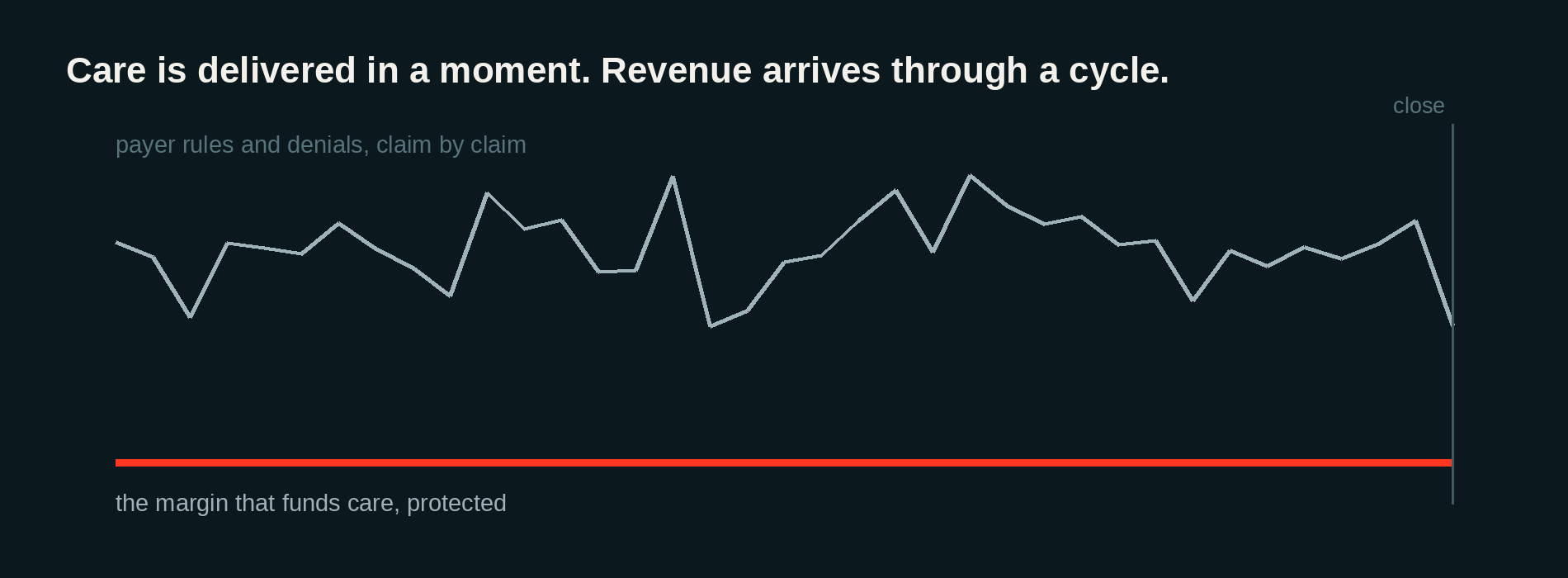
Why a word like ontology now matters to healthcare finance
Finance has always been good at finding the number, even when it is buried in complexity. But they are also the first to let the business know the numbers do not tell the whole story. What matters is the meaning behind them: which payer, which contract, which service line, and how each of those is changing as the business moves. An answer can be perfectly accurate and still not be correct, because it rests on a partial or dated picture of how the business actually works. Put plainly, is the number seen in the full context of the business?
That is what an ontology does: it captures meaning and keeps it current as the business changes.
As Ali Ghodsi puts it, most enterprise AI is guessing with false confidence, a context problem, not an intelligence problem.
But, as with every technology, it is how the capability is delivered that makes all the difference. Which brings us to a new kind of ontology, built for the demands healthcare finance places on it.
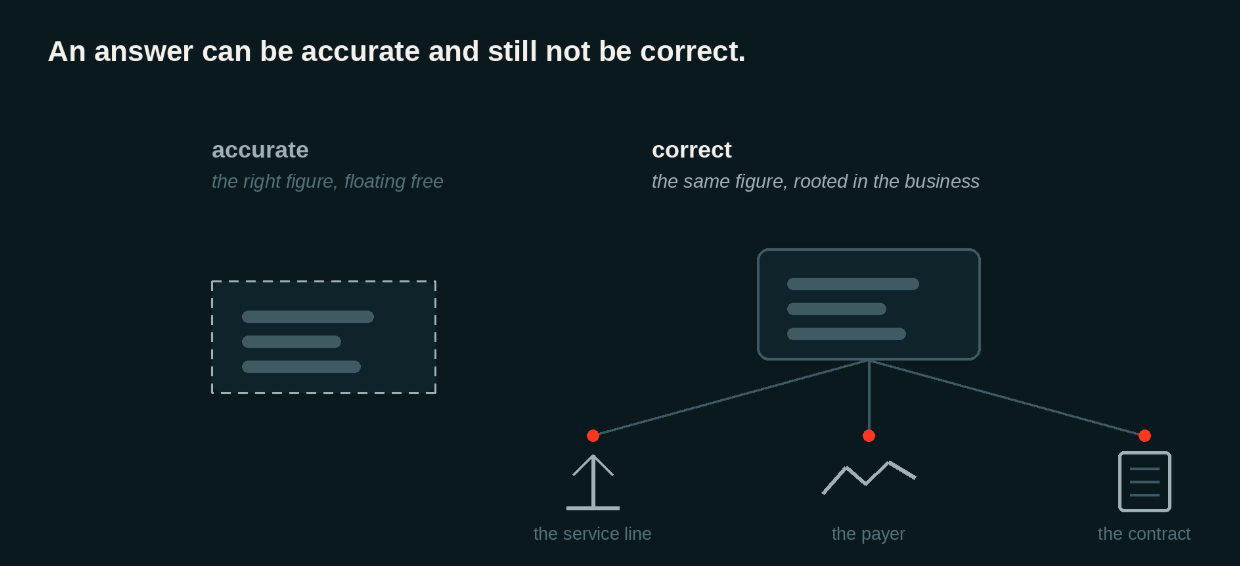
Accurate is the right figure. Correct is the same figure, rooted in the service line, the payer, and the contract.
Where Genie becomes the answer
In Frederick Brooks' book “The Mythical Man Month”, he argues that the greater the number of human interactions and communication happening, the slower the pace of delivery which is one reason why many organizations today strive to achieve self service.
This is where Genie becomes the answer. Databricks built Genie as a data-smart AI coworker: a coworker that a finance leader can ask a direct question to and gets a trustworthy, sourced answer in return, grounded in Genie's ontology and governed at every step. It is built to help finance have more accurate answers and, more importantly, deliver trusted actions, beyond just providing readouts of what has happened.
Consider the three questions on the minds of every healthcare finance team, each tied to one of three outcomes that compound, one feeding the next. For each, Genie does more than retrieve the data and answer. Its ontology learns the business, sharpens with every question, and shows its work:
› Where is the cost of delivering care outrunning what payers reimburse, and by how much?
Start with the cost of care. The rate a contract sets and the margin a service line keeps are rarely the same number once labor, supply, and overhead are counted against what each payer pays.
› Across our claims, where is earned revenue slipping to denials and underpayments, and how much can we recover?
Then the revenue already earned. Care gets delivered and documented, yet revenue still slips to denials and underpayments, often for reasons that could have been caught before filing.
› Where is cash tied up in aging receivables and care delivered but not yet billed?
Then cash. The same dollar of delivered care can sit unbilled or unpaid for weeks, quietly holding money the organization could be putting to work elsewhere.
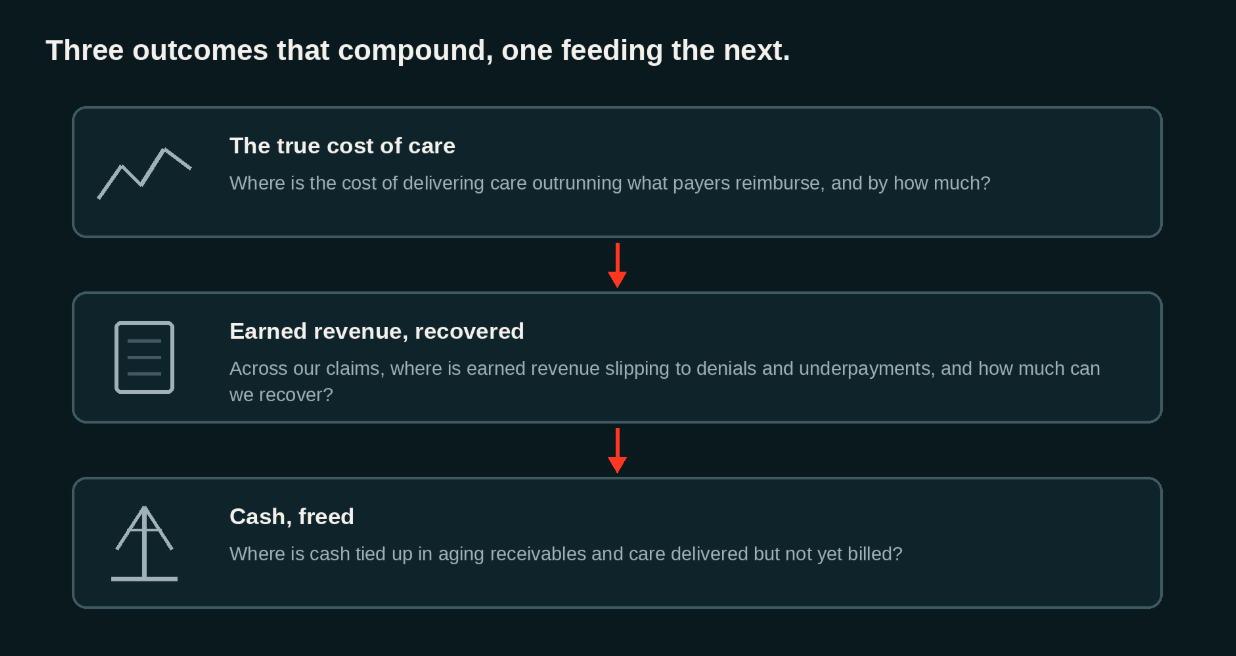
Three questions, three outcomes, one mechanism. Genie learns the business, sharpens with every question, and shows its work.
That is the difference between reporting what already happened and continuously learning about your business, getting smarter with every interaction. And because every figure traces to its source, every permission holds, and the cost of the AI itself stays governed under one model, it is an answer finance can trust to act on. Genie readies the move, to fix a claim before it is filed, to renegotiate a rate, to accelerate a collection, and a person in the loop makes the call.
Finally, Genie's learning across all three comes together. Seeing the true cost of care sets the value every payer should reimburse, and shows where earned revenue is slipping and where cash is trapped. Recover the revenue a denial would have taken before the claim is filed, and free the cash before it ages. That turns three separate fights into one reinforcing mechanism: each move sets up the next, and the momentum compounds.
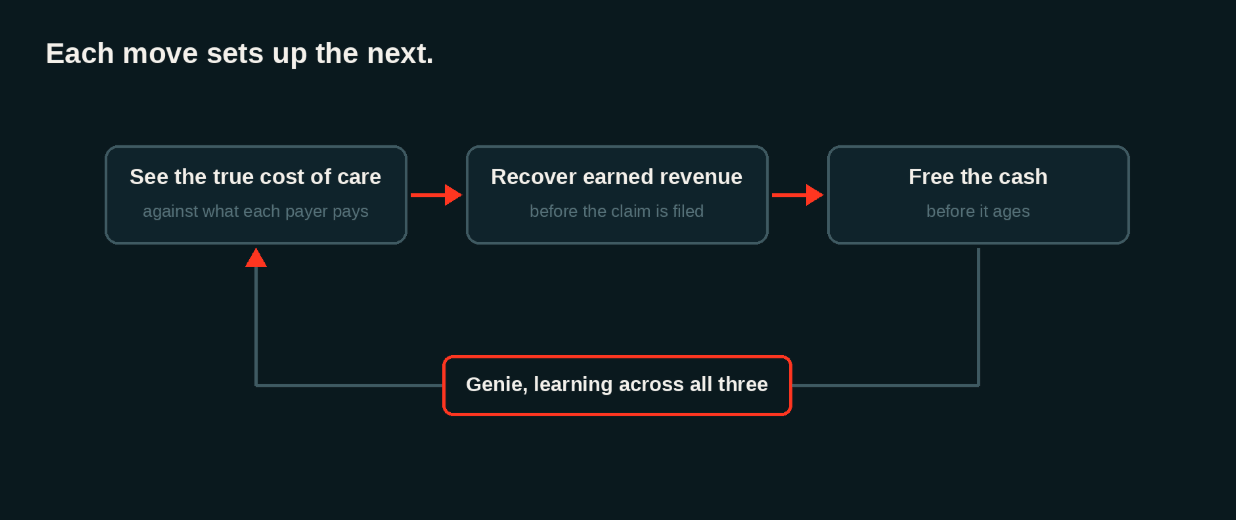
Each move sets up the next. Genie's learning across all three is what makes the momentum compound.
A data-smart AI coworker built for the way healthcare finance works
This is the force multiplier built for what finance departments require. The critical people driving rigor and discipline across the business can now lean on a data-smart AI coworker that is always getting smarter, always current, always governed, truly understanding the business. Health systems will keep delivering care, while a tool like Genie will help finance protect more of the margin that funds it.
See what a data-smart AI coworker looks like for healthcare finance. Databricks Genie is available today. databricks.com/product/ai-bi/genie
Frequently asked questions
What is changing for finance in healthcare?
More of the decisions that move margin, coding, claim adjudication, denials, and collections, are made by agents. Finance's mission to protect the margin that funds care is unchanged; what has grown is the speed and complexity of change, which finance tools must understand and govern.
Does Genie make clinical or coding decisions?
No. Clinical decisions belong to clinicians, and coding and revenue-cycle actions belong to the teams that own them. Genie gives finance an accurate, governed view to see a forming risk early and guide or direct the owners who act on it.
Why do ontology and governance matter to a healthcare CFO?
Ontology captures what the numbers mean for your business and keeps it current, so an answer is correct and not just accurate. Governance keeps every figure traced, permissioned, and sensitive patient data protected. Together they make an answer safe to act on.
How is Genie different from an AI dashboard or BI tool?
A dashboard shows you what the data says. Genie is a data-smart AI coworker that helps you act on it, grounded in your ontology and governed end to end, with a person deciding.
0 Comments
Log in to join the conversation.No comments yet. Be the first to share your thoughts.