
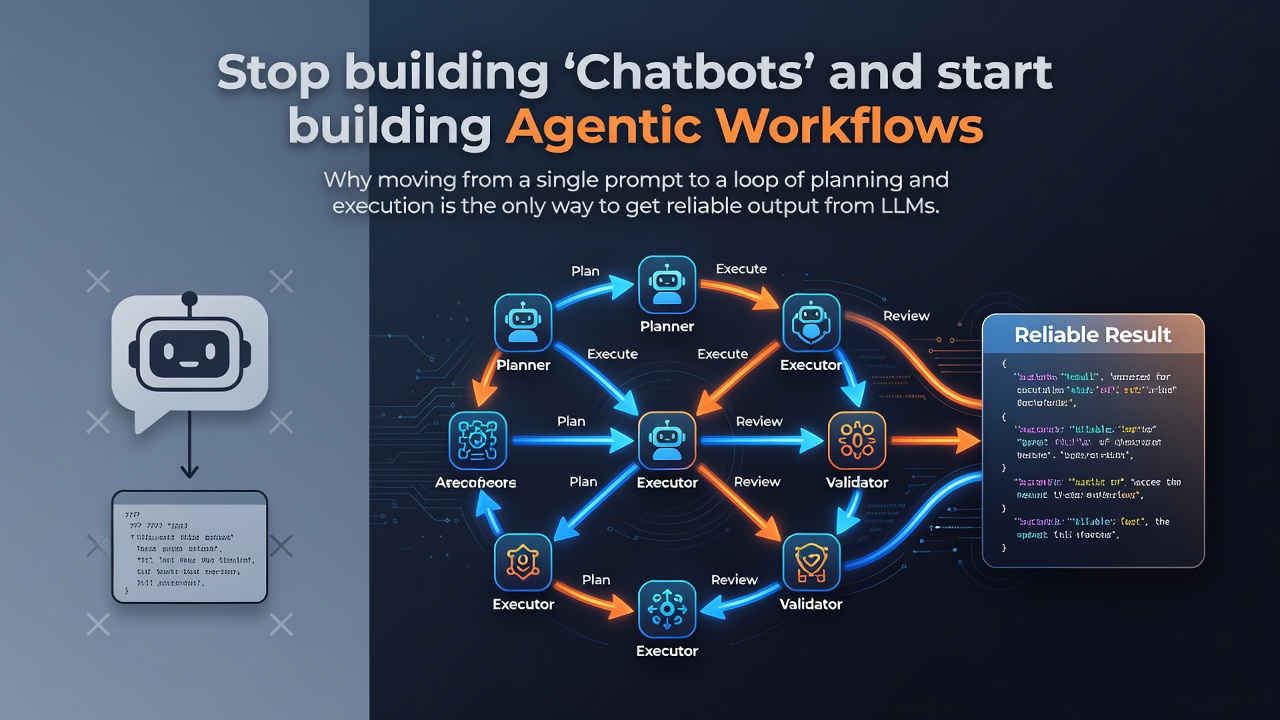

The Wall of Single Prompts
Most developers start with a simple pattern: user input goes in, the LLM processes it, and a response comes out. We call this a zero-shot or few-shot prompt. It works for summarizing a paragraph or writing a basic function. But the second you ask it to perform a complex task, like "Research this company and write a personalized sales email based on their latest SEC filing," it falls apart.
It will hallucinate the filing, miss a key detail, or simply forget the constraints you set in the first paragraph. This is because you are treating the LLM as a magic box rather than a processor. To get actual reliability, you need to move toward agentic workflows.
What actually makes a workflow 'Agentic'?
An agentic workflow is not about a more powerful model. It is about the architecture around the model. Instead of one long prompt, you break the task into a loop of reasoning, acting, and observing.
Think of it like a junior developer. You would never tell a junior, "Build the entire authentication system and tell me when it is done." You would tell them to design the schema, review it with you, write the tests, and then implement the code.
In an agentic system, this looks like a cycle:
- Planning: The LLM breaks the goal into smaller steps.
- Tool Use: The LLM decides which tool (API, database, search) it needs to execute a step.
- Observation: The LLM looks at the output of the tool and determines if it solved the problem.
- Correction: If the output was an error or incomplete, the LLM adjusts its plan and tries again.
A Practical Pattern: The Reflection Loop
One of the simplest agentic patterns to implement is the Reflection Loop. Instead of taking the first answer, you force the LLM to critique itself.
Here is how I implement this in my projects:
First, I have a "Generator" prompt. It produces the initial code or text.
Second, I pass that output to a "Critic" prompt. This prompt is told to be pedantic. It looks for edge cases, security flaws, or deviations from the original requirements. It returns a list of specific improvements.
Third, the Generator receives the original goal and the Critic's feedback to produce a second version.
I have found that this simple loop reduces logic errors by about 30 percent compared to a single high-quality prompt. You are essentially trading latency and token cost for accuracy.
Dealing with the 'Infinite Loop' Problem
When you give an LLM the ability to loop, you risk the infinite loop. The agent keeps trying the same failing API call over and over because it thinks it is "almost there."
To prevent this, you need hard constraints. I use three specific guardrails:
- Max Iterations: Set a hard limit (usually 5 to 10) on how many times the agent can loop. If it hits the limit, it must return a failure message.
- State Tracking: Keep a history of the tools called and the results. If the agent attempts the exact same tool call with the exact same arguments twice, force a state change or trigger a human intervention.
- Token Budgeting: Monitor the context window. Agentic loops eat tokens quickly. If the history gets too long, the agent loses the original goal. I use a sliding window or summarize the previous steps to keep the context clean.
The Takeaway
Stop trying to write the "perfect prompt." It does not exist. The prompt is just the starting point.
If you want a system that actually works in production, stop treating the LLM as a writer and start treating it as a controller. Break your process into a sequence of small, verifiable steps. Give the model a way to check its own work.
Build a loop, not a line.
0 Comments
Log in to join the conversation.No comments yet. Be the first to share your thoughts.