
[Submitted on 24 Jul 2026]
Abstract:The increasing deployment of large language models (LLMs) has magnified the computational and memory bottlenecks of autoregressive decoding, where low compute intensity and bandwidth-bound kernels dominate inference cost. Weight pruning offers a promising remedy,
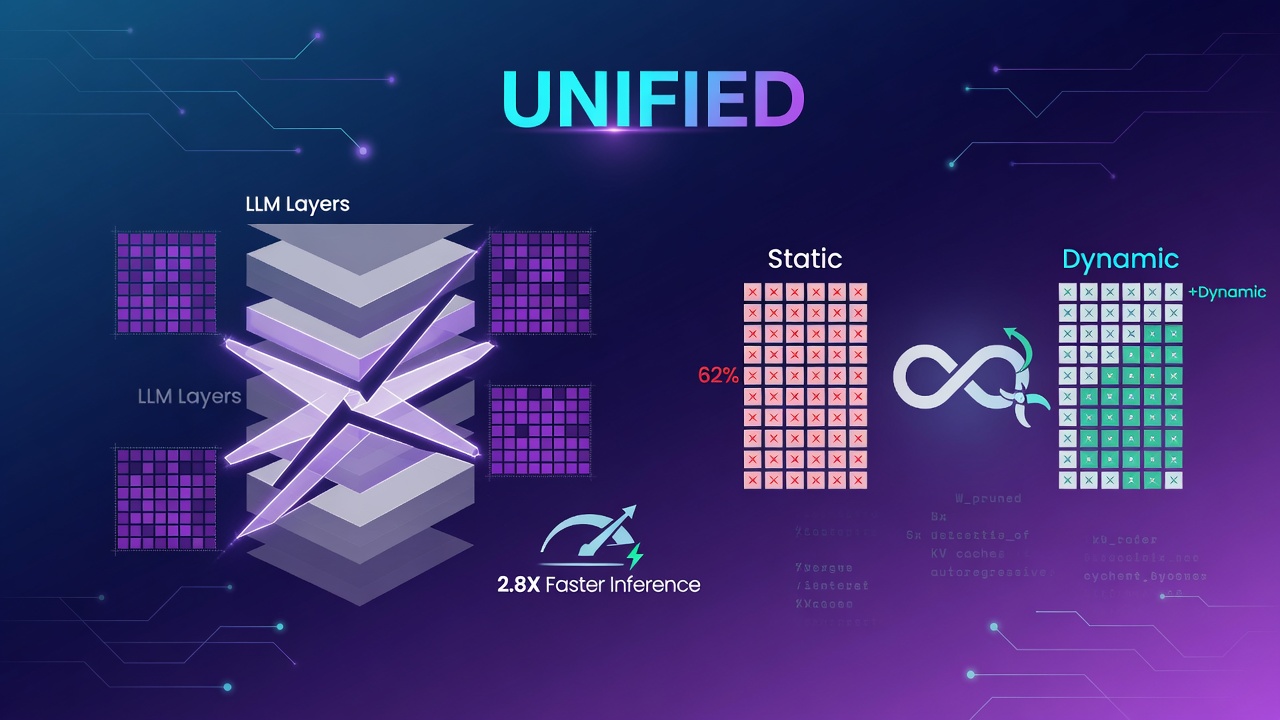
but existing methods remain confined to either static pruning (SP), which permanently removes redundant weights but lacks adaptivity, or dynamic pruning (DP), which adapts to input sparsity but introduces runtime irregularity. This paper presents SPDP, a unified
sparse-inference framework that integrates unstructured SP with input-adaptive DP for efficient LLM inference on GPUs. SPDP co-designs a new Tiled-Column-wise Bitmap Compressed (Tiled-CBC) format and two complementary GPU kernels: (1) a CUDA-core spMspV kernel
featuring Hybrid Activation-aware Dynamic Shared-Memory Bitmap Decoding (HAD-SMBD) for fine-grained, runtime activation skipping, and (2) a Tensor-Core SpMM kernel optimized for prefill computation. This joint format-kernel design harmonizes static and dynamic
sparsity, maintaining bandwidth-efficient memory access and high compute intensity under both phases of LLM inference. Comprehensive evaluations on inference-optimized GPUs demonstrate that SPDP achieves 1.24x-1.37x average speedup (up to 2.51x) over state-of-the-
art sparse frameworks such as SpInfer, while matching. perplexity with up to 25% higher sparsity. SPDP advances the inference efficiency-quality Pareto frontier, showing that unified static-dynamic pruning can deliver substantial throughput and performance-per-watt
improvements in large-scale LLM serving
Submission history
From: Jinhyeok Kim [view email]
[v1]
Fri, 24 Jul 2026 05:19:41 UTC (1,740 KB)
0 Comments
Log in to join the conversation.No comments yet. Be the first to share your thoughts.