
[Submitted on 24 Jul 2026]
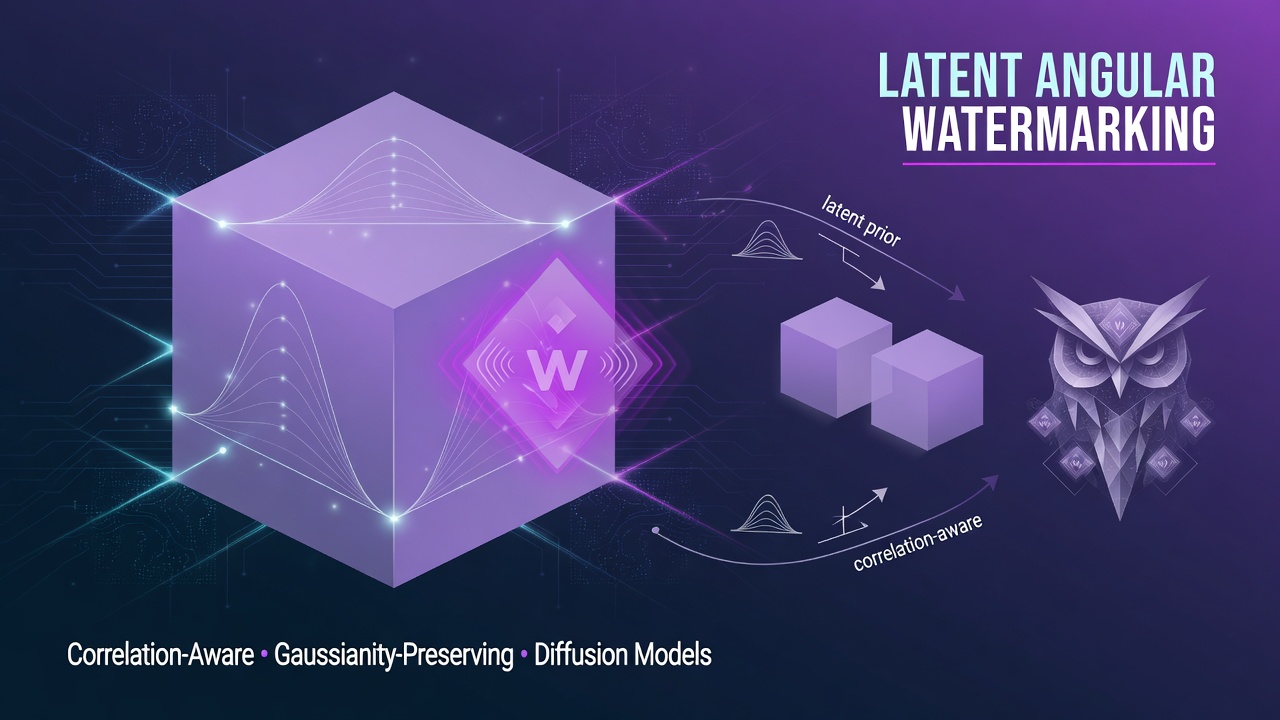
Abstract:Latent domain watermarking for diffusion models embeds watermarks directly into the latent prior, enjoying non-intrusiveness to model parameters and seamless integration with the generation process. However, due to the violation of latent Gaussianity or sensitivity to normal and malicious perturbations during latent inversion, existing methods are prone to watermark detection or removal attacks. A further overlooked problem is the violation of the i.i.d. latent condition after watermarking, which leads to latent correlation degradation and generation fidelity loss. Although this has been externally measured by FID, the internal correlation structure has yet to be rigorously characterized. To address the above issues, and motivated by the rotation-invariant property of isotropic Gaussian, we propose \textit{Latent Angular Watermarking (LAW)}, which encodes watermark bits as antipodal angles ($\pm\pi/2$ relative to a reference pair) between disjoint pairs of latent elements while preserving the Gaussianity. The antipodal ($\pi$-separation) encoding maximizes geometric separation between bit values, and we prove that the decoding angular-error variance is proportional to the norm of the latent pair, i.e., $\operatorname{var}(\Delta\phi) \propto 1/\rho^2$. We further propose a magnitude-driven variant, LAW-M, which anchors watermark bits in the most geometrically stable latent dimensions, yielding additional robustness gains. Theoretically, we provide a rigorous characterization of the induced correlation degradation, deriving in closed form the autocorrelation structure of the watermarked latent and proving that correlations are confined to a sparse, structured set of off-diagonal elements with fixed $\pm\pi/4$ values.
Submission history
From: Yebin Zheng [view email]
[v1]
Fri, 24 Jul 2026 15:10:44 UTC (35,306 KB)
0 Comments
Log in to join the conversation.No comments yet. Be the first to share your thoughts.