

Every systems language faces the same age-old tradeoff:
- Garbage Collection: Easy to write, but introduces runtime pauses and memory bloat.
- Manual / Ownership Models: Blazing fast, but adds steep learning curves or borrow checker friction.
While building Proton (a system programming language), I wanted a third path: Deterministic memory management without GC pauses, and without forcing developers to manually track allocations.
This led to the design of LAM (Lifetime Allocation Model) — a system based on Garbage Prevention rather than Garbage Collection.
What is Lifetime Allocation Model (LAM)?
Traditional Garbage Collectors clean up trash after it's created. LAM takes a different approach: it predicts object lifetimes at compile-time and routes data into three distinct memory structures:
- Stack: Short-lived local variables (zero allocation overhead).
- Region (Arena): Grouped dynamic allocations tied to a specific execution scope. The entire region is wiped in $O(1)$ time when the scope ends.
- Heap: Reserved strictly for long-lived, truly dynamic data that outlives local scopes.
By eliminating unpredictable heap allocations and replacing them with deterministic Region sweeps, we completely bypass runtime GC pauses.
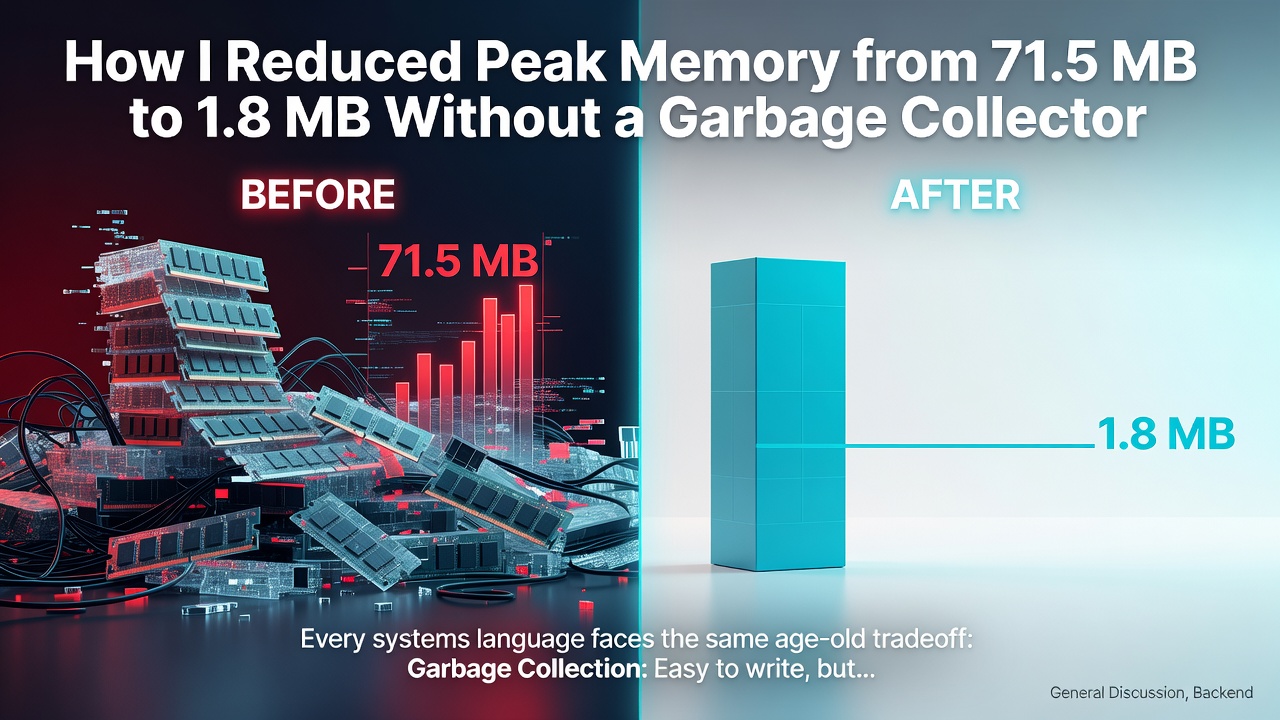
The Benchmark: 71.5 MB vs 1.8 MB
To put LAM to the test under heavy stress, I ran comparative benchmarks simulating high-throughput allocations:
| Metric | Traditional Runtime / Baseline | Proton with LAM |
|---|---|---|
| Peak Memory Usage | 71.5 MB | 1.8 MB |
| Allocation Overhead | $O(N)$ dynamic sweeps | $O(1)$ Region allocation |
| GC Pause Time | Variable (ms-scale) | 0 ms (No GC) |
By preventing unnecessary heap pollution and reclaiming entire memory regions at once, peak memory consumption dropped by ~97.5%.
How It Feels in Code
LAM works mostly under the hood during the analysis pass, so developers get high-level syntax without worrying about manual free() calls or complex lifetimes:
fn process_data(stream: Stream) {
    // Allocations here are automatically scoped to a Region
    let buffer = stream.read_chunk();
    let parsed = parse_payload(buffer);

    send_response(parsed);
    // End of scope: The entire Region is freed at O(1) instantly.
}
Enter fullscreen mode Exit fullscreen mode
What's Next & Open Source
Proton and the LAM architecture are actively under development. The core compiler pipeline, memory manager benchmarks, and tests are all open source.
I'd love to hear feedback from compiler engineers, systems programming enthusiasts, and language designers!
👉 Check out the repository & run the benchmarks yourself: https://github.com/musabX44/Proton-5
What are your thoughts on region-based garbage prevention versus borrow checking? Let’s discuss in the comments!
0 Comments
Log in to join the conversation.No comments yet. Be the first to share your thoughts.