
The put/call ratio has fallen to about 0.52 from 0.76 in late June, and one-week downside protection has collapsed in price. The options market is positioned for a quiet week that contains an FOMC decision.
- Bitcoin options traders have sharply reduced downside hedges since late June, with the put/call open-interest ratio falling to about 0.52 from 0.76.
- Short-dated options show much lower demand for near-term protection than for three- to six-month tenors, signaling traders see this week as calmer even as they insure against turbulence later in the year.
- Implied volatility is subdued across the curve and slopes upward into the future, leaving markets with limited cushion if Wednesday’s Federal Reserve decision or projections surprise investors.
Bitcoin's BTC$65,094.85 options market has turned notably less defensive over the past month, unwinding the downside protection traders built up in June just as the Federal Reserve prepares to meet.
The put/call ratio on open interest, which measures how much of the market is positioned in puts, contracts that pay off when the price falls, against calls, which pay off when it rises, has dropped to roughly 0.52 from about 0.76 in late June, according to Glassnode.
Calls are gaining share, the pattern of traders stepping back from hedging rather than adding to it. Recently, large traders have been accumulating $70,000 strike calls and bull call spreads, signaling expectations of upside in the spot price.
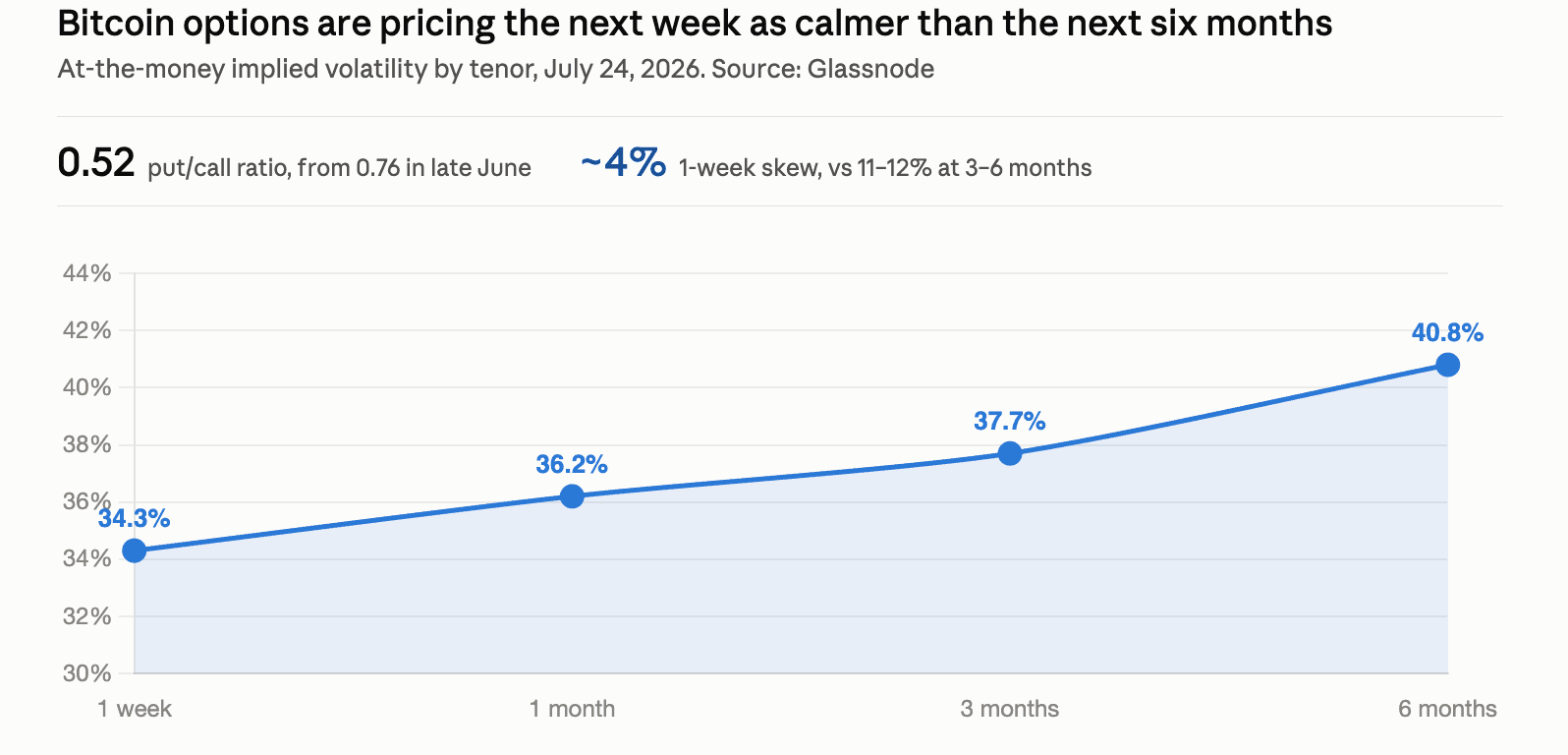
The 25-delta skew, the premium traders pay for downside protection relative to equivalent upside exposure, has fallen to around 4% at the one-week tenor while three- and six-month contracts hold at 11% to 12%. That indicates traders are still paying for insurance against something going wrong later this year, but have largely stopped paying for it this week.
Implied volatility, or the market's expectation for how much the price will move, is compressed across the curve, at 34.3% for one week against 40.8% for six months.
That upward slope is the market modeling the immediate future looks calmer than the distant one, which is not how the curve usually looks ahead of a scheduled macro event.
The Fed's rate decision lands Wednesday. Markets have put the odds of a July increase at roughly 15%, so the low near-term pricing is defensible on the base case.
It also leaves little cushion if the statement or the projections surprise, and positioning that thin has a way of amplifying moves rather than absorbing them.
Bitcoin held near $65,000 through most of the past week, including Thursday's selloff that took $797 billion off the largest U.S. technology stocks, and through a period in which blockchain networks Movement Labs and Storj filed for bankruptcy protection while crypto exchanges BitMEX and BitMart announced wind-downs.
Crypto Flows, Share and the Selective Rotation

Crypto Flows, Share and the Selective Rotation
Markets repositioned since June, but Binance held share (~55% user funds, ~24% spot) and drew net inflows in early July while the tracked market saw outflows.
Markets repositioned since June, but Binance held share (~55% user funds, ~24% spot) and drew net inflows in early July while the tracked market saw outflows.
Why it matters:
Markets repositioned since June, but Binance held share (~55% user funds, ~24% spot) and drew net inflows in early July while the tracked market saw outflows.
0 Comments
Log in to join the conversation.No comments yet. Be the first to share your thoughts.