
Senior Editor, News,GameDeveloper.com
July 22, 2026
7 Min Read
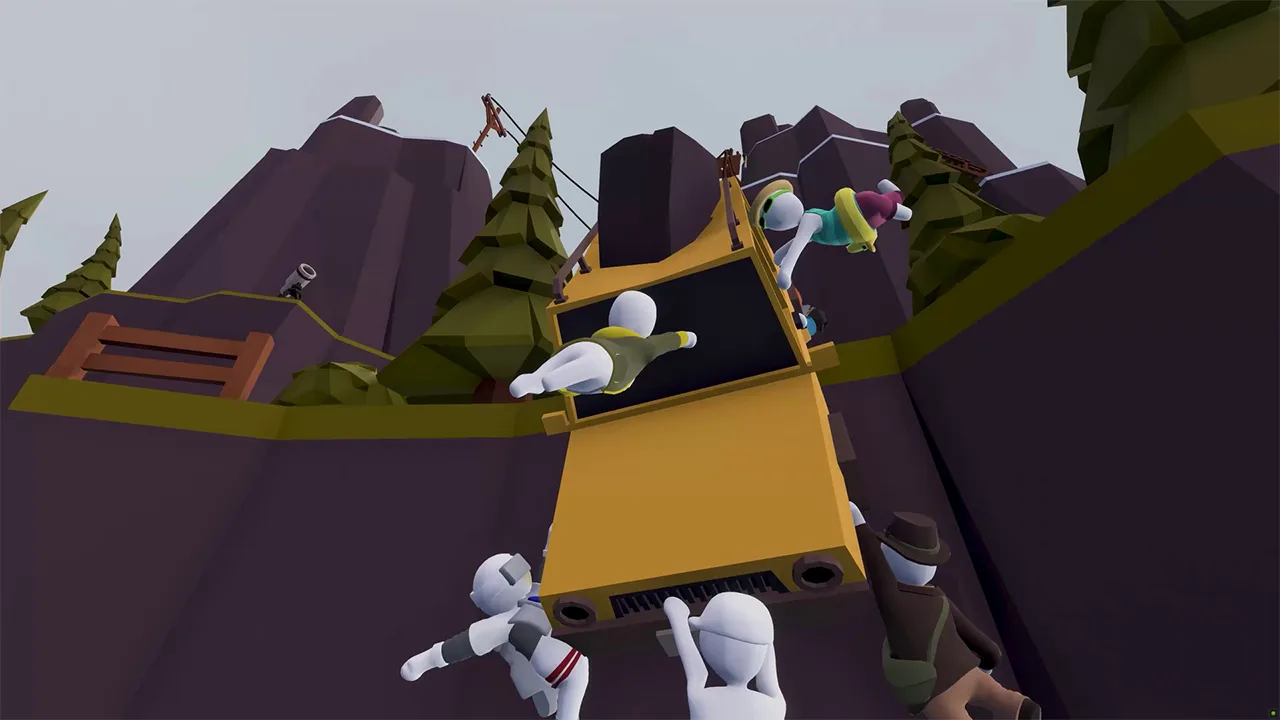
Image via No Brakes Games
A decade on from launching as a prototype on Itch.io, slapstick physics puzzler Human Fall Flat has topped 60 million players worldwide. It's an extraordinary number that would surely represent meteoric success at even the biggest triple-A studio—let alone an indie developer like No Brakes Games, which currently has 40 people working on the original and its upcoming sequel. The title itself began life as a passion project under creator Tomas Sakalauskas, who worked as a solo developer during those early days.
This week, Game Developer sat down with Sakalauskas to see what the Lithuanian developer has learned after 10 years transforming a passion project into a global franchise.
Over the years, I've had countless conversations with indie developers who have experienced success only to find that fame and fortune can become a poison chalice. They set out to flex their creative muscles, but after striking gold (often, unexpectedly) find themselves taking on managerial responsibilities more befitting of a fledgling exec.
Related:Two thirds of remaining Doom (2016) devs laid off during latest round of Xbox cuts
I was curious to hear how Sakalauskas managed to preserve the soul of Human Fall Flat (and his own sanity) as the title became a top seller. It, was he admits, a struggle at times.
"I had several attempts at doing that. I just got burnout, like really bad burnout, somewhere along the way," said Sakalauskas, who explains publisher Curve Digital initially helped ease the burden by subcontracting and outsourcing some aspects of development so he could focus on engineering—which remains his passion.
That approach didn't stick, however, and Sakalauskas felt that compartmentalizing development would hurt the player experience. "It needs to be a live organism that evolves," he says. It's a belief that led Sakalauskas to open a studio in Tenerife in the hopes to creating a more unified production environment under the stewardship of someone with more experience than himself. Again, he encountered stumbling blocks.
"With that experience came some bad habits from bigger studios where again you go into more like rigid processes without too much iteration. I got levels for review when it was too late to make changes. The culture was impossible to shift there, so I closed that studio basically and opened another studio in Lithuania, where I had a much stronger tech team because it's a technology project [at heart]," he explains.
"It's all physics and engineering and so on, and you cannot base it on game design documents. You make systems, and from those systems, nice behaviors emerge. [...] It is difficult to scale because when you are used to doing things alone, everything is super fast and super easy to change, and you're always in agreement with all the team. So yeah, for tips on how to scale it, I don't know. You you really have to look for people that have similar mindset to yourself."
Related:Unions take legal action against Microsoft for allegedly mishandling Xbox layoffs
Sakalauskas feels working alongside people you trust makes delegation far easier, which in turn makes scoping a project more manageable. Importantly, it allowed Sakalauskas to continue playing to his own strengths—the very traits that imbued Human Fall Flat with so much personality in the first place.
"Currently, I'm working on the things that are really interesting for me: game direction and physics programming. Those, I can do it forever," he adds.
"A publishing deal is a little bit like a marriage"
Sakalauskas tells me that in Lithuania, "success" and "luck" are represented by the same word. He struggles to understand why Human Fall Flat resonated with so many players, but feels it has something to do with him choosing to experiment in a field he continues to find genuinely fascinating.
He also credits publisher Curve Digital with taking on the work he found unappealing—marketing, platform outreach, commercialization.
Related:UK union launches free resource to decode video game writing contracts
"I would attribute the luck part to myself and success part more to the people at Curve. For them, the bottom line is important. For me, it never was. So, they were looking at new partnerships, expanding to different platforms, helping arranging workshop competitions to make sure the game still is fresh and live. The longevity is mostly on them," said Sakalauskas.
"I created the seed that had potential, but if I were alone as a solo developer, most probably I would have died by now. Those people who are interested in commercial success are important. I am an idealist. I want to create nice things. I don't care about the bottom line. What I care about is when people send me an email saying 'I had a really nice time [playing this] with my grandkids.' This is what matters more. But just with that, you won't be able to to scale."
Sakalauskas spoke with multiple publishers before choosing to partner with Curve, and when pressed on what make the UK company stand out from the crowd, he explains the choice came down to a gut feeling based on conversations with (now-former) publishing director Simon Byron as opposed to the company's existing portfolio or specific contract terms.
"A publishing deal is a little bit like a marriage—if it's someone who has all the check boxes but you would hate to see them every day, you don't marry them," he said.
Although the scale demanded by Human Fall Flat's success brought challenges, the title's longevity has also afforded Sakalauskas and No Brakes Games a huge amount of freedom. Human Fall Flat 2 was announced back in 2023. Three years later, the sequel doesn't even have a release date. So, what's going on?
Sakalauskas explains the studio spent years working on the project before choosing to rebuild it from scratch. The issue was partly one of his making. He said he fell down a rabbit hole centered on the "wrong branch of physics," meaning the sequel lost the clumsiness that made the original so endearing. "It was too stiff. Too polished," he adds.
It's a predicament that could be fatal for some projects or entire studios, but because Human Fall Flat has delivered sustained success, Sakalauskas felt comfortable returning to the drawing board (although some design beats have been repurposed).
As it stands, he tells me the sequel will launch when it's ready and not a second before, while also suggesting it will be quite a different beast that first envisaged. "I'm really happy we had the luxury not to release that," he explains. "Essentially, Human Fall Flat 2 is cancelled. We are making Human Fall Flat 3. [The initial project] was not 'wrong' as such, but it just took some time for the design team to really work together and develop the right tools and the right mindset to what this game specifically needs."
That mindset, says Sakalauskas, will prioritize immersion and physical reactivity above all else. That's something he feels is absolutely fundamental to the franchise.
If you're reading this and haven't released a video game that has sold 60 million copies, you might be wondering what you can learn from this interview? It's a fair question. By way of an answer, Sakalauskas suggests his success—or perhaps luck—was the result of choosing to create something that felt completely fresh as opposed to imitating another market-leader.
"There will always be demand for fresh ideas. There will not be a moment where it's like 'okay, this year the world needs 100 fresh ideas—and in 10 years it will need just 10.' There will always be a place for creative people," he says.
Sakalauskas concedes the market is becoming more saturated, but says that only means it has become even more important to rationalize why you want to create video games in the first place. If you're chasing the pot of gold at the end of the rainbow, you might be better off in a different industry.
"It's not cool when people are blinded by success stories. That's why I explicitly don't want to say 'okay, this is how you make a game that sells 60 million copies.' I have no clue how to make a game that sells 60 million. I don't expect the second game to sell 60 million," he adds.
"Being delusional [and saying] I will make a game and be rich is the wrong motivator. It should just be 'I want to make a game and release a game.' That's a good goal. Wanting to make something fresh, something new, is an even better goal. Both of those things are achievable. Making a successful game? If you make that your goal, there's a big chance you might end up disappointed. But if you follow the first or especially the second, there is a slight chance like in a lottery. You'll have bought your ticket."
About the Author
Senior Editor, News, GameDeveloper.com
Game Developer news editor Chris Kerr is an award-winning reporter with over a decade of experience in the game industry. His byline has appeared in notable print and digital publications including Edge, Stuff, Wireframe, International Business Times, and PocketGamer.biz. Throughout his career, Chris has covered major industry events including GDC, PAX Australia, Gamescom, Paris Games Week, and Develop Brighton.
0 Comments
Log in to join the conversation.No comments yet. Be the first to share your thoughts.