
I wanted two things: short links under my own brand (every link I share points traffic back to my site), and a real excuse to run a complete system on the edge — DNS, distributed compute, storage, auth and a dashboard — in production, at zero infrastructure cost.
The result is flino.link: a shortener that responds in under 10 ms from 300+ locations, runs entirely on Cloudflare's free tier, and whose only expense is the domain: $4.68 a year. This post covers the design decisions, which is where the interesting parts are.
The architecture in 30 seconds
A single Cloudflare Worker serves the whole domain:
-
GET /<slug>— the hot path. One read from Workers KV (globally replicated) and a302redirect. Nothing else touches that path. -
/api/links— a REST API with Bearer auth to create, list and delete links. -
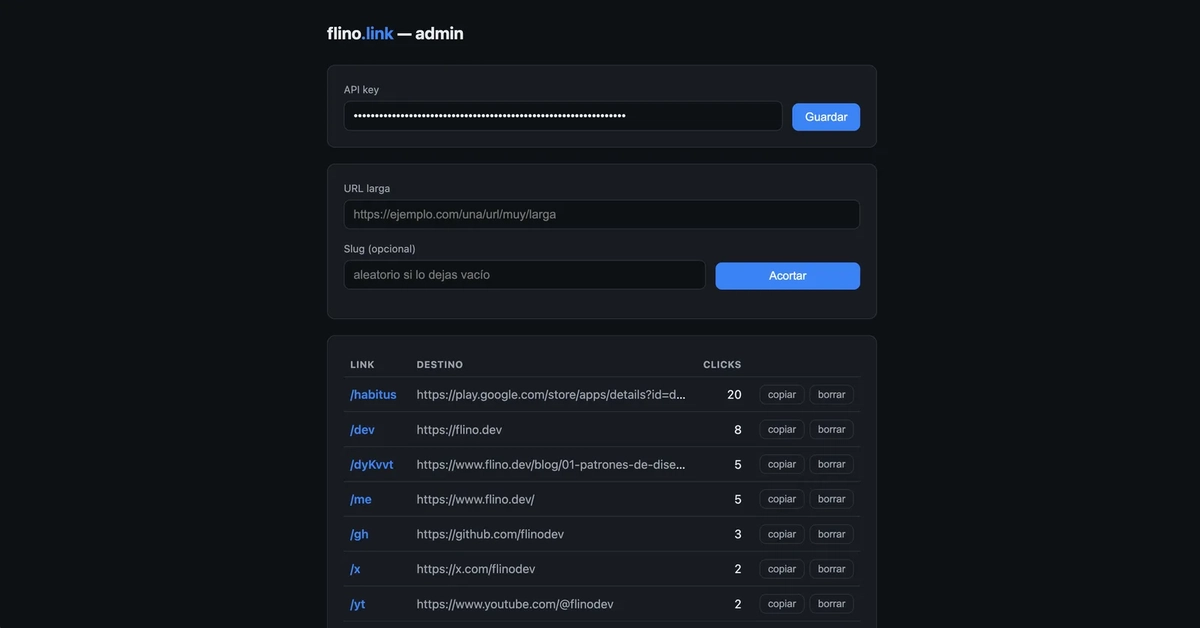
/admin— a single-page dashboard served as inline HTML from the Worker itself. No framework, no build step. - A Durable Object with embedded SQLite keeps per-slug click counts.
No servers, no containers, no database to manage. The whole Worker is three TypeScript files and zero runtime dependencies.
Why a dedicated domain?
My first idea was to hang the shortener off a route on flino.dev. Bad idea: shorteners attract abuse — spam, phishing — and their domains sooner or later end up on blocklists. If that happens, I don't want it dragging my main domain down with it. A separate domain isolates that reputation risk completely, and a short .link costs less than a coffee per year.
KV for links, a Durable Object for counters
This is the central design decision. Workers KV is perfect for a shortener's access pattern — read-heavy, write-light, reads served from the edge — but its writes are eventually consistent: two concurrent increments in different datacenters would clobber each other. For counting clicks, it's useless.
A Durable Object solves exactly that: it's a single global instance with transactional SQLite storage. Every increment, no matter which datacenter it comes from, serializes through one consistent point:
export class ClickCounter extends DurableObject<unknown> {
  private sql = this.ctx.storage.sql;

  increment(slug: string): void {
    const now = Date.now();
    this.sql.exec(
      "INSERT INTO clicks (slug, count, last_click) VALUES (?, 1, ?) " +
        "ON CONFLICT(slug) DO UPDATE SET count = count + 1, last_click = ?",
      slug, now, now,
    );
  }
}
Enter fullscreen mode Exit fullscreen mode
Doesn't that single point become a bottleneck for redirects? No — because of what comes next.
The waitUntil trick: click counting with zero latency
A shortener's contract is to redirect fast. If the redirect had to wait for the Durable Object write, every click would pay an extra round-trip. The solution is ctx.waitUntil(): it hands the runtime a promise that executes after the response has been sent to the visitor.
const target = await env.LINKS.get(slug);
if (target !== null) {
  // Runs after the response is sent — adds no latency to the redirect.
  ctx.waitUntil(counter(env).increment(slug));
  return Response.redirect(target, 302);
}
Enter fullscreen mode Exit fullscreen mode
The visitor gets their 302 after a single KV read; the counting happens in the background. Free analytics, in the literal sense of the word.
Fail toward the brand
What happens when someone visits a slug that doesn't exist, or the domain root? Never a 404: always a redirect to flino.dev. A broken or deleted link never shows an ugly error page — it shows my site. Every dead path in the system becomes a touchpoint.
// Unknown slug, root, or anything else:
return Response.redirect("https://flino.dev", 302);
Enter fullscreen mode Exit fullscreen mode
The dashboard: inline HTML, no framework
The admin panel is a TypeScript constant holding a complete HTML page that the Worker serves at /admin. The API key lives in localStorage, dark mode comes free with prefers-color-scheme, and creating a link auto-copies the short URL to the clipboard. Zero dependencies, zero build, and it deploys together with the Worker in the same wrangler deploy.
For a project this size, a frontend framework would have been more infrastructure than product.
The numbers
| Redirect latency | < 10 ms from 300+ locations |
| Capacity (free tier) | ~100,000 requests/day |
| Infrastructure cost | $0/mo |
| Total cost | $4.68/yr (the domain) |
| Runtime dependencies | 0 |
What I'm taking away
- The edge changes the defaults. For a read-heavy service, the question is no longer "how close do I put the server?" but "why would there be a server?".
- Pick storage by semantics, not by habit. KV and Durable Objects coexist in the same Worker, each doing the one thing it's good at: global replication for reads, strong consistency for counting.
-
waitUntilis the most underrated pattern in Workers. Anything the visitor doesn't need — metrics, logs, counters — can move off the critical path.
The full code is on GitHub, and if you want to see the system in action, this link goes through it: flino.link/devto-en. (Yes — your click is already on my dashboard 😄)
Where would you have hosted this? Workers, a $5 VPS, Deno Deploy, fly.io? I'd genuinely like to read other approaches in the comments. 👇
0 Comments
Log in to join the conversation.No comments yet. Be the first to share your thoughts.