
Quantum computers promise to solve problems beyond the most powerful classical supercomputers. But this raises a fundamental challenge: how do you prove the validity of answers that can’t be calculated any other way? In a trio of papers released yesterday, IBM and collaborators say they have demonstrated several techniques for solving this conundrum.
The holy grail for quantum computing is a machine that unambiguously solves problems that are impossible for a classical machine, something that has come to be known as “quantum advantage.” Pinning down exactly what counts as advantage has proven trickier though. So far, most demonstrations have relied on highly contrived problems that bear little resemblance to real world use cases. They have also struggled to show their answers were correct, as classical ground truth is missing and statistical workarounds rely on strong assumptions about how the hardware will behave.
In a series of collaborations with researchers at the University of Chicago and quantum software startups Algorithmiq and Qedma, IBM claims to have now demonstrated three separate instances of quantum advantage alongside methods that validate the results are correct despite not being classically simulatable.
“I see these demonstrations as proof that we can scale quantum computing forward with confidence,” Jay Gambetta, Director of IBM Research and IBM Fellow, said in a press briefing. “First, they show that quantum computers can solve problems that go beyond the reach of classical methods that could run on the biggest classical computers, and second, they show a series of results of quantum computers that can be validated with confidence.”
Random quantum circuits become verifiable
Each of the three papers, all of which have yet to undergo peer review, tackles the problem of validation from a different angle. In the collaboration with University of Chicago, the researchers modified a popular approach for demonstrating quantum advantage called random circuit sampling, which was the basis of the first (since contested) claim of quantum advantage by Google in 2019. This involves running a randomly generated sequence of quantum gates on a quantum processor, recording the output and then getting a classical machine to replicate the results. If the classical machine can’t replicate the results, the argument goes, the quantum processor is doing something a classical machine is incapable of.
The challenge is that if you can’t simulate the results, you also can’t check if the quantum processor is actually running the circuit you asked it to or just producing a jumble of noise. Previously, researchers have got around this by checking the machine on quantum circuits simple enough to be analyzed classically, and then extrapolating the results to larger circuits. However, this requires strong assumptions about how the hardware behaves.
To get round this, the IBM and Chicago team exploited the fact that not all quantum gates are equal. So-called “Clifford gates” can be efficiently simulated on classical hardware, but “non-Clifford gates” make simulation exponentially more costly as more are added to a circuit. So, the researchers built circuits entirely out of Clifford gates. They used an approach they call “spacetime code”, which makes it possible to detect when errors have occurred and discard failed runs. They then gradually added non-Clifford gates in places where they could be sure it doesn’t disturb the error detection process.
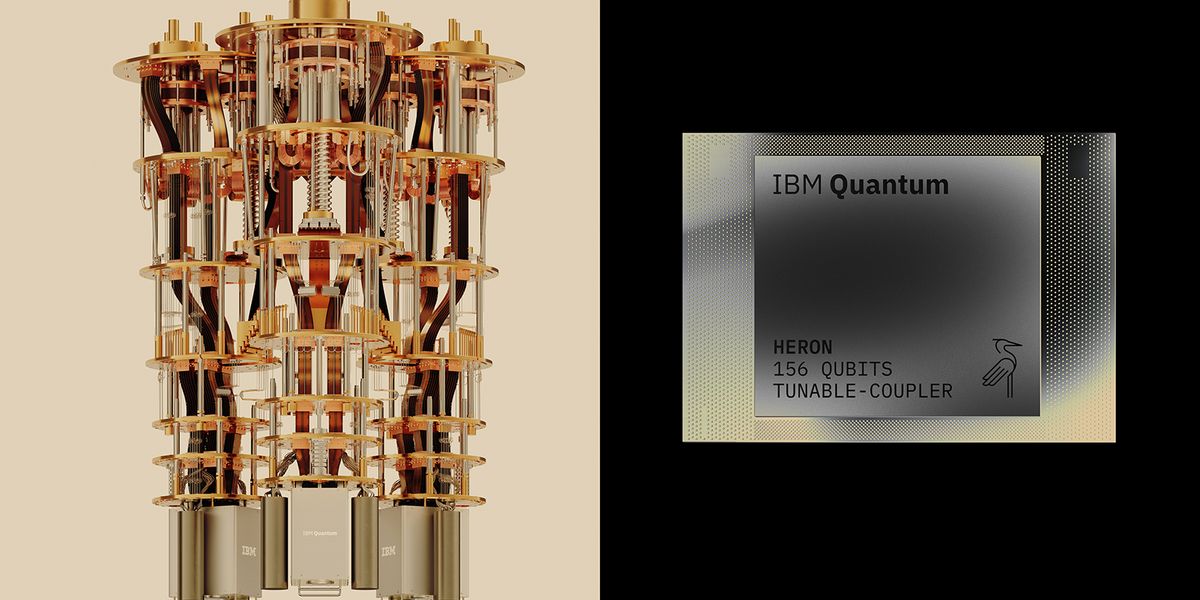
This meant that even after adding 468 non-Clifford gates to a 70 qubit circuit running on IBM’s Heron processor, which Gambetta said is more than double what is classically simulatable, the circuit ran faithfully on at least 28 percent of the runs that weren’t discarded. That might not sound particularly impressive, but it’s a significant improvement over previous quantum advantage claims. More importantly, the result comes with a 95 percent confidence guarantee, something no previous approach has been able to provide. The main downside is that the error detection scheme has a high overhead of rejections, which meant they had to do 860x more runs than if they had skipped this step.
Building trust in quantum results on simulation
But while this approach provides some concrete guarantees about the fidelity of the computations, the problem has been specifically designed to make this possible. The other two approaches outlined by IBM and its collaborators attempt to tackle problems closer to the kind of physical simulations quantum computers will ultimately be used for. Both used IBM’s hardware to simulate an abstract theoretical model of a magnetic material being subjected to a regular pulse in some parameter. And both relied on “error mitigation”—which uses mathematical post-processing to cancel out the errors inevitable with today’s noisy quantum processors—to simulate systems beyond leading classical approaches.
In the Qedma paper, the researchers used IBM’s Heron processor to simulate oscillatory behaviour in their model. They then compared the results against leading classical techniques running on Japan’s Fugaku supercomputer and an Nvidia H100 GPU server. On systems of up to 35 qubits all three produced the same kind of oscillating pattern. But at 51 the classical methods held for the first few pulses before breaking down, and 74 was out of their reach entirely. The key question though, says Netanel Lindner, chief technology officer at Qedma, is whether those observed oscillations actually exist.
To validate their results, the team subjected their approach to a series of challenges. First they switched off error mitigation and saw that their results stopped agreeing with the classical approaches even at smaller scales. They then compared their mitigation approach against one that provides mathematical guarantees but can’t tackle larger problems, and found they match perfectly at smaller scales. But most tellingly, the authors ran the same simulation on completely different quantum computers—Quantinuum’s H2 and Helios trapped-ion machines—and observed the same behaviour. “The results we get with Quantinuum...are in perfect match with what we got from IBM, which really gives us very strong confidence in the accuracy of these results,” says Lindner.
The Algorithmiq paper tackled a slightly different problem but took a similar approach to validating the results. Rather than trying to model realistic physical dynamics, their model was deliberately designed to be difficult for classical methods to simulate. They ran a 56 qubit circuit on IBM’s Heron processor and compared the results against several leading classical approaches. They found that in the most challenging regimes the classical approaches disagreed with both their results and each other.
To validate that the quantum processor was the one getting it right, they compared their results against classical simulations of shorter runs of the same circuit, where those calculations are still reliable, and found they matched. They then ran their model using slower gates, with noise deliberately injected into the calculation and on a different IBM processors, and found the results remained stable. “This consistency is not coincidence,” Algorithmiq CEO Sabrina Maniscalco said in the briefing. “It’s evidence.”
All three papers are good science, says Dominik Hangleiter, a post-doctoral researcher at ETH Zurich in Switzerland. The Chicago paper’s idea of moving from random circuits to ones with more structure so you can carry out verification is a particularly promising one that he advocated for in a paper himself last year. However, he’s more sceptical whether the Algorithmiq or Qedma research demonstrates a clear advantage, noting that the authors don’t actually make such a claim in their papers. “Both of them seem to say, “Oh yeah, this seems to be hard to simulate,” he says. “Which I think is good. They shouldn’t make much stronger claims than that.”
Jens Eisert, a professor at the Free University of Berlin, points out that establishing quantum advantage is not some milestone to be crossed, but an ongoing process. That’s making it critical for the field to come up with new methods for building trust in quantum outputs, something all three papers contribute to in their own way, he writes in an email to IEEE Spectrum.
“Verification of quantum simulations in regimes beyond the reach of straightforward classical simulation is not a single procedure, but rather a process of building confidence through a portfolio of complementary validation methods,” he writes.
0 Comments
Log in to join the conversation.No comments yet. Be the first to share your thoughts.