
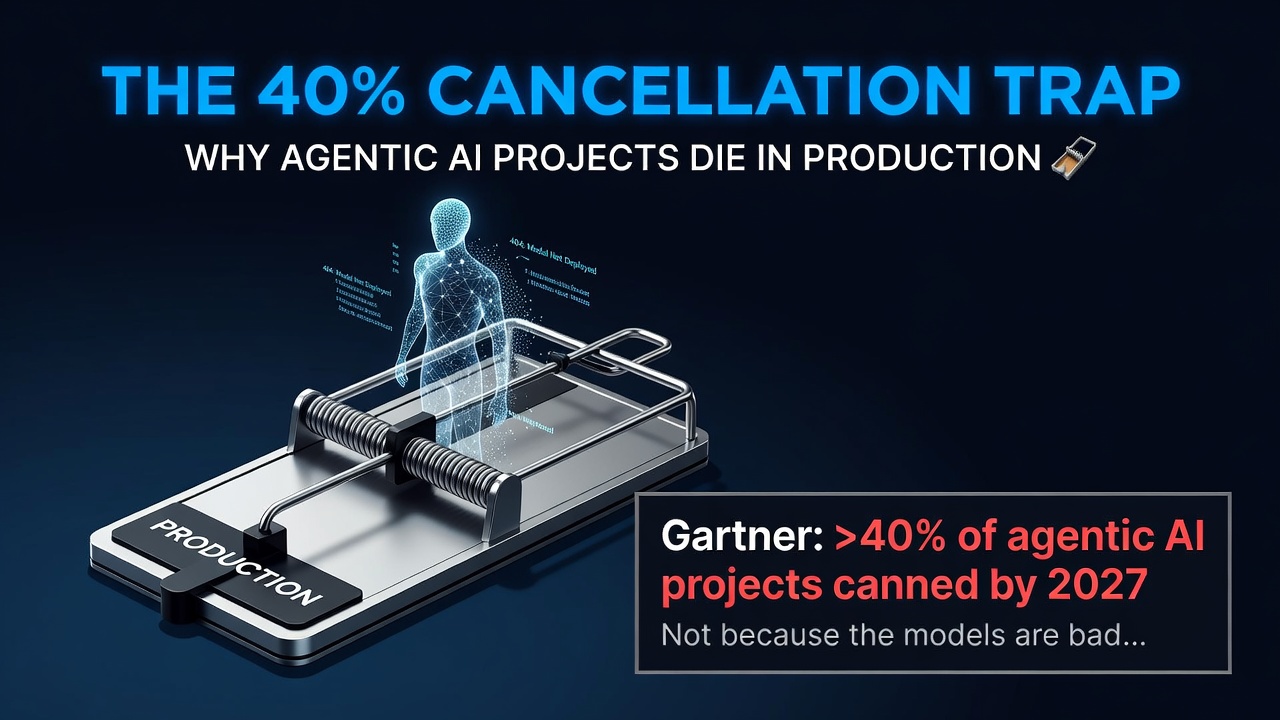
Gartner reckons over 40% of agentic AI projects get canned by 2027. Not because the models are bad. Because nobody built the safety net.
Okay so that stat has been quoted so much it's basically lost its bite by now. But stick with me, because the reason buried inside it is the one most teams still aren't talking about: inadequate risk controls. Not cost. Not "unclear ROI." Risk controls.
If you're building agentic AI for a fintech or healthtech company, that line should worry you more than any of the others, because it's not a demo problem. It's a production problem. And in a regulated shop, production problems don't get killed in a budget review. They get killed in a compliance review.
Key Definitions 🧐
Before we get into why this happens, a few terms worth pinning down.
What's an agentic loop?
The retrieve → evaluate → retrieve-again cycle an agent runs when it's deciding whether it has enough information to answer. Sounds harmless. It's where most of the trouble starts.
What's Evidence Override?
When the retriever actually pulls the right document, hands it to the model, and the model just... doesn't use it properly. Leans on something more familiar instead. The evidence was there. The generation step ignored it.
What's cascading hallucination?
One wrong claim early in a multi-step reasoning chain becomes "context" for every step after it. Each step stays logically consistent with the step before, so the whole thing reads as confident and coherent, right up to the end — even though it was wrong two steps back.

The fear isn't "it doesn't work" 😬
Here's the actual fear, if you're honest about it: it's not that the agent gives a wrong answer. It's that the agent gives a wrong answer that looks right. Well formatted. Internally consistent. Confident. The kind of wrong that sails straight past a reviewer.
In a regulated environment that's not an embarrassing bug you patch on Monday. That's an incident report. That's an audit finding. That's a regulator asking a question you don't have a good answer to.
Pilots survive because someone is watching every single output closely. Production doesn't survive that same way, because nobody can watch every output closely at scale, and the agent has no internal sense of the difference between "confidently right" and "confidently wrong."
The failure everyone assumes vs. the one actually happening

Ask most teams why their RAG agent hallucinated and you'll hear "bad retrieval" almost every time. Wrong chunks got pulled. Fix the chunking, fix the embeddings, ship it.
Current research says that's usually the wrong diagnosis. Evidence Override — the generation-side failure, not the retrieval-side one — shows up several times more often than genuine retrieval failure. The retriever did its job. The correct evidence was sitting right there in context. The model just didn't weight it properly.
That distinction actually matters a lot, because the fix is completely different depending on which one you've got. Retrieval failure gets fixed with better chunking. Generation failure needs something that checks what the model did with the evidence it was handed. That's a validation problem. Not a search problem.
Why agents fail quietly, and APIs never do 🔗
A normal API call fails loudly. It errors out, it times out, you get a status code, you get a stack trace, you know something broke.
An agentic loop fails quietly. It fails by continuing. Without a hard stopping rule, the default answer to "do I have enough?" is always "get more" — so the loop retrieves again, escalates, retrieves again, burning tokens the whole way without necessarily getting any closer to correct.
Worse, the mistakes compound. An early hallucinated claim doesn't just sit there quietly; it becomes the foundation the next reasoning step builds on. The system isn't lying badly. It's reasoning cleanly from a bad premise, all the way to a confident, wrong, and completely traceable-looking conclusion.
Framework choice is a control surface, not a preference 🎲
This is where the tooling you pick actually matters, and it's worth being blunt about it.
CrewAI's default recovery behavior, when a tool call fails, is to retry with the same approach. That can loop forever unless you build custom callbacks yourself to stop it.
LangGraph takes a different route. Its interrupt-and-checkpoint model lets you pause the workflow at a defined point, wait on a human decision, and resume from that exact state. For a regulated environment where every AI decision needs an audit trail behind it, that's just a meaningfully better fit.

A quick composite example 🤓
(Built from patterns we see repeatedly across clients, not any one specific company, just to be clear.)
A healthtech intake agent classified incoming patient documents and routed them to the right internal system. Tested well. High accuracy in the pilot.
In production, an ambiguous document type triggered the "do I have enough to classify this?" loop. The agent re-queried its knowledge base four times, drifting the classification a little further each pass, until it confidently filed the document under the wrong compliance category.
No error thrown. Nothing broke. It just quietly did the wrong thing, cleanly, and moved on.
The reframe
Your agent didn't fail because it couldn't find the right answer. It failed because nothing was watching what it did with the answer once it had it.
That's the shift. The whole industry spent close to two years obsessing over retrieval — better chunking, better embeddings, better vector stores. Retrieval was never the whole problem. The generation step, and the agent's own decision loop, need the same level of scrutiny retrieval already got. Most architectures still don't give it to them.
The fix: a checkpoint, not a patch 🚀
The pattern that actually survives contact with production isn't one validation interceptor bolted between the retriever and the model. It's a checkpoint built directly into the orchestration graph, sitting at every point where the agent makes a decision that actually matters.

Firstly, notice the fallback isn't "retry." Retry is usually what caused the loop to begin with.
Next, the real fallback is a human review queue the agent escalates to on its own, once confidence drops below a threshold or the decision crosses a defined policy boundary — a compliance-sensitive classification, a transaction above a certain size, anything diagnosis-adjacent.
Lastly, the human reviewer sees exactly what the agent saw, approves or rejects it, and the workflow resumes from that exact checkpoint. Which is, not coincidentally, exactly what gives you the audit trail a regulator or an internal compliance team is eventually going to come asking for.
This is the "capability-deployment verification gap" that shows up over and over in the cancellation-risk research: agents that pass every pilot test but were never built with the escalation path production actually needs. The gap was never the model. It's the missing checkpoint. 🔗
Find out where your build actually sits 🔍
If you're not totally sure whether your architecture has this checkpoint, or whether it just has a retry loop dressed up in a checkpoint's clothes, that's exactly what our AI Reliability Scorecard is built to show you.
The Scorecard checks:
- Whether failure gets caught at retrieval, at generation, or not until a human notices downstream
- Whether you have an explicit stopping rule for agentic loops, or you're relying on implicit token/time limits and hoping
- Whether low-confidence or policy-boundary decisions escalate to a real human review queue, or just retry
- Whether every AI-driven decision in your pipeline leaves behind an auditable record of what was seen, decided, and overridden
- How exposed your current architecture is to cascading hallucination across multi-step chains
Take it here: https://www.topiax.xyz/audit
What happens after: you get a scored breakdown by category, not one single grade, mapped straight to the gaps above, plus a short written read on which failure mode is the biggest production risk for your specific stack and industry. If your score flags real exposure, we'll follow up with an invite to a 20-minute call to walk through the checkpoint pattern for your architecture specifically. No pitch deck. Just your results and what we'd fix first.
Thanks for reading this one. If it was useful, share it with whoever on your team owns the "why did the agent do that" conversation. 🙏
0 Comments
Log in to join the conversation.No comments yet. Be the first to share your thoughts.