
[Submitted on 20 Jul 2026 (v1), last revised 24 Jul 2026 (this version, v2)]
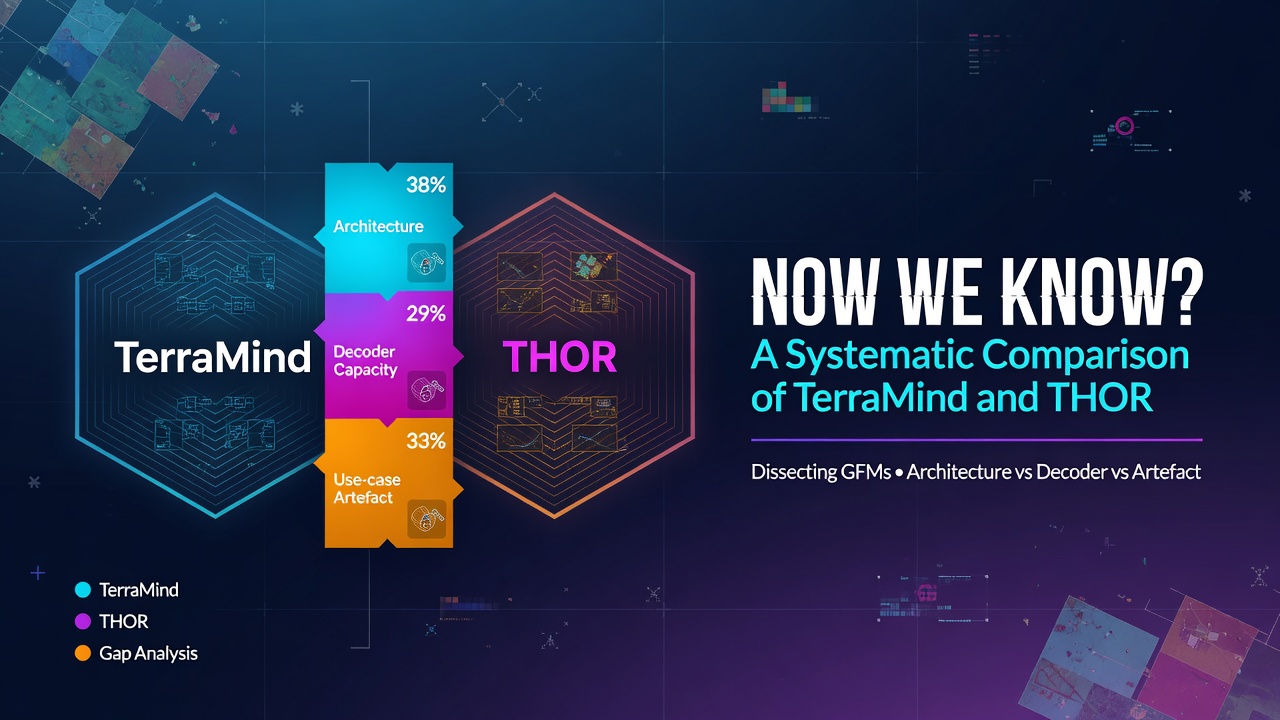
Abstract:Benchmarks for Geospatial Foundation Models (GFMs) increasingly rank models by aggregate score, but such rankings obscure why models differ: how much of the gap is architecture, how much is decoder capacity, and how much is a use-case-specific artefact? This study addresses that gap through a controlled comparison of two GFMs developed under European Space Agency's $\Phi$-lab with contrasting design philosophies: THOR, which introduces a compute-adaptive architecture supporting variable patch sizes and unifies Sentinel-1, -2, and -3 data at their native resolutions; and TerraMind, a multimodal generative GFM pretrained with a dual-scale token/pixel objective that enables any-to-any cross-modal generation (Thinking-in-Modalities) to infer missing sensors at inference time. Rather than reporting a single leaderboard, we investigate the axes along which the two architectures actually differ - patch size, decoder complexity, finetuning regime, input modality, and model scale - across ten use cases spanning segmentation and regression in diverse domains, including climate disaster response, methane leak detection, snow monitoring, or sea ice mapping. We find that architectural design choices - patch size and decoder type in particular - explain more performance variance than model identity itself, that the two models embody complementary investment strategies (pretraining-time scale for TerraMind versus inference-time tokenisation for THOR), and that correctly interpreting results requires dataset-level characterisation. The resulting picture is not a single winner but a set of hypotheses and a diagnostic ablation methodology that we expect to generalise to future GFMs beyond THOR and TerraMind.
Submission history
From: Eva Gmelich Meijling [view email]
[v1]
Mon, 20 Jul 2026 20:55:06 UTC (1,954 KB)
[v2]
Fri, 24 Jul 2026 09:06:53 UTC (1,956 KB)
0 Comments
Log in to join the conversation.No comments yet. Be the first to share your thoughts.