
[Submitted on 24 Jul 2026]
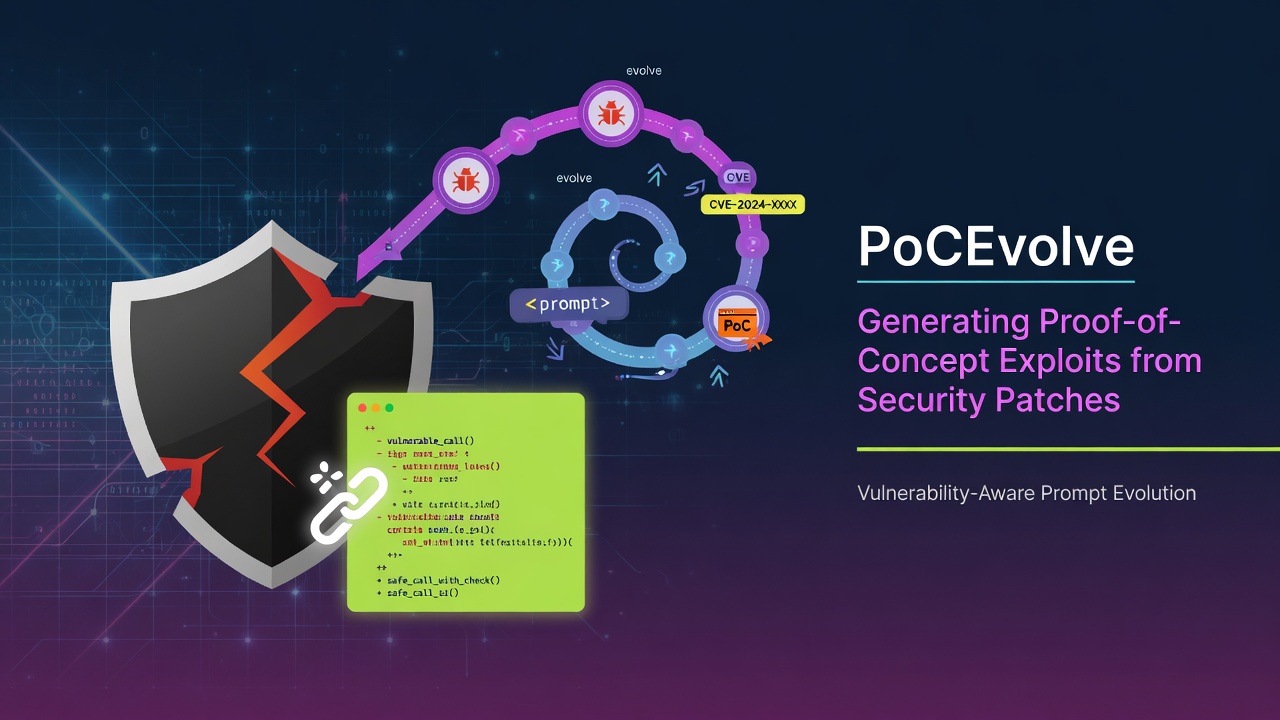
Abstract:Ideally, the detailed information about a vulnerability should be made available together with the fixing commit. In practice, however, such details often become available only long after the commit, even when a CVE has already been published. During this window, the patch is already public, so attackers can reverse-engineer it, yet defenders lack the details needed to assess exposure, prioritize, and validate the fix. Executable evidence, such as a proof-of-concept (PoC) exploit, could fill this gap. Prior work has automated PoC generation, but the state-of-the-art approach, PoCGen, assumes that a detailed vulnerability report is already available, which is precisely what is missing during this window. In this paper, we first present an empirical study quantifying the long delay between the fixing commit and the availability of a detailed vulnerability report. We then introduce PoCEvolve, a vulnerability-aware prompt-evolution framework that generates PoCs directly from vulnerability-fixing commits. Given a vulnerability-fixing commit, PoCEvolve synthesizes a corresponding PoC exploit. To learn from unsuccessful generation attempts, PoCEvolve assesses the usefulness of different dimensions of vulnerability-related context, including the inferred vulnerable API and code-coverage information. These assessments guide prompt evolution towards more effective exploit-generation prompts. We evaluate PoCEvolve on this http URL, where PoCEvolve achieves a PoC generation success rate of 58.4%, corresponding to relative improvements of 20.7% over PoCGen and 200.0% over the LLM baseline with GPT-4o-mini. With a recent model, Qwen3.7-Plus, PoCEvolve achieves a higher success rate of 85.3%. When detailed vulnerability reports are available, PoCEvolve achieves a success rate of 71.7%, improving over PoCGen by 11.1%.
Submission history
From: Duc Manh Tran [view email]
[v1]
Fri, 24 Jul 2026 08:20:28 UTC (1,705 KB)
0 Comments
Log in to join the conversation.No comments yet. Be the first to share your thoughts.