
[Submitted on 10 Feb 2026 (v1), last revised 24 Jul 2026 (this version, v3)]
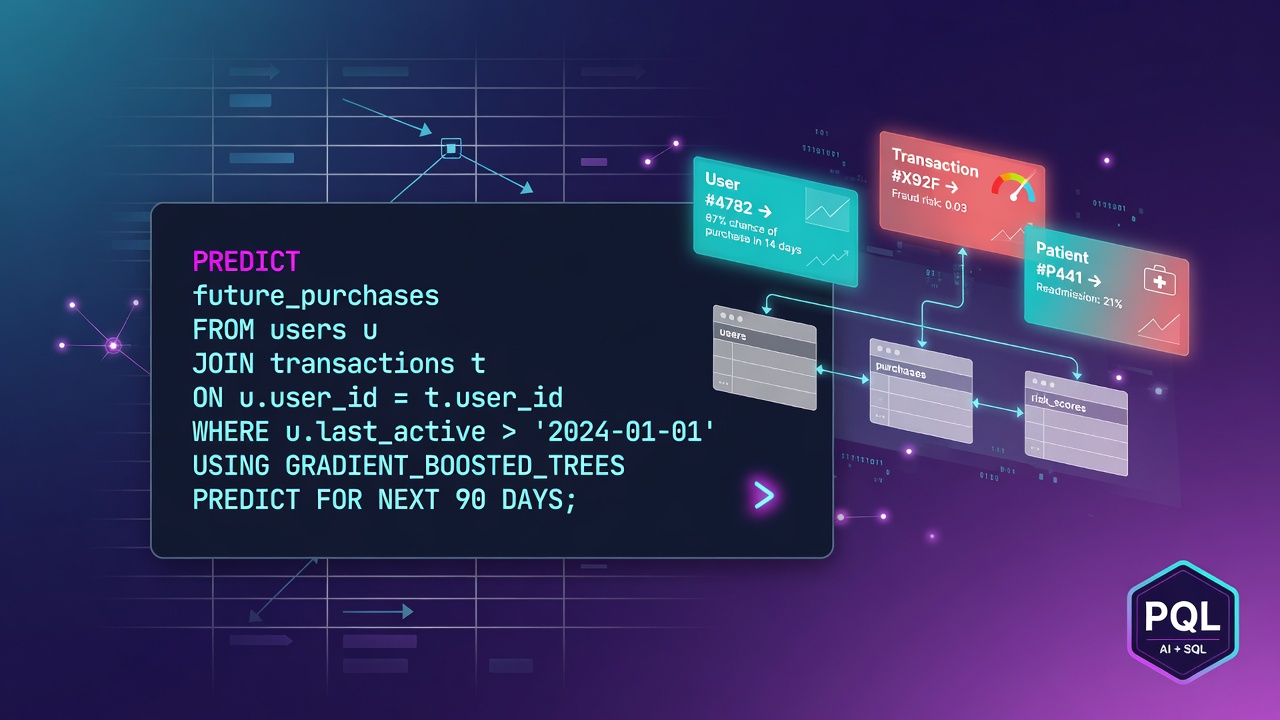
Abstract:The purpose of predictive modeling on relational data is to predict future or missing values in a relational database, for example, future purchases of a user, risk of readmission of the patient, or the likelihood that a financial transaction is fraudulent. Typically powered by machine learning methods, predictive models are used in recommendations, financial fraud detection, supply chain optimization, and other systems, providing billions of predictions every day. However, training a machine learning model requires manual work to extract the required training examples - prediction entities and target labels - from the database, which is slow, laborious, and prone to mistakes. Here, we present the Predictive Query Language (PQL), an SQL-inspired declarative language for defining predictive tasks on relational databases. PQL allows specifying a predictive task in a single declarative query, enabling the automatic computation of training labels for a large variety of machine learning tasks, such as regression, classification, time-series forecasting, and recommender systems. PQL is already successfully integrated and used in a collection of use cases as part of a predictive AI platform. The versatility of the language can be demonstrated through its many ongoing use cases, including financial fraud, item recommendations, and workload prediction. We demonstrate its versatile design through two implementations; one for small-scale, low-latency use and one that can handle large-scale databases.
Submission history
From: Vid Kocijan [view email]
[v1]
Tue, 10 Feb 2026 09:22:17 UTC (222 KB)
[v2]
Mon, 16 Feb 2026 10:18:23 UTC (222 KB)
[v3]
Fri, 24 Jul 2026 09:08:00 UTC (223 KB)
0 Comments
Log in to join the conversation.No comments yet. Be the first to share your thoughts.