
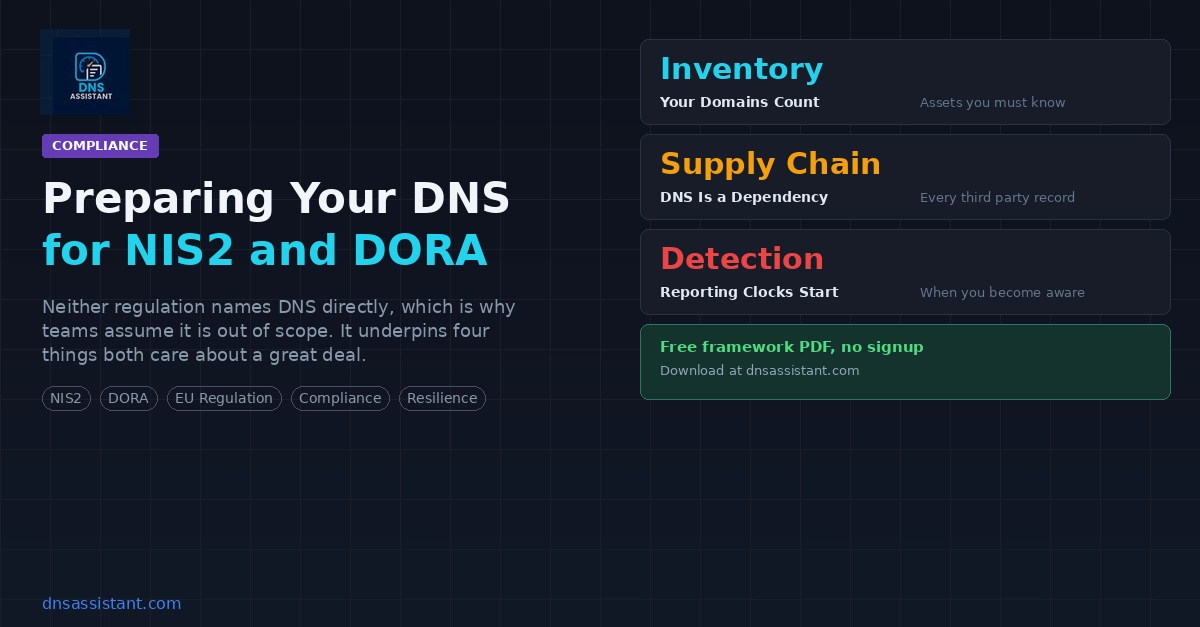
Two European regulations have changed what organizations are expected to prove about their security. NIS2 broadens the scope of cybersecurity obligations across a wide range of sectors and supply chains. DORA sets operational resilience requirements for financial entities and the technology providers they depend on. Both share a common theme: it is no longer enough to have security controls. You have to be able to evidence that they work, continuously, and to report when they fail.
DNS sits awkwardly inside these requirements. It is rarely named explicitly, which leads many teams to assume it falls outside scope. In practice, DNS underpins several things both regulations care about a great deal: asset inventory, supply chain dependencies, incident detection, and service continuity. If your DNS is unmonitored, you have a gap in exactly the areas an assessor will probe.
This article covers what NIS2 and DORA expect in general terms, where DNS intersects those expectations, and how to prepare. It is a practical guide rather than a legal one, and the note at the end explains why you should treat it that way.
What the Two Regulations Are Asking For
The two frameworks differ in scope and detail, but for the purposes of DNS preparation their demands converge.
NIS2 extends EU cybersecurity requirements to a far wider set of sectors than its predecessor, and places significant emphasis on risk management, supply chain security, and incident reporting. A recurring theme is accountability: organizations are expected to understand their own attack surface, manage the risk introduced by third parties, and detect and report significant incidents within tight timeframes.
DORA focuses on digital operational resilience in the financial sector, covering financial entities and critical technology providers serving them. Its emphasis falls on ICT risk management, third party dependency management, incident classification and reporting, and the ability to keep operating through disruption.
Strip both back and four expectations emerge that DNS touches directly:
- Know your assets. You cannot manage risk on infrastructure you have not inventoried.
- Manage third party dependency. Understand and monitor what you rely on outside your own perimeter.
- Detect and report incidents. Identify problems quickly enough to meet reporting timeframes.
- Maintain continuity. Keep critical services available and recover when they fail.
Where DNS Intersects Each Expectation
Asset Inventory Includes Your Domains
Every domain and subdomain you own is an internet facing asset. Most organizations cannot produce a complete list of theirs, because subdomains accumulate through marketing campaigns, development environments, retired SaaS tools, and acquisitions. That gap is the shadow DNS problem, and under a regime that expects you to understand your attack surface, an incomplete inventory is a finding waiting to happen.
Preparation means moving from a documented list of what you think you own to an actively discovered picture of what actually exists and resolves.
DNS Is a Supply Chain Surface
Supply chain risk is central to NIS2 and to DORA's third party provisions, and DNS is where a surprising amount of that dependency lives. Every CNAME pointing at a SaaS platform, every delegation to an external nameserver, every record aimed at a cloud provider is a third party dependency expressed in DNS.
When one of those services is decommissioned and the record remains, the dependency becomes an exposure: a dangling record vulnerable to subdomain takeover, where an attacker serves content from a subdomain of your own trusted domain. That is a supply chain failure with a direct security consequence, and it is invisible to anything that only checks whether your site is up.
Incident Detection Depends on Noticing Changes
Both regulations expect prompt detection and reporting of significant incidents. Reporting clocks generally start when you become aware of something, which makes the speed of detection a compliance concern rather than only an operational one.
DNS changes can be the earliest visible sign of compromise. An unauthorized record change, a nameserver switch, a registrar modification, or a sudden alteration to email authentication can each indicate an attacker with access. If nobody is watching, you might not become aware for days, and everything downstream of awareness is delayed with it.
Continuity Runs Through DNS
Resilience requirements assume your services stay available. DNS failure takes everything with it. The classic causes are mundane rather than exotic: a domain lapses because a renewal notice reached an unmonitored inbox, or a DNSSEC signature expires and the domain stops resolving for validating resolvers. We cover the first in our piece on domain expiration as a silent risk, and the mechanics of the second in our DNSSEC guide.
A Practical Preparation Path
Five steps take you from an unmonitored DNS estate to one you can evidence.
1. Establish a real inventory. Discover every domain and subdomain rather than relying on documentation. Include assets inherited through acquisitions, which are often the least documented part of an estate. Assign an owner to each, and treat anything without one as a candidate for removal.
2. Map your DNS dependencies. Identify every record pointing at a third party. This is both a supply chain inventory and the working list for finding dangling records. Confirm each target is still a service you use and still under your control.
3. Turn on continuous detection. Move from periodic checks to real time monitoring for record changes, new subdomains, dangling records, expiry, DNSSEC validity, and email authentication drift. Detection speed is what makes reporting timeframes achievable.
4. Route DNS events into your incident process. Detection only counts if it reaches the people who respond. Feed DNS alerts into the channels and systems your security team already uses, so a DNS event enters the same triage flow as any other signal rather than sitting in an isolated console.
5. Keep evidence as a byproduct. Maintain a record of what changed and when, and be able to export the current state of your estate on demand. Evidence gathered continuously is far cheaper than evidence reconstructed under deadline, which is the core argument in our guide to building a continuous DNS compliance program. For the periodic human review that sits on top, our quarterly DNS audit checklist gives you a repeatable structure.
Free Template: DNS Compliance and Governance Framework
To structure this work, we publish a free DNS Compliance and Governance Framework as a shareable PDF. It includes a roles and responsibilities matrix, a control checklist with recommended frequencies, a risk scoring matrix with remediation targets, and a summary mapping to SOC 2, ISO 27001, NIS2, DORA, and PCI-DSS. No signup required, and it is free to circulate inside your organization.
Download the DNS Compliance and Governance Framework (PDF)
Where DNS Assistant Fits
DNS Assistant is a continuous monitoring and visibility layer for DNS. It supplies the detection and evidence that these preparations depend on, while the governance decisions and the compliance program itself remain yours to run.
- Subdomain discovery builds the inventory your documentation does not have, surfacing subdomains you had lost track of.
- Dangling DNS and subdomain takeover detection across 22+ cloud providers turns your third party DNS dependencies into a monitored list rather than an assumption.
- Continuous change detection across record types, with real time alerts by email, Slack, Microsoft Teams, SMS, and webhooks, so detection is fast enough to matter for reporting.
- SIEM integration via API and webhooks, push and pull, so DNS events reach the systems your responders already work in.
- DNSSEC validation, TLS posture, and email authentication checks, covering the configuration failures that break continuity and trust.
- WHOIS and expiration monitoring, independent of registrar notifications.
- A viewable change history and data export in CSV, Excel, or PDF, giving you records to attach to your own documentation.
- Multi-tenant, role based access for organizations managing DNS across teams or entities.
Two boundaries worth stating plainly. DNS Assistant detects and alerts on changes rather than gating them, so change approval remains part of your own workflow. And its exports are data you use as evidence, not reports pre-mapped to specific NIS2 or DORA articles. What it removes is the manual effort of discovery and watching; the judgment stays with you.
Start With Visibility
You can inspect a domain you already know about, its records, DNSSEC status, email authentication, and TLS posture, using the free DNS lookup tool or a Free Domain Risk Report. That is a reasonable way to begin assessing a single domain today.
For the parts that require discovery and continuous coverage across an estate, finding forgotten subdomains and catching dangling records as they appear, start free at dnsassistant.com.
This article is general information about how DNS relates to common themes in NIS2 and DORA. It is not legal or regulatory advice, and it does not attempt to interpret specific obligations. Scope, applicability, and requirements vary by sector, entity type, and national implementation. Confirm how these regulations apply to your organization with qualified legal or compliance advisors.
0 Comments
Log in to join the conversation.No comments yet. Be the first to share your thoughts.