
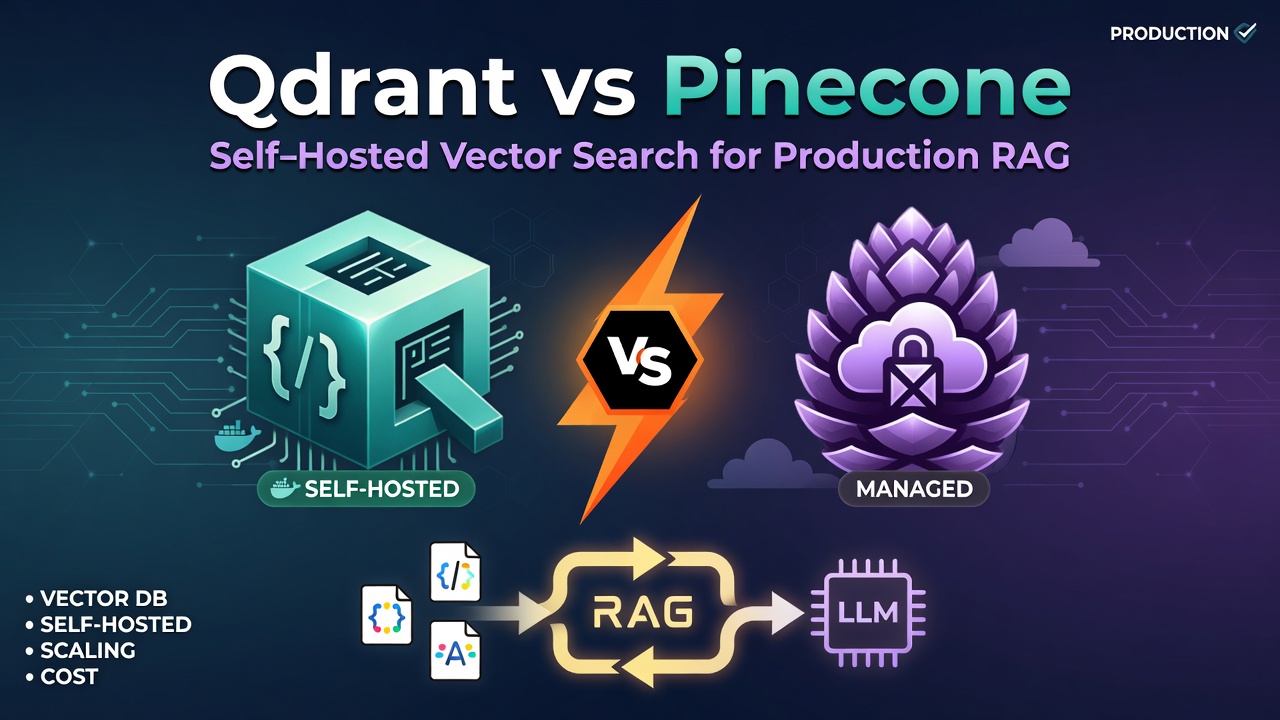
If you're building a production retrieval-augmented generation (RAG) system, the Qdrant vs Pinecone decision is one of the few infrastructure choices you'll live with for years. Both are capable vector databases, but they sit on opposite ends of the operational spectrum: Qdrant is an open-source engine you can self-host, while Pinecone is a fully managed, cloud-only service with no self-hosting option at all. That single distinction cascades into almost every other tradeoff — cost structure, latency ceilings, data residency, and how much engineering time you'll spend on database operations instead of product features.
This post goes past the usual feature-matrix comparison: what each system is, how their architectures differ under load, what self-hosting Qdrant really costs in engineering time, how pricing diverges at scale, and a decision framework you can use without a six-week bake-off.
What Qdrant and Pinecone Actually Are
Qdrant is an open-source vector search engine written in Rust, distributed under Apache 2.0. You can run it as a single Docker container on a laptop, deploy a clustered version across your own Kubernetes infrastructure, or pay for Qdrant Cloud, the company's managed hosting product. Because the core engine is open source, there's no vendor lock-in at the software layer. Qdrant stores vectors alongside a flexible JSON payload, and supports both dense and sparse vector search natively, with a query API that combines the two in one request.
Pinecone is a proprietary, fully managed vector database delivered as a cloud API. There's no binary to download and run yourself; every index lives in Pinecone's infrastructure, built on AWS, with serverless indexes available in specific regions. You interact with it exclusively through their SDK or REST API, and capacity, replication, and index maintenance are entirely abstracted away. Pinecone's pitch is operational simplicity: create an index, upsert vectors, query — no cluster sizing, no node upgrades, no storage tuning. That "control-everything" versus "control-nothing" framing is the lens for the rest of this comparison.
For canonical setup details, see the official Qdrant documentation and the Pinecone documentation — both are kept current with each release and are the best source for API-level specifics that go beyond this comparison.
Architecture Differences
Qdrant's storage engine separates vector indexing (HNSW, with an optional quantization layer) from payload storage, and lets you choose between in-memory and on-disk indexes per collection. A collection of 50 million 768-dimensional embeddings kept fully in RAM behaves very differently, cost- and latency-wise, than the same collection on-disk with memory-mapped payloads. It also supports sharding and replication natively in clustered mode via Raft-based consensus, which means you're responsible for choosing shard counts and replication factors up front — decisions that are hard to change without a reindex later.
Pinecone's architecture is intentionally opaque from the outside. Pod-based indexes require picking a pod type and size, similar to choosing a Qdrant node's RAM and CPU. Serverless indexes, Pinecone's newer default, decouple storage from compute and auto-scale query capacity — removing the shard-sizing decision but also your ability to reason precisely about cost and latency ceilings under load. In short: with Qdrant you own the capacity-planning problem; with Pinecone you delegate it and accept whatever headroom their autoscaler gives you.
Self-Hosting Operational Cost and Complexity (Qdrant)
This is the part most comparison articles skip, and it's the one that determines whether Qdrant vs Pinecone is a fair fight for your team. Self-hosting Qdrant is not "free" just because the software has no license fee — you're taking on:
- Infrastructure provisioning — nodes sized for vector count and dimensionality, plus disk I/O tuned for the chosen index mode.
- Cluster operations — version upgrades, Raft consensus health, snapshot backups, node failure and replacement.
- Capacity planning — forecasting growth and resharding before hitting memory or disk ceilings, often meaning a full reindex.
- Security and networking — TLS termination, API key rotation, network policies, keeping the service off the public internet.
- On-call coverage — someone owns the 2am page when a node runs low on memory or a shard goes unhealthy.
For a small team, this is realistically half a person's ongoing attention, more during the first few months of tuning index parameters and quantization settings. Qdrant Cloud exists specifically to remove this burden while keeping the open-source engine underneath. The honest comparison isn't "Qdrant is free, Pinecone costs money" — it's "Qdrant lets you trade cash for engineering time, and Pinecone forces you to spend cash instead." Whether that trade is worth it depends on whether your team has spare infrastructure capacity and database operations experience on hand.
Pricing Model Differences
Pinecone's pricing is consumption-based: you pay for reads, writes, and storage on serverless indexes, or for pod-hours on the legacy pod-based model, plus a free tier that's genuinely useful for prototyping. Costs scale roughly linearly with query volume and stored vector count — you get a bill, not a capacity plan. This suits bursty workloads well, since you're not paying for idle capacity, but it also means a viral traffic spike or a runaway batch job can produce a startling invoice with little warning.
Qdrant's cost structure depends on the deployment mode. Self-hosted open-source Qdrant costs whatever your underlying compute and storage costs, plus the operational labor described above — there's no per-query fee at all. Qdrant Cloud reintroduces a managed-service pricing model closer to Pinecone's, typically priced around cluster size (RAM/CPU/disk) rather than per-query volume. A high-QPS, low-vector-count workload can be dramatically cheaper on self-hosted or Qdrant Cloud, since you're paying for fixed capacity rather than per read, while a low-QPS, high-vector-count workload with unpredictable spikes may be cheaper on Pinecone's model. Any credible pricing comparison has to be workload-specific — vector count, query volume, and payload size all shift which one wins.
Performance and Latency Characteristics
Both systems are built around HNSW-style approximate nearest neighbor search and are capable of sub-50ms query latency at moderate scale (low millions of vectors, reasonable dimensionality) when properly configured. Beyond that baseline, the practical differences show up in edge cases rather than steady-state throughput:
- Cold starts. Pinecone serverless indexes can see elevated latency on the first queries after a period of inactivity, since compute scales down when idle. Qdrant, self-hosted or on Qdrant Cloud, generally runs on persistently allocated resources — no cold-start penalty, but you pay for always-on capacity whether or not it's used.
- Index rebuild costs. A large batch of new vectors, or a changed distance metric or quantization setting, can trigger a full or partial HNSW rebuild in either system. With self-hosted Qdrant you feel this directly — CPU and memory spike visibly, and you can schedule around it. With Pinecone, rebuild behavior is managed internally, which is convenient until you need to explain a deployment that briefly saw degraded recall after a large upsert.
- Tail latency under load. Because you control sharding and replication factor directly in Qdrant, you can over-provision replicas to flatten p99 latency for a latency-sensitive endpoint. Pinecone's serverless model handles this for you, but you're relying on their infrastructure to react correctly to your traffic shape.
Neither vendor publishes an apples-to-apples benchmark across dataset sizes and filtering complexity, so treat any specific number — including the figures above — as directional, not a guarantee. Always benchmark with your own embeddings, filter patterns, and concurrency profile before committing.
Filtering and Hybrid Search
Production RAG systems almost never do pure vector search — you're filtering by tenant ID, document type, date range, or access-control attributes alongside the similarity query, and increasingly combining dense embeddings with sparse (keyword-style) vectors for hybrid search.
Qdrant supports rich payload filtering natively, including nested JSON fields, geo filters, full-text match, and range queries, all combinable with boolean logic in a single request. It also has first-class support for sparse vectors and a dedicated hybrid query API that fuses dense and sparse results server-side, so no separate reranking step is needed in application code.
Pinecone supports metadata filtering with a similar set of operators (equality, range, "in", logical combinators), and added native sparse-dense hybrid support as well, with a configurable weighting (alpha parameter) between vector types. The filtering syntax and hybrid mechanics differ enough between the two that migrating filter logic is a genuine rewrite of your query-building layer, not a copy-paste exercise.
For complex, deeply nested filter conditions — think multi-tenant SaaS with per-customer document taxonomies — Qdrant's filter engine is generally more expressive out of the box. For teams that just want hybrid search without hand-tuning fusion logic, both platforms now handle it well enough that this is no longer the strong differentiator it was a couple of years ago.
Code Example: Qdrant Client Setup and Query
from qdrant_client import QdrantClient
from qdrant_client.models import VectorParams, Distance, PointStruct

client = QdrantClient(url="https://your-cluster.qdrant.io", api_key="YOUR_API_KEY")

# Create a collection (one-time setup)
client.create_collection(
    collection_name="support_docs",
    vectors_config=VectorParams(size=768, distance=Distance.COSINE),
)

# Upsert a document embedding with metadata payload
client.upsert(
    collection_name="support_docs",
    points=[
        PointStruct(
            id=1,
            vector=[0.014, -0.032, 0.221],  # 768-dim embedding
            payload={"tenant_id": "acme-corp", "doc_type": "faq", "lang": "en"},
        )
    ],
)

# Similarity search with a metadata filter
results = client.query_points(
    collection_name="support_docs",
    query=[0.011, -0.029, 0.218],  # query embedding
    query_filter={
        "must": [
            {"key": "tenant_id", "match": {"value": "acme-corp"}},
            {"key": "lang", "match": {"value": "en"}},
        ]
    },
    limit=5,
)

for point in results.points:
    print(point.id, point.score, point.payload)
Enter fullscreen mode Exit fullscreen mode
Code Example: Pinecone Client Setup and Query
from pinecone import Pinecone, ServerlessSpec

pc = Pinecone(api_key="YOUR_API_KEY")

# Create a serverless index (one-time setup)
pc.create_index(
    name="support-docs",
    dimension=768,
    metric="cosine",
    spec=ServerlessSpec(cloud="aws", region="us-east-1"),
)

index = pc.Index("support-docs")

# Upsert a document embedding with metadata
index.upsert(
    vectors=[
        {
            "id": "1",
            "values": [0.014, -0.032, 0.221],  # 768-dim embedding
            "metadata": {"tenant_id": "acme-corp", "doc_type": "faq", "lang": "en"},
        }
    ]
)

# Similarity search with a metadata filter
results = index.query(
    vector=[0.011, -0.029, 0.218],  # query embedding
    filter={
        "tenant_id": {"$eq": "acme-corp"},
        "lang": {"$eq": "en"},
    },
    top_k=5,
    include_metadata=True,
)

for match in results["matches"]:
    print(match["id"], match["score"], match["metadata"])
Enter fullscreen mode Exit fullscreen mode
Code Example: Hybrid Search (Dense + Sparse) in Qdrant
For RAG systems where exact keyword matches matter as much as semantic similarity — product SKUs, error codes, proper nouns — combining dense and sparse vectors typically outperforms dense-only search. Here's a hybrid query against Qdrant using a named dense vector and a sparse vector together, fused server-side:
from qdrant_client import QdrantClient
from qdrant_client.models import (
    NamedVector, SparseVector, FusionQuery, Fusion, Prefetch
)

client = QdrantClient(url="https://your-cluster.qdrant.io", api_key="YOUR_API_KEY")

dense_query = [0.011, -0.029, 0.218]  # e.g. from an embedding model
sparse_indices = [102, 7841, 33]      # token ids from a sparse encoder (e.g. SPLADE)
sparse_values = [0.42, 1.85, 0.61]

results = client.query_points(
    collection_name="support_docs",
    prefetch=[
        Prefetch(query=dense_query, using="dense", limit=20),
        Prefetch(
            query=SparseVector(indices=sparse_indices, values=sparse_values),
            using="sparse",
            limit=20,
        ),
    ],
    query=FusionQuery(fusion=Fusion.RRF),  # reciprocal rank fusion
    query_filter={
        "must": [{"key": "tenant_id", "match": {"value": "acme-corp"}}]
    },
    limit=5,
)

for point in results.points:
    print(point.id, point.score, point.payload)
Enter fullscreen mode Exit fullscreen mode
Scaling Considerations
Scaling Qdrant is a capacity-planning exercise you own. Horizontal scaling means adding shards and rebalancing, but requires planning shard count ahead of major growth, since resharding an existing collection isn't a live, zero-cost operation. Vertical scaling means bigger nodes with more RAM for in-memory indexes, or faster NVMe storage for on-disk indexes with quantization. Multi-tenancy works either through payload-based filtering within a shared collection (efficient for many small tenants) or per-tenant collections (better isolation, more overhead at high tenant counts) — you decide that tradeoff explicitly.
Scaling Pinecone is largely automatic on serverless indexes — you don't choose shard counts or node sizes, and the platform scales query capacity based on observed load. The tradeoff is less control over how scaling behaves under unusual traffic. Pinecone also supports namespaces within an index as a lighter-weight multi-tenancy primitive, which works well for large numbers of small-to-medium tenants.
For data residency and on-prem requirements — a real constraint for healthcare, government, and financial services clients — Qdrant is the only one of the two that can be deployed entirely within your own infrastructure, including air-gapped environments. Pinecone requires data to live in their cloud, with no on-prem option. If regulation mandates that vector embeddings — which can leak sensitive information about source documents — never leave a specific jurisdiction, that constraint alone often settles the question before performance or pricing enter the conversation.
Comparison Table
| Dimension | Qdrant | Pinecone |
|---|---|---|
| Hosting model | Self-hosted (Docker/Kubernetes) or Qdrant Cloud (managed) | Fully managed cloud only, no self-hosting option |
| Pricing structure | Infrastructure cost (self-hosted) or cluster-size-based (Qdrant Cloud); no per-query fee | Consumption-based (reads/writes/storage) with a free tier |
| Open source status | Apache 2.0, fully open source core engine | Proprietary, closed source |
| Filtering support | Rich payload filtering: nested JSON, geo, full-text, boolean logic | Metadata filtering with equality, range, "in", and logical operators |
| Hybrid search | Native dense + sparse fusion (RRF and other methods) in one query | Native dense + sparse with configurable alpha weighting |
| Typical latency | Sub-50ms at moderate scale; no cold starts on persistent deployments | Sub-50ms at moderate scale; possible cold-start latency on serverless |
| Scaling approach | Manual shard/replica planning; full control, full responsibility | Largely automatic on serverless indexes; less visibility into internals |
| Data residency / on-prem | Supported, including air-gapped deployments | Not supported; data stays in Pinecone's cloud regions |
Decision Framework: When to Choose Each
Boiled down, the decision comes down to a short checklist. Choose Pinecone when your team wants to minimize time spent on database operations, your traffic is unpredictable or bursty and you'd rather pay per-query than provision idle capacity, you have no data residency constraint, and you're optimizing for time-to-production over infrastructure control — a strong default for startups shipping a RAG feature without a dedicated infrastructure function.
Choose Qdrant when data must stay within your own network boundary (regulated industries, government contracts, strict data-residency law), when query volume is high and steady enough that fixed-capacity pricing beats consumption pricing, when you need filtering or index-tuning control a black-box service won't expose, or when avoiding long-term vendor lock-in is a strategic priority. Qdrant Cloud is a middle path — open-source flexibility without owning the lowest-level operations.
In practice the deciding question isn't "which is faster" — both are fast enough for most RAG workloads — it's whether your team has the headcount to run infrastructure, and whether a hard requirement forces one option off the table.
Migration Considerations
If you're moving between the two, the migration is more than a data export. Plan for:
- Re-embedding, usually not required — vectors are portable as raw arrays, but you still need to export and re-upsert every vector plus its metadata, a nontrivial batch job at tens of millions of vectors, with its own rate limits and retry logic.
- Filter syntax rewrites — Qdrant's filter DSL and Pinecone's metadata filter operators aren't compatible; your query-building layer needs a genuine rewrite, not a find-and-replace.
- Index configuration decisions — moving to Qdrant means choosing distance metric, quantization, and shard count explicitly; moving to Pinecone means choosing pod-based versus serverless.
- Hybrid search reimplementation — sparse-vector and fusion-ranking logic differs enough between platforms that it needs to be rebuilt and re-tested, not ported.
- Cutover strategy — run a dual-write period, verify recall parity before switching read traffic, and keep the old system as a rollback path for at least one full traffic cycle.
- Downtime budget — dual writes can make the cutover zero-downtime, but a naive switch risks stale results, which is especially damaging for RAG since silently wrong retrieval degrades answers without an obvious error.
Teams that treat migration as "export vectors, import vectors" consistently underestimate the work in the filtering and hybrid search layers — that's usually where the real engineering time goes.
Closing Thoughts
There's no universally correct answer here — the right choice depends on your team's operational capacity, your data residency requirements, and how predictable your query volume is. Qdrant rewards teams willing to own infrastructure in exchange for control, cost efficiency at scale, and deployment flexibility, including full on-prem support. Pinecone rewards teams that want to ship fast and never think about cluster health again, at the cost of vendor lock-in. Both are mature, production-ready systems — the deciding factors here are organizational, not technical.
If you're weighing this decision for a production RAG system and want a second opinion grounded in real deployment experience rather than vendor marketing, my AI integration services work can help you benchmark both options against your actual data before you commit.
0 Comments
Log in to join the conversation.No comments yet. Be the first to share your thoughts.