
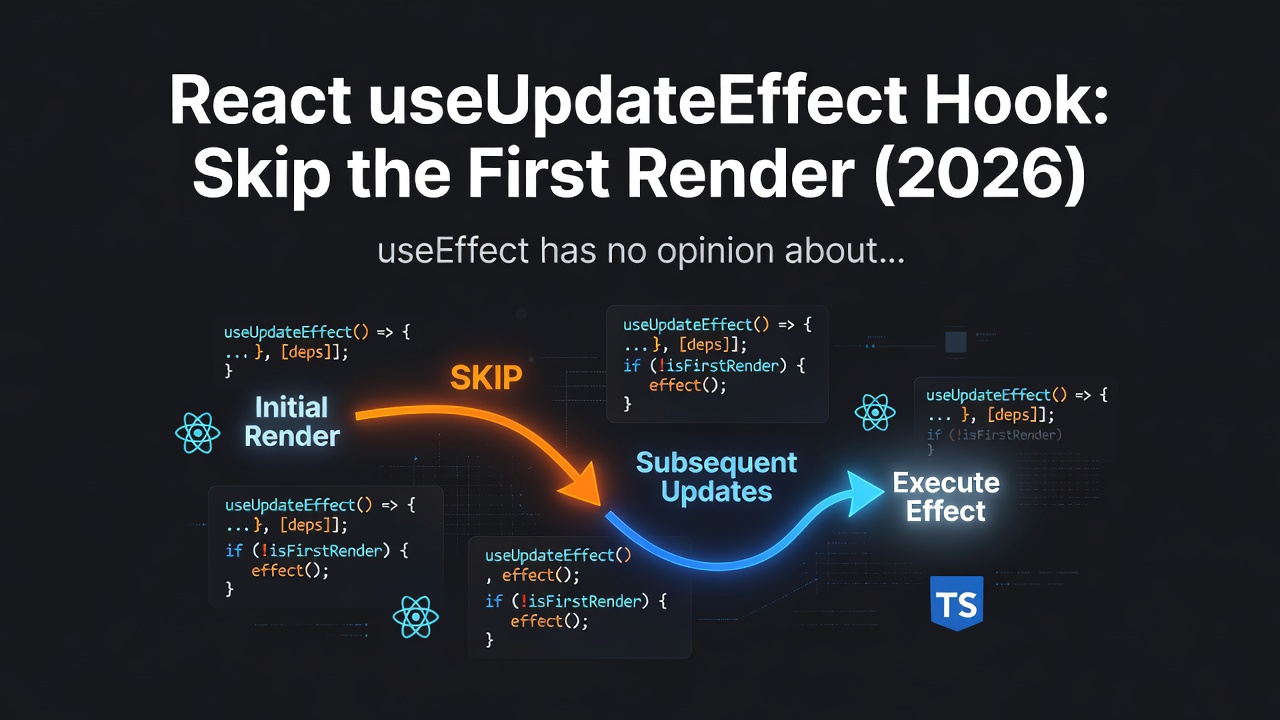

React useUpdateEffect Hook: Skip the First Render (2026)
useEffect has no opinion about why it's running. Mount, update, doesn't matter — the callback fires either way. Which is how a "settings saved ✓" toast greets users the moment the page loads, an autosave POSTs a form nobody has touched yet, and an analytics event reports a "change" that was actually just the component appearing. What you meant was run this when the value changes; what you wrote was run this when the value changes, and also once at the start for no reason.
useUpdateEffect from @reactuses/core is useEffect minus the mount run: identical signature, identical cleanup semantics, skips exactly one invocation. The implementation is four lines, so this post covers what those four lines do, the one place the abstraction genuinely leaks — React 18 StrictMode, where we'll prove with a test that the callback does fire on mount in development — and the neighboring hooks people confuse it with. TypeScript-first.
The Hand-Rolled Guard
There's no mystery about how to skip a mount run — every React codebase past a certain age contains this:
function SearchFilters({ filters }: { filters: Filters }) {
  const isFirst = useRef(true);

  useEffect(() => {
    if (isFirst.current) {
      isFirst.current = false;
      return;
    }
    trackEvent("filters_changed", filters); // not on page load, please
  }, [filters]);
  // ...
}
Enter fullscreen mode Exit fullscreen mode
It works. The problem isn't correctness, it's that the guard is per effect: the ref, the check, and the flip get re-typed into every effect that needs the behavior, and the actual intent — three words, "skip the mount" — is buried under six lines of ceremony. Variants of the recipe also rot in review: someone "simplifies" the flag into useState and buys an extra render, or copies the guard into a second effect but shares one ref between them, so whichever effect runs first consumes the skip and the other one fires on mount anyway.
The fix is the standard one for boilerplate with a name: give it the name.
useUpdateEffect — useEffect, Minus the Mount
import { useState } from 'react';
import { useUpdateEffect } from '@reactuses/core';

function EditorSettings({ userId }: { userId: string }) {
  const [settings, setSettings] = useState(loadDefaults);

  useUpdateEffect(() => {
    saveSettings(userId, settings);
    toast("Settings saved ✓");
  }, [settings]);

  return <SettingsForm value={settings} onChange={setSettings} />;
}
Enter fullscreen mode Exit fullscreen mode
On mount: nothing — no phantom save, no toast over a form the user hasn't touched. On every settings change after that: exactly what useEffect would do. The signature is useEffect's, verbatim:
function useUpdateEffect(effect: React.EffectCallback, deps?: React.DependencyList): void;
Enter fullscreen mode Exit fullscreen mode
Dependency array, cleanup function returned from the effect, all of it behaves the way your useEffect instincts say it should. There is nothing new to learn, which is the point.
Four Lines, One Primitive
The implementation is a wrapper so thin it's almost embarrassing to walk through — almost:
const createUpdateEffect = (hook) => (effect, deps) => {
  const isFirstMount = useFirstMountState();

  hook(() => {
    if (!isFirstMount) {
      return effect();
    }
  }, deps);
};

export const useUpdateEffect = createUpdateEffect(useEffect);
Enter fullscreen mode Exit fullscreen mode
And the primitive underneath, useFirstMountState, which answers "is this the first render?" by flipping a ref during render:
export const useFirstMountState = (): boolean => {
  const isFirst = useRef(true);
  if (isFirst.current) {
    isFirst.current = false;
    return true;
  }
  return isFirst.current;
};
Enter fullscreen mode Exit fullscreen mode
Two details are worth pausing on. First, the effect itself still runs on mount — React registers it, diffs the deps, schedules the callback as usual. What's skipped is your function inside it. That matters because it means the deps array is live from render one; the second render's diff has something real to compare against. Second, createUpdateEffect is a factory over the effect hook, which is how useUpdateLayoutEffect exists: same skip, useLayoutEffect timing, for when the update-only work measures or mutates the DOM before paint.
Cleanup follows from "your callback never ran": there's nothing to clean up after mount, so the first cleanup runs before the second update-run of your effect — and on unmount, if your effect has run at least once, its cleanup fires normally. The library's own test suite pins that down.
The StrictMode Gotcha — Verified, Not Rumored
Here's the section most useUpdateEffect write-ups skip, and it's the one that will actually bite you. Wrap the component in <StrictMode> on React 18+ and run it in development:
const effect = jest.fn();

function Comp() {
  const [c, setC] = useState(0);
  useUpdateEffect(() => { effect(c); }, [c]);
  // ...
}

render(<StrictMode><Comp /></StrictMode>);
// effect.mock.calls.length === 2   ← on MOUNT. Twice.
Enter fullscreen mode Exit fullscreen mode
That's not a hypothetical — it's the output of a test against the real implementation. The "skip the first run" hook runs on mount, twice, in StrictMode dev. Here's the chain:
- StrictMode double-invokes the render function. The first invocation flips the ref:
useFirstMountStatereturnstrue. The second invocation — same component instance, same ref — finds it already flipped and returnsfalse. Instrumenting the hook shows exactly[true, false]across the two passes. - The committed render is the second one, so the effect closure captures
isFirstMount === false. The guard is already defeated before any effect runs. - StrictMode then runs effects twice (mount → simulated unmount → remount), and both runs sail through the open guard. Two calls.
Before you file the bug: this isn't a reactuse defect, it's the collision StrictMode exists to cause. Flipping a ref during render is how essentially every ref-based first-mount detector works, and "how many times has this function rendered" is precisely the kind of hidden render-count dependency StrictMode's double-invocation is designed to smoke out. Production builds don't double-invoke, so in production the skip works exactly as advertised — the divergence is dev-only.
The practical guidance:
- Use
useUpdateEffectfor UX-grade skips — toasts, autosaves, analytics, refetch-on-filter-change. A dev-only extra firing costs you nothing real, and in production it behaves. - Don't use it for correctness-grade guarantees — "this network call must never happen at mount" enforced only by
useUpdateEffectwill happen at mount on every StrictMode dev run, and you'll burn an afternoon on it. Correctness wants a condition on data, not on render count: compare against the previous value withusePrevious, or check the actual state ("form is dirty") before firing.
If you've ever seen a "my useUpdateEffect runs on mount!" issue on a hooks library — this is what happened, every time.
Don't Confuse It With Its Neighbors
The effect family has some near-collision names, and picking wrong is a category error rather than a bug, so — a field guide:
-
useMountis the mirror image: runs the callback only on mount, never on updates. Between it anduseUpdateEffect, the two halves ofuseEffectget names. -
useUpdate— despite the name — is not in this family at all. It returns a function that forces a re-render. If you reached for it wanting "effect on update," you wanted this post's hook instead. -
useUpdateLayoutEffectis the same skip onuseLayoutEffecttiming — update-only DOM measurement without a flash of unpainted state. -
useDeepCompareEffectsolves the other classic effect complaint: deps compared byObject.is, so a fresh object literal re-fires every render. If your effect over-fires because of object identity rather than mount timing, that's the hook you want. -
useFirstMountStateis the primitive itself — reach for it directly when you need first-render awareness during render (e.g., skipping an animation class on initial paint), not inside an effect.
Real Use Cases
-
Autosave that respects hydration. Form state arrives from the server or
localStorage; saving it back on mount is at best a wasted write and at worst clobbers fresher data with defaults. Save on change. (Debounce it too —useDebounceFncomposes cleanly inside the callback.) - Change notifications. "Theme updated", "Filters applied", "Copied!" — feedback for an action. On mount there was no action, so a toast on page load reads as a glitch. This is the single most common reason people go looking for this hook.
- Skip the duplicate initial fetch. The page was server-rendered with data, or the first payload came down in props; the effect exists to *re*fetch when the query changes. Mount run = an immediate second request for data already on screen.
-
Analytics on transitions.
trackEvent("sort_changed", sort)should mean the user changed the sort — not that the component mounted with a default. Pair withusePreviouswhen the event payload needs from → to.
SSR Safety
Nothing to guard. Effects never run during server rendering — that's React, not the library — and useFirstMountState touches no window, no document, only a ref. Server render, hydration, first client render: your callback stays unfired through all three, then wakes on the first real update. SSR-safe by construction, like every hook in @reactuses/core aims to be — though this one earns it by simply having nothing to get wrong.
Takeaways
-
useEffectruns on mount; sometimes you meant "on change only."useUpdateEffectis that intent with a name — same signature, same cleanup, minus one invocation. -
The implementation is a four-line wrapper over
useFirstMountState; the effect still registers on mount, only your callback is skipped, so deps tracking starts from render one. - StrictMode dev fires it on mount — twice — and that's verified, not folklore. Double-invoked renders defeat any ref-flipped-during-render guard. Production is unaffected. Use it for UX-grade skips; enforce correctness-grade rules on data, not render counts.
-
Mind the name collisions:
useMountis the complement,useUpdateis a re-render trigger from a different universe, and identity-caused over-firing wantsuseDeepCompareEffect. - SSR-safe with zero ceremony — effects don't run on the server, and the mount skip carries through hydration untouched.
Grab it from @reactuses/core and let your effects stop celebrating their own birth.
0 Comments
Log in to join the conversation.No comments yet. Be the first to share your thoughts.