
[Submitted on 24 Jul 2026]
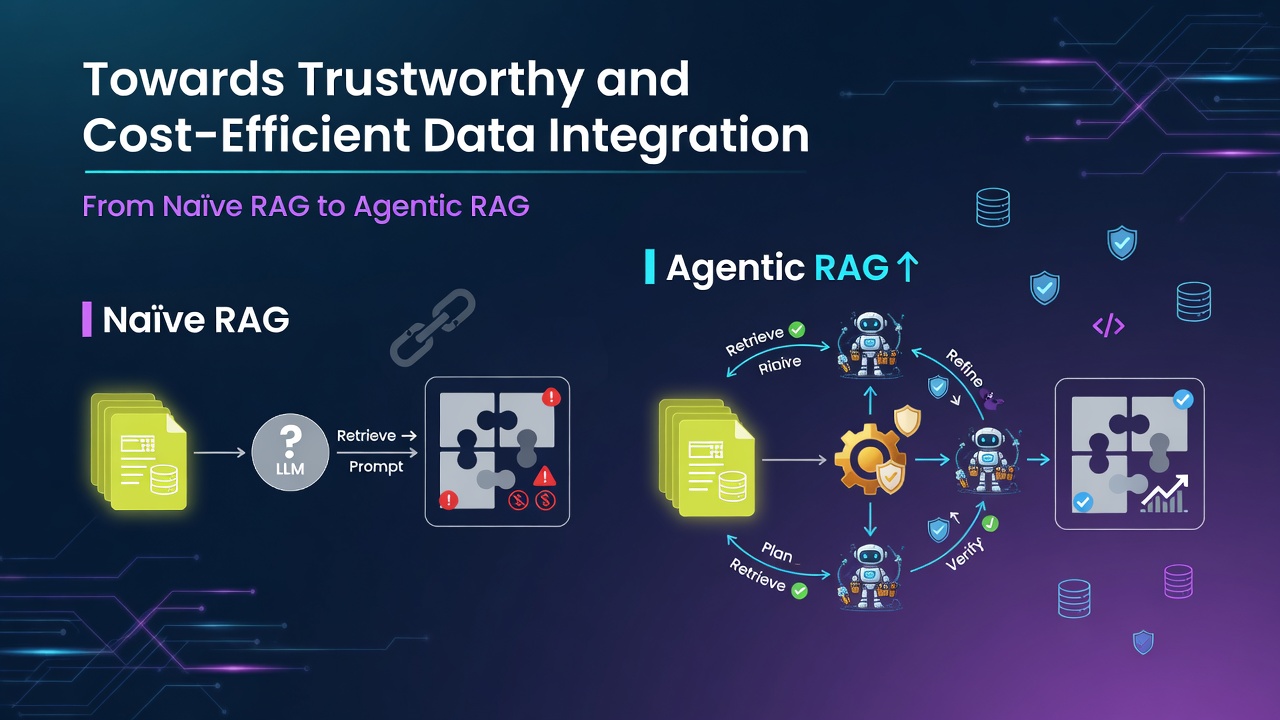
Abstract:Large language models (LLMs) and AI agents have demonstrated strong potential for data integration in zero-shot and few-shot settings. However, they continue to face significant accuracy and cost challenges in enterprise environments due to a persistent knowledge gap. This paper envisions trustworthy, scalable, and cost-efficient integration through knowledge-grounded LLMs and agents operating within a retrieval-augmented generation (RAG) workflow. Here, trustworthiness refers to evidence-grounded, verifiable reasoning, where integration decisions are transparently supported by retrieved knowledge, robust against hallucination, and consistent across tasks. We trace the evolution from classic RAG to GraphRAG and KG-RAG (knowledge graph-based RAG), highlighting how these paradigms bridge parametric and contextual knowledge. Building on this trajectory, we explore the shift toward Agentic RAG, where autonomous multi-agent systems adaptively plan, retrieve, refine, and reason for complex integration tasks. We examine optimization strategies for cost-efficient integration, addressing computational bottlenecks in large-scale enterprise settings. Finally, we outline open challenges and future directions toward building reliable, explainable, and scalable knowledge-grounded integration systems.
Submission history
From: Chuangtao Ma [view email]
[v1]
Fri, 24 Jul 2026 13:58:44 UTC (592 KB)
0 Comments
Log in to join the conversation.No comments yet. Be the first to share your thoughts.