
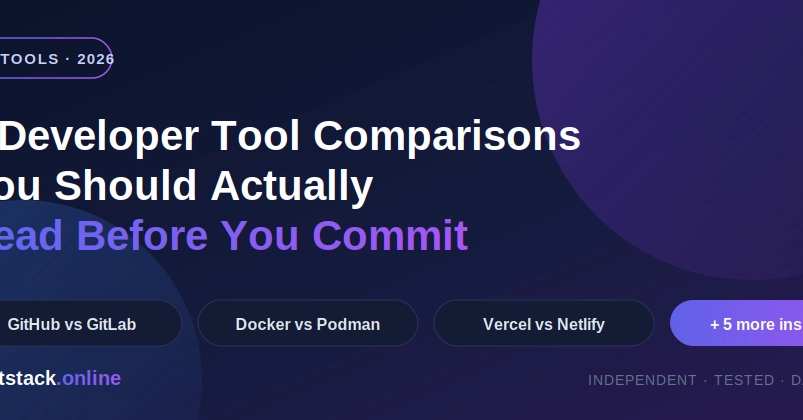
Picking a dev tool by vibes ("everyone uses X") works until it doesn't — usually right after you've built three months of workflow around it. Below are eight comparisons worth reading in full before you commit budget or migration effort, covering the tools developers actually get stuck choosing between in 2026.
Each summary below is the short version. Full breakdowns (pricing tiers, security/compliance, integrations, migration complexity) are linked if you want the deep dive.
- GitHub vs GitLab
The core Git hosting is table stakes at this point — the real decision is CI/CD and DevOps scope. GitHub wins on ecosystem size and Copilot integration depth; GitLab wins if you want CI/CD, container registry, and security scanning built into one platform without stitching together third-party Actions.
If your team is already deep in the GitHub Actions marketplace, switching cost is real. If you're starting fresh and want fewer moving parts, GitLab's single-application approach is worth the look.
📊 Full GitHub vs GitLab comparison — feature-by-feature, pricing, migration complexity.
- Docker vs Podman
Podman's daemonless, rootless architecture is the actual differentiator — not a marketing bullet point. If you're running containers in security-sensitive environments or just tired of the Docker daemon owning root, Podman's pod-native model maps directly to Kubernetes pods, which simplifies the mental model for anyone doing local K8s dev.
Docker still wins on tooling maturity and Docker Compose ubiquity — most CI templates and tutorials assume Docker.
📊 Full Docker vs Podman comparison
- Vercel vs Netlify
Both do git-push-to-deploy JAMstack hosting well. The split shows up at the edges: Vercel's tighter Next.js integration (unsurprising, same company) versus Netlify's framework-agnostic approach and longer track record with forms/functions as first-class features rather than framework-specific add-ons.
If you're all-in on Next.js, Vercel removes friction you'd otherwise configure manually. If you're framework-agnostic or multi-framework across projects, Netlify avoids any perceived lock-in.
📊 Full Vercel vs Netlify comparison
- Supabase vs Firebase
Postgres vs proprietary NoSQL is the real fork in the road, not the feature checklist. Supabase gives you a real relational database with row-level security and SQL you can actually query and reason about; Firebase gives you a mature, battle-tested realtime NoSQL store with a much bigger existing ecosystem.
Open-source portability matters here too — Supabase is self-hostable if vendor lock-in is a concern; Firebase is not.
📊 Full Supabase vs Firebase comparison
- Postman vs Insomnia-class tools (via Postman's broader API platform)
Postman has expanded well past "Swiss army knife REST client" into a full API platform (mock servers, monitoring, API governance). That's either exactly what you need for team-scale API work, or unnecessary bloat if you just want to fire requests during local dev.
📊 Full Postman comparisons — see how it stacks up across categories.
- Sentry vs Datadog
Different scope, often confused. Sentry is purpose-built for error tracking and performance monitoring at the application code level — stack traces, release tracking, source maps. Datadog is a full observability platform: infrastructure metrics, logs, APM, and yes, error tracking too, but as one module among many.
Teams often run both: Sentry for the "what broke in my code" question, Datadog for "what's happening across my infrastructure."
📊 Full Sentry vs Datadog comparison
- Zapier vs n8n
The no-code/low-code automation split: Zapier is polished, has the largest app integration catalog, and requires zero technical setup. n8n is fair-code (source-available, self-hostable), gives you actual code nodes when the visual builder isn't enough, and is dramatically cheaper at scale if you self-host.
If your team has zero DevOps capacity, Zapier's hosted simplicity wins. If you're comfortable self-hosting and want to avoid per-task pricing at volume, n8n pays for itself fast.
📊 Full Zapier vs n8n comparison
- ChatGPT vs Claude (for dev workflows specifically)
Not a general capability shootout — for coding-adjacent tasks specifically, the practical differences are context window handling for large codebases, and how each handles long, structured technical documents without losing the thread. Worth testing both against your actual repo before picking one as your default.
📊 Full ChatGPT vs Claude comparison
The pattern across all eight
Every one of these comes down to the same question: what's your actual constraint — budget, self-hosting requirements, ecosystem lock-in, or team size — not which tool has the longer feature list. Feature parity between top-tier tools in the same category is closer than marketing pages suggest; the deciding factor is almost always something specific to your setup.
If you're mid-evaluation on any of these, the full comparisons above go deeper on pricing tiers, security/compliance posture, and migration complexity than fits in a dev.to post. All comparisons are independently tested and dated, not affiliate-ranked.
More comparisons (CRM, project management, analytics, and 100+ other SaaS categories) at pilotstack.online.
0 Comments
Log in to join the conversation.No comments yet. Be the first to share your thoughts.