
Posted on July 28, 2026 by Ansuman Sahoo, Lima Project Maintainer
CNCF projects highlighted in this post

Following macOS and FreeBSD guests in v2.1, Lima v2.2 takes the next big step: Windows guest support. With this release, a single `limactl` workflow can now boot Linux, macOS, FreeBSD and Windows virtual machines. Lima v2.2 also introduces emulated TPM (Trusted Platform Module) 2.0, a foundational building block for modern guest operating systems and for disk-encryption workflows.
What is Lima ?
Lima (Linux Machines) is a command-line tool to launch local virtual machines. Originally focused on running containers on a laptop and promoting containerd to Mac users, Lima joined the CNCF as a Sandbox project in September 2022 and was promoted to Incubating in October 2025. Today, Lima supports a wide variety of non-container workloads, non-macOS hosts, non-Linux guests and robust AI sandboxing.
If you are using Homebrew, Lima can be installed using:
brew install limaFor other installation methods, see https://lima-vm.io/docs/installation/.
Updates in v2.2
Windows guests (experimental)
Lima v2.2 introduces experimental support for Windows Server 2025 and Windows 11 guests. With v2.1 adding macOS and FreeBSD, Windows was the natural next step toward making Lima an OS-agnostic VM launcher.
To create and start a Windows Server 2025 guest:
limactl start template:windows-2025Once the VM is up,
limactl shell windows-2025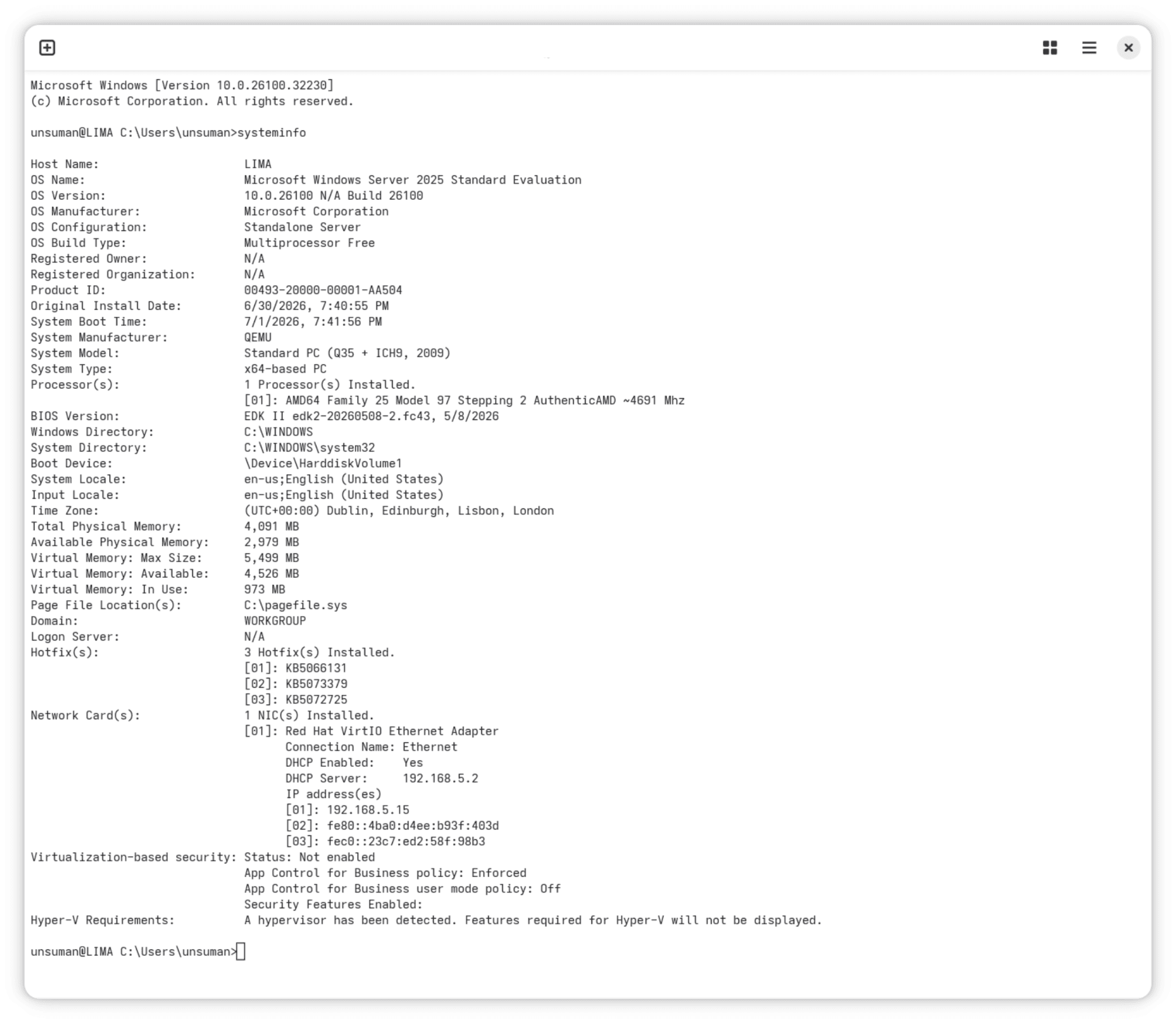
Under the hood, Lima now knows how to:
- Drive an unattended Windows installation from a generated
`autounattend.xml`answer file, packaged into an ISO that QEMU attaches alongside the install media. This handles disk partitioning, driver loading, and user creation without any manual clicks. - Download and mount the virtio-win driver ISO so that Windows can use virtio block, network, and other paravirtualized devices for good performance.
- On first logon, a PowerShell script generates a random password (replacing the initial one from
`autounattend.xml`), installs OpenSSH Server, opens the Windows Firewall for port 22, and injects the SSH public key into`C:\ProgramData\ssh\administrators_authorized_keys`so that`limactl shell`works out of the box.
Current limitations
- Only the QEMU driver is supported.
- The Windows template requires
`plain: true`. File mounts, port forwarding via the guest agent, and other Lima conveniences that rely on the Linux guest agent are not available yet.
What’s next for Windows guests
- File sharing into the guest (likely via virtio-fs, or maybe SMB (Server Message Block)).
- A Windows-side guest agent so that port forwarding, environment propagation, and provisioning scripts behave the same as on Linux guests.
- Broader architecture and image coverage (Windows 11 ARM64, more languages beyond
`en-us`, etc.) - Eventually, a native Windows Host Compute System (HCS) backend driver for users running Lima on Windows, which would give first-class vTPM.
TPM 2.0 emulation (experimental)
TPM (Trusted Platform Module) 2.0 is a dedicated microchip built into your computer’s motherboard designed to secure hardware using cryptographic keys. To make Windows 11 guests possible at all, Lima v2.2 also adds emulated TPM via swtpm (a software emulator that acts like a physical TPM) on the QEMU driver.
When `tpm: true`, Lima:
- Spawns a
`swtpm`process per instance, with its own state directory under the instance directory. - Communicates with
`swtpm`over a Unix domain socket. - Picks the right QEMU TPM device as per the architecture Cleans up the
`swtpm`process when the instance stops.
LFX Mentorship 2026
This year Lima participated in the LFX Mentorship 2026 Term 2 program (June – August 2026), and this term is currently under progress. The work is tracked under the umbrella issue #4907. We are thrilled to announce Mie Tokunaga (@mie313 on GitHub) as our selected mentee for this term. Huge thanks to her for driving the Windows guests development. Also many thanks to Arnav Sharma (@Shardz4 on GitHub) whose earlier proof of concept for `swtpm` integration #5079 laid the groundwork for the TPM feature.
The main goal of the mentorship program was to add Windows Guest support. Now that our mentee has successfully implemented this, their focus has shifted to ensuring a seamless Lima experience on Windows hosts. This includes automating Windows host configurations and eliminating dependencies so that Lima “just works” out of the box. A key deliverable is the complete removal of the `cygpath.exe` dependency, so that Lima on Windows no longer requires Cygwin, MSYS2, or Git for Windows to be installed. The secondary phase aims to explore and evaluate native virtualization support for Windows hosts. This includes researching the trade-offs between Hyper-V and the Host Compute System (HCS, used by WSL2).
Catch us at KubeCon + CloudNativeCon Japan 2026
Come say “Hi!” in Yokohama!
Conference Session: Project Lightning Talk: Lima in 5 Minutes: From Containers to AI Sandboxing
– Speaker: Ansuman Sahoo (BITS Pilani)
– When: Wednesday, July 29, 2026 | 12:33 PM JST
– Where: 3F | 313+314
Project Pavilion Kiosk:
– When: Thursday, July 30, 2026 | 10:45 – 13:00 JST
– Where: Level 3 | 301-304 + Foyer | T-3
See also:
0 Comments
Log in to join the conversation.No comments yet. Be the first to share your thoughts.