
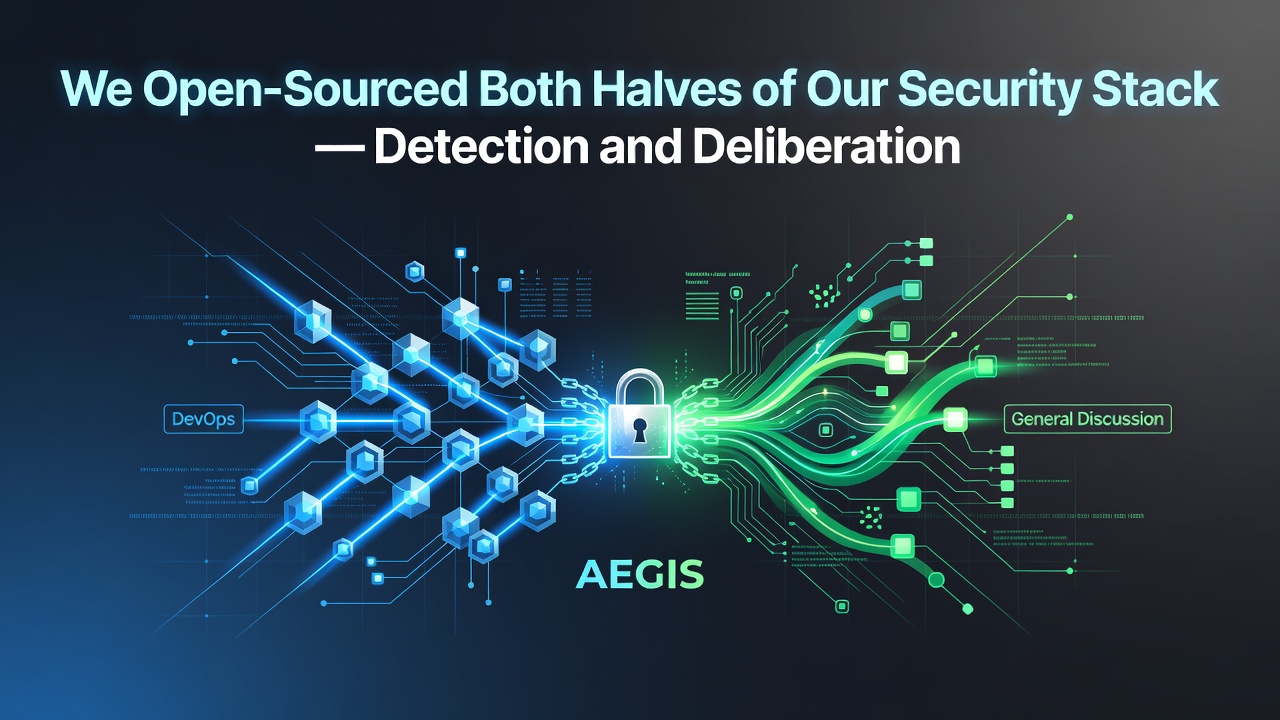
We Open-Sourced Both Halves of Our Security Stack — Detection and Deliberation
AEGIS catches the threat. ENLIL decides what it means. Both are free, and we want to know if they actually help you.
We've written before about each of these projects separately — AEGIS's post-quantum forensic logging and why ENLIL runs 9 LLMs in parallel instead of one. This post is about why they're actually one system, and why we're not gatekeeping either half of it.
Two different jobs
AEGIS is an intrusion detection/prevention system. It watches traffic, correlates signals across nine layers (from crypto-level filtering to adaptive moving-target defense), and decides — fast, locally, without calling out to anything — whether something is an attack. It's deliberately narrow: detection and containment, nothing else. No counterattacks, no active reconnaissance, one process, deployable on a standard VPS.
ENLIL does the opposite job. It's slow by design — it convenes a council of independent LLMs, lets them reason in isolation (no model sees another's answer until synthesis), and produces a signed Decree: the majority view, the dissents, and a final verdict. It's built for the decisions where being fast and wrong is worse than being slow and right.
Neither one replaces the other. AEGIS shouldn't spend 30 seconds deliberating about whether a SYN flood is a SYN flood. ENLIL shouldn't be making split-second network decisions. But there's an obvious seam between them: what happens when AEGIS catches something that isn't a simple yes/no — a pattern that's ambiguous, or severe enough that you want more than one model's opinion before you act on it?
The Bridge
That seam is a small connector: when AEGIS's detector layer flags something at high or critical severity, it fires a signed event at ENLIL's API. ENLIL convenes a tier of the council sized to the severity — a lighter tier for routine escalations, the full council (including the most expensive model) only for the things that deserve it. The response comes back as a Decree, with reasoning you can actually read, not just a score.
It's intentionally simple: fire-and-forget, no blocking calls inside AEGIS's detection path, no dependency that would stop AEGIS from working standalone if ENLIL isn't there.
Why both are free, and how we'd actually charge for anything
Full source for both is public. You can self-host the whole pipeline — detection and deliberation — without paying us a cent, using your own API keys for whatever models you route ENLIL through. That's not a limited trial; that's the whole thing.
What we'd charge for, if anyone wants it, is never the code: it's running the pipeline for you, or the signed audit trail itself when it needs to hold up for compliance purposes (the EU AI Act is the obvious case). That's a real distinction — self-hosting means you own the whole chain, including your own compute cost; paying us means you're paying for us to carry that operational weight, not for permission to use the software.
What we actually want from this post
Stars are a nice signal. They're not the signal we need. We've been building both of these for months without a clear read on whether they hold up outside our own use — whether the detection layers catch what real traffic throws at them, whether the deliberation format is actually useful to someone who isn't us, whether the pack makes sense to run together or is better used as two unrelated tools.
So: if you try either one — even just spinning it up locally for an afternoon — we added a feedback template to both repos that takes two minutes: what you used it for, what worked, what didn't, whether you'd trust it in production. Direct link in both README's "New Issue" flow.
- AEGIS: https://github.com/conchaestradamiguelangel-droid/aegis
- ENLIL: https://github.com/conchaestradamiguelangel-droid/enlil
We'd rather have ten honest "this doesn't work for X" reports than a hundred stars and no idea if the thing is actually good.
0 Comments
Log in to join the conversation.No comments yet. Be the first to share your thoughts.