
[Submitted on 30 Jul 2026]
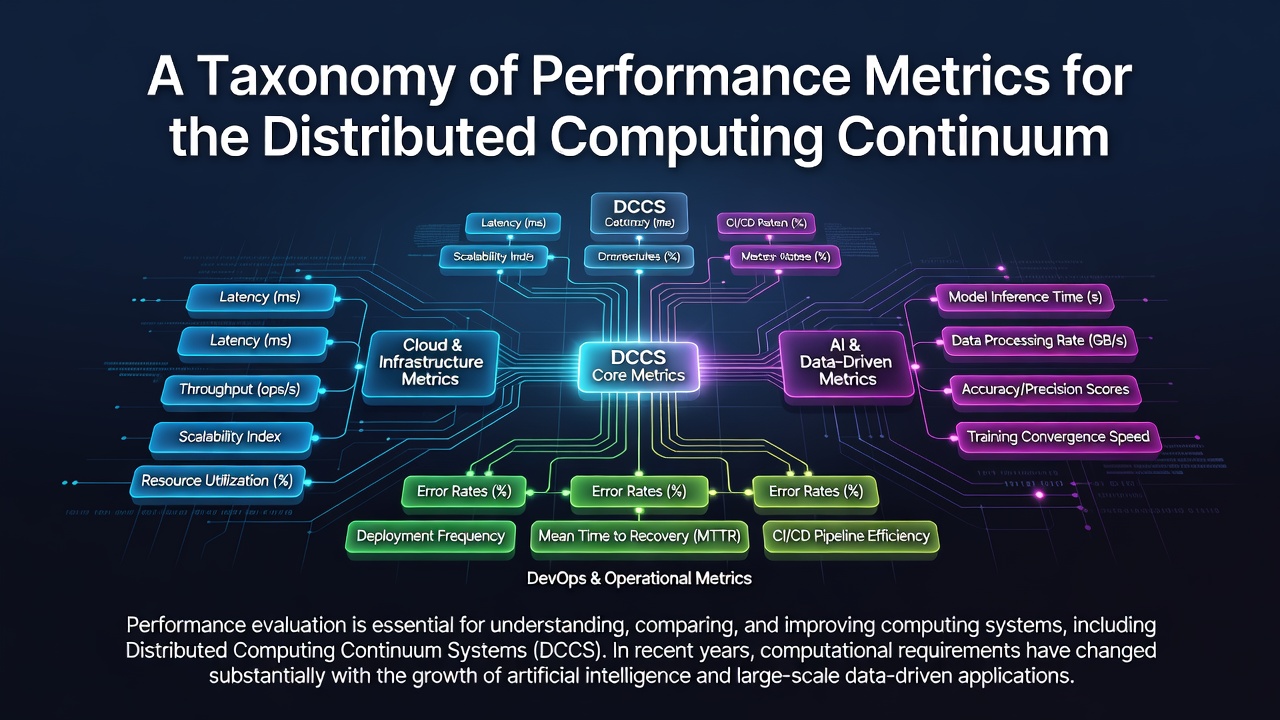
Abstract:Performance evaluation is essential for understanding, comparing, and improving computing systems, including Distributed Computing Continuum Systems (DCCS). In recent years, computational requirements have changed substantially with the growth of artificial intelligence and large-scale data-driven applications. These application tasks are increasingly distributed between resource-intensive data centers and resource-constrained edge environments. In this context, novel computing continuum architectures and algorithms are emerging, creating a need for transparent and consistent performance evaluation. However, existing evaluation practices often focus on isolated dimensions, such as computation, networking, energy efficiency, or application-level quality, and therefore provide only a partial view of cross-layer DCCS behavior. This paper presents a structured taxonomy of performance metrics for DCCS. The taxonomy organizes metrics into computing-level, network-level, and application/user-level categories, while also highlighting emerging dimensions such as sustainability, observability, adaptability, data locality, migration awareness, and continuum fragmentation. Further, we provide mathematical formulations and discuss their relevance to heterogeneous and dynamic continuum environments. We also summarize metric acquisition requirements in terms of acquisition scope, acquisition phase, and measurement method. These requirements help clarify whether a metric can be collected from a single node, multiple nodes, or the full system, and whether it is more suitable for operational monitoring or experimental evaluation.
Submission history
From: Alaa Saleh [view email]
[v1]
Thu, 30 Jul 2026 15:55:29 UTC (177 KB)
0 Comments
Log in to join the conversation.No comments yet. Be the first to share your thoughts.