
[Submitted on 25 Feb 2026 (v1), last revised 30 Jul 2026 (this version, v2)]
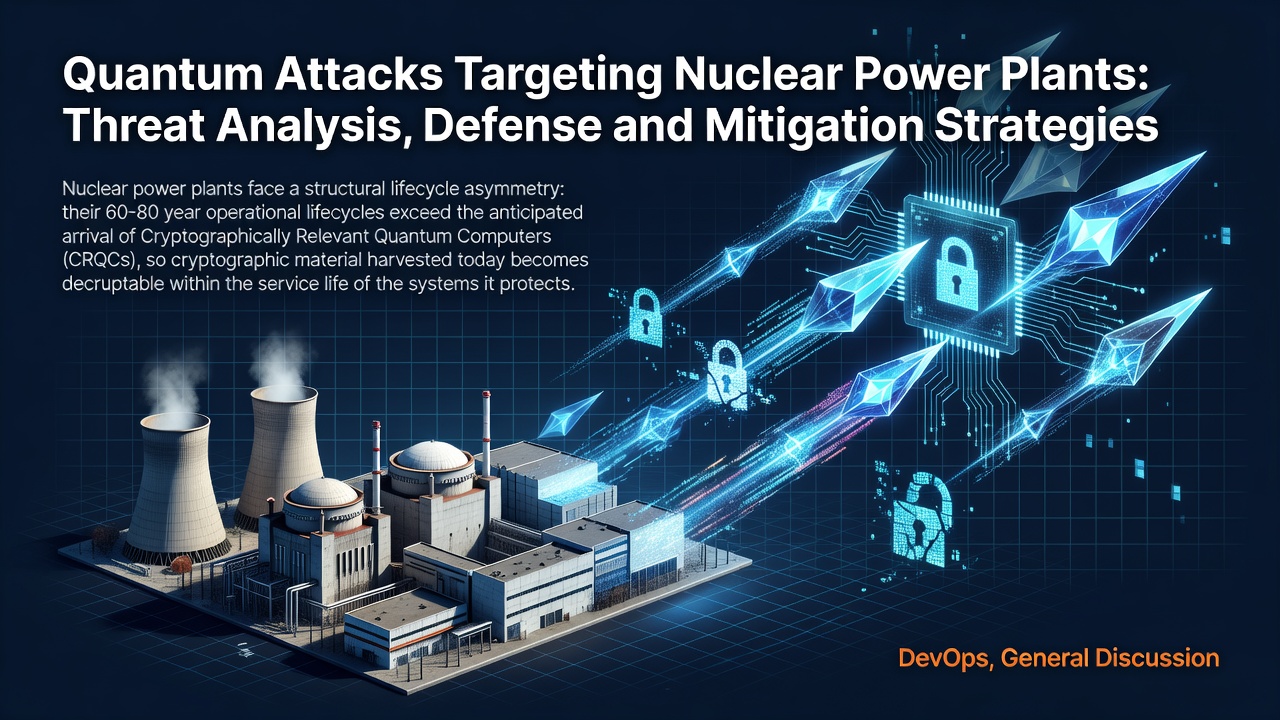
Abstract:Nuclear power plants face a structural lifecycle asymmetry: their 60-80 year operational lifecycles exceed the anticipated arrival of Cryptographically Relevant Quantum Computers (CRQCs), so cryptographic material harvested today becomes decryptable within the service life of the systems it protects. This paper introduces a forensics-first framework for quantum resilience that treats forensic integrity as operationally essential rather than merely evidentiary, analyzing the quantum threat landscape across the Purdue architecture (L0-L5) to show how Harvest-Now, Decrypt-Later (HNDL) campaigns enabled by Shor's algorithm can retroactively compromise cryptographic foundations and undermine forensic evidence. Through two case studies, Quantum Scar and Quantum Dawn, we model attack feasibility via a conditional-chain formulation over structured expert-judgment priors anchored to documented HNDL activity and published CRQC roadmaps, yielding success probabilities of 8-78% under current defenses, where the upper bound corresponds to high-value facilities exhibiting cryptographic monoculture. We propose a defense-in-depth migration to Post-Quantum Cryptography (PQC) integrating hybrid key exchange, code and log integrity with anti-rollback, authenticated time synchronization, and side-channel-resistant implementations aligned with ISA/IEC 62443 and NIST standards, and specify seven design-level conformance criteria for validating it; modeled residual feasibility falls to 1-8% at Security Level 4 and below 1% under full PQC migration. We further contribute six MITRE ATT&CK for ICS technique extensions (T1001-T1006) as a standardized vocabulary for quantum-enabled infrastructure attacks. Quantum threats thus extend beyond cybersecurity to system safety, operational reliability, and post-incident evidence admissibility across multi-decade nuclear asset lifecycles.
Submission history
From: Yaser Baseri [view email]
[v1]
Wed, 25 Feb 2026 03:26:09 UTC (1,123 KB)
[v2]
Thu, 30 Jul 2026 16:26:52 UTC (1,119 KB)
0 Comments
Log in to join the conversation.No comments yet. Be the first to share your thoughts.