

Your day-ahead look for July 27, 2026

This is an excerpt from CoinDesk newsletter 'Daybook.' Sign up here, if you haven't already.
The broader outlook for perceived store-of-value assets such as bitcoin BTC$65,094.85 and gold remains constructive. The reason is simple: the U.S. government is more indebted than ever, with no end in sight.
The Treasury’s Debt to the Penny dataset put the federal debt at an all-time high of $39.7 trillion on Friday. According to some observers, the government’s debt is growing by roughly $7 billion each day. If that were market capitalization, the accumulation alone would rank as the 16th-largest cryptocurrency, well ahead of privacy coins like XMR and other tokens.
According to the founders of the crypto newsletter service LondonCryptoClub, the pace of growth supports the so-called debasement trade, a bet that fiat currency will fall in value. The trade involves buying limited-supply assets like gold and bitcoin that benefit from the devaluation, which often occurs when governments face high debt.
"This is the world of fiscal dominance and ultimately will dictate Fed policy. Rates will necessarily need to be kept artificially low and liquidity will need to be provided to help fund the refinancing cycle," the founders told CoinDesk. "The 'debasement' trade was a popular narrative last year but has gone quiet. Yet it’s set to go into overdrive!," the founders told CoinDesk.
Several observers have raised the alarm over the ballooning debt in recent months.
Apollo chief economist Torsten Slok warned that the U.S. debt-to-GDP ratio of over 120% means there is little room to spend more money should a recession arrive. Moreover, the Fed can't cut interest rates as aggressively as during previous recessions because that would add to inflation and, more importantly, reduce the yield on bonds. The government needs to issue more bonds to fund deficits and those need to offer a high return to draw demand.
"The U.S. has never entered a recession with this little fiscal buffer,” he wrote in a blog post in May.
All this means that if a recession occurs, the pain could be longer-lasting and may trigger demand for assets that fall largely outside of the financial system, such as BTC and cryptocurrencies. That said, since its inception in 2010, BTC has moved largely like a tech stock and not a haven investment.
For now, the cryptocurrency is changing hands just above $65,000, cheering the overnight slide in oil prices. Ether is outperforming BTC, hinting at a potential altcoin rally ahead.
Stay alert!
Read more: For analysis of today's activity in altcoins and derivatives, see Crypto Markets Today . For a comprehensive list of events this week, see CoinDesk's "Crypto Week Ahead."
What’s trending
- Bitcoin is back above $65,000 as U.S. and Iran hold fire. Oil drops 5% (CoinDesk): Risk-on peace trades are back in vogue after the U.S. and Iran held fire on Sunday, sending oil prices lower. Bitcoin is back above $65,000 and ether rose to nearly $1,950. Other top-10 cryptos are on the rise as well.
- U.S. and Iran pause fighting to give peace talks ‘space.’ Here’s where negotiations stand (CNBC): A temporary hiatus to two weeks of hostilities between the U.S. and Iran appeared to hold on Monday, after negotiations over a lasting peace faced fresh hurdles over the weekend.
- Cloud data firm Storj files for Chapter 11, extending a week of crypto failures. Token slides 16% (CoinDesk): Decentralized cloud network Storj Labs said it filed for Chapter 11 bankruptcy, becoming the fourth crypto company in seven days to announce a failure or wind-down as investor interest switches to AI.
- Chipmaker CXMT vaults to top of China's valuation with 466% surge in Shanghai debut (Reuters) Shares of CXMT Corp. soared 466% on their Shanghai trading debut on Monday following Asia's biggest IPO this year, catapulting the chipmaker to the top of China's stock market by valuation despite a recent selloff in global tech stocks.
Today’s signal
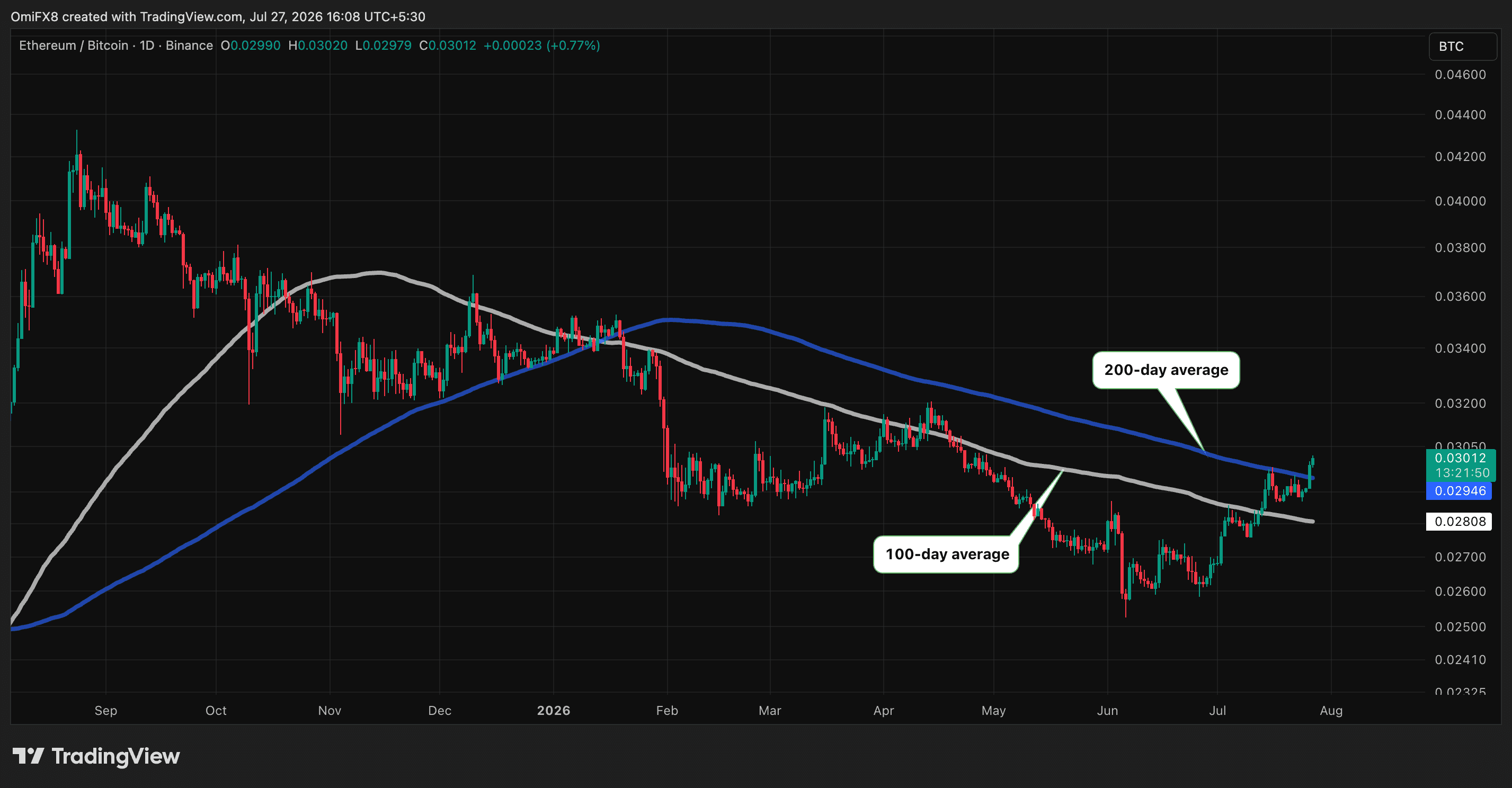
The chart shows daily swings in the ether-bitcoin (ETH-BTC) ratio in candlestick format.
The ratio has topped both the 100- and 200-day simple moving averages (SMA) for the first time since the bear market began early this year.
The latest configuration shows strengthening upside momentum in ether relative to bitcoin.
Crypto Flows, Share and the Selective Rotation

Crypto Flows, Share and the Selective Rotation
Markets repositioned since June, but Binance held share (~55% user funds, ~24% spot) and drew net inflows in early July while the tracked market saw outflows.
Markets repositioned since June, but Binance held share (~55% user funds, ~24% spot) and drew net inflows in early July while the tracked market saw outflows.
Why it matters:
Markets repositioned since June, but Binance held share (~55% user funds, ~24% spot) and drew net inflows in early July while the tracked market saw outflows.
0 Comments
Log in to join the conversation.No comments yet. Be the first to share your thoughts.