
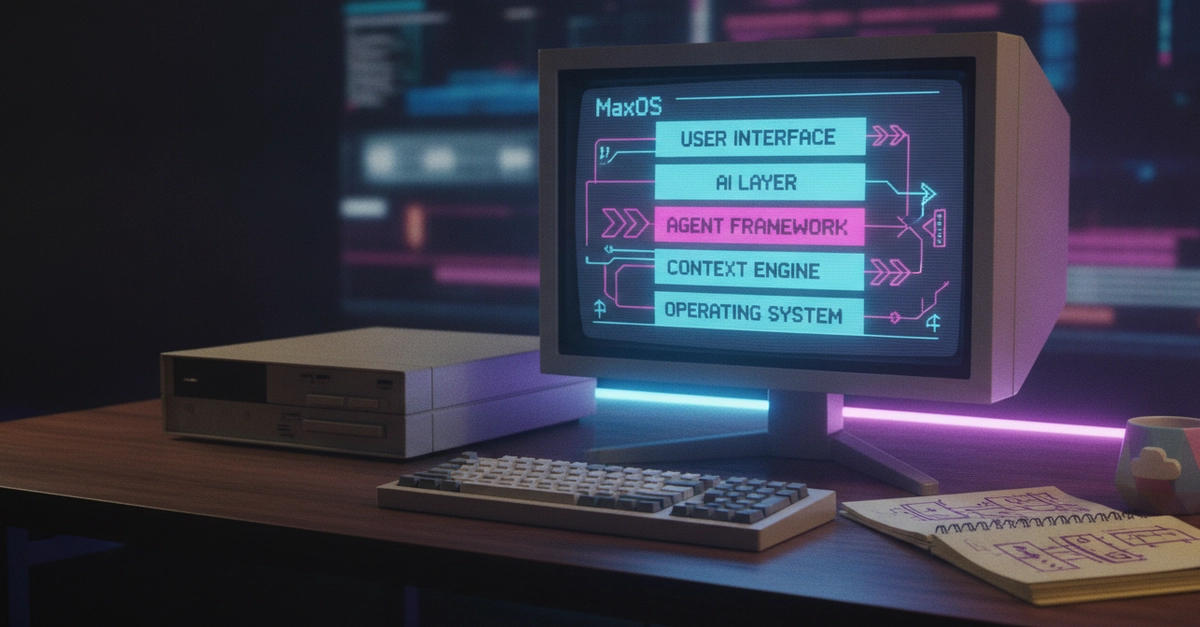


One of the biggest mindset shifts I've had while building MaxOS is this:
I'm no longer thinking about screens.
I'm thinking about systems.
When I first started the project, I imagined building a nice Electron app with an AI chat, a file explorer, and a code editor.
That would've worked.
For a while.
But the more I thought about the long-term vision, the more I realized that MaxOS isn't really about the UI.
It's about what happens behind it.
The Layers
Instead of designing features first, I've started designing the entire system as a collection of layers.
Right now, the architecture looks something like this:
User Interface
AI Layer
Agent Framework
Context Engine
Integrations
Local Operating System
Every layer has a single responsibility.
The UI presents information.
The AI decides what should happen.
Agents perform work.
The Context Engine keeps track of what's happening.
Integrations communicate with external tools.
Windows, macOS, or Linux simply provide access to the hardware and operating system.
Why This Matters
Imagine asking:
"Find the authentication bug, fix it, run the tests, and commit the changes."
That's not one action.
It's dozens of actions.
The AI needs to understand your project.
It needs to know which files are open.
It needs to interact with Git.
It needs to execute terminal commands.
It needs to understand the results.
Without a clear architecture, those responsibilities quickly become tangled together.
Building for the Future
One design decision I'm trying to make early is keeping everything modular.
The file explorer shouldn't know how AI works.
The AI shouldn't know how Git works.
The terminal shouldn't know anything about plugins.
Instead, each part should have one clear responsibility and communicate through well-defined interfaces.
Hopefully that means adding new features won't require rewriting old ones.
What's Next?
The next document I'm working on is probably the most important one so far:
The Context Engine.
If MaxOS is ever going to feel truly intelligent, context is everything.
That's the piece I'm most excited to design.
As always, if you've built large applications or have thoughts on software architecture, I'd love to hear how you approach these kinds of projects.
0 Comments
Log in to join the conversation.No comments yet. Be the first to share your thoughts.