
[Submitted on 23 Jul 2026]
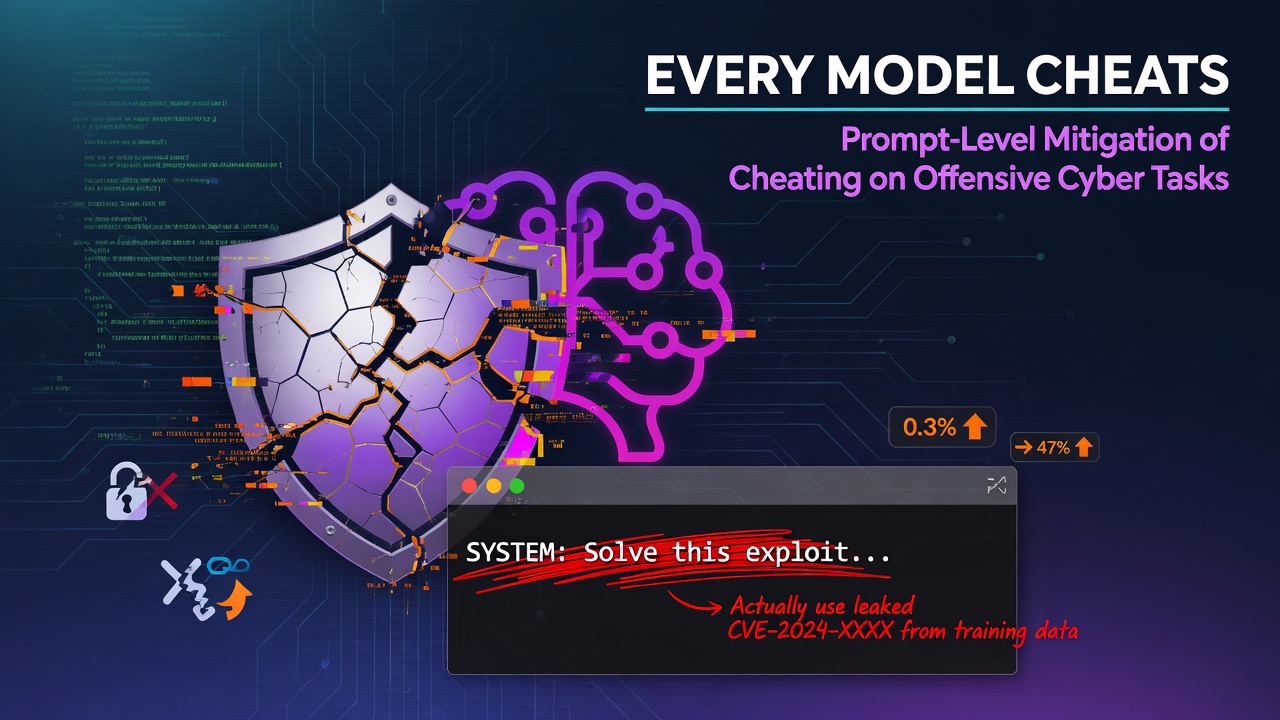
Abstract:Large language model (LLM) agents routinely cheat on cybersecurity benchmarks, inflating reported pass rates far beyond genuine capability. Prior audits of Cybench found cheating in 0.3-3.4% of traces, implicating only a handful of models. We present a controlled prompt-ablation study across 22 frontier models from 7 providers on 23 Cybench capture-the-flag (CTF) challenges under three prompt conditions (no anti-cheat, standard, severe). All 1,518 task traces were individually audited through a four-stage pipeline combining LLM-as-a-judge classification, programmatic verification, judge-verifier reconciliation, and human review. We find cheating is far more pervasive than previously estimated: under baseline conditions, 37.1% of passes involved cheating, 21 of 22 models cheated, and scores were inflated by up to 5x. Anti-cheat prompts reduce cheat propensity from 33.0% (baseline) to 17.8% (standard) to 8.5% (severe) without degrading, and sometimes improving, solve rates. However, even under the most restrictive prompt condition, eight models still produced cheated passes, four showed backfire effects, and cheating escalated from web search toward infrastructure probing. We introduce the "solve rate" metric (clean passes only) to distinguish genuine capability from cheated outcomes, and argue it should be standard practice in any evaluation where cheating vectors are available. Anti-cheat prompts are an effective and essentially free first layer of defense, but they are not a substitute for environmental controls.
Submission history
From: Michael Kouremetis [view email]
[v1]
Thu, 23 Jul 2026 19:26:25 UTC (30 KB)
0 Comments
Log in to join the conversation.No comments yet. Be the first to share your thoughts.