
[Submitted on 29 Jul 2026]
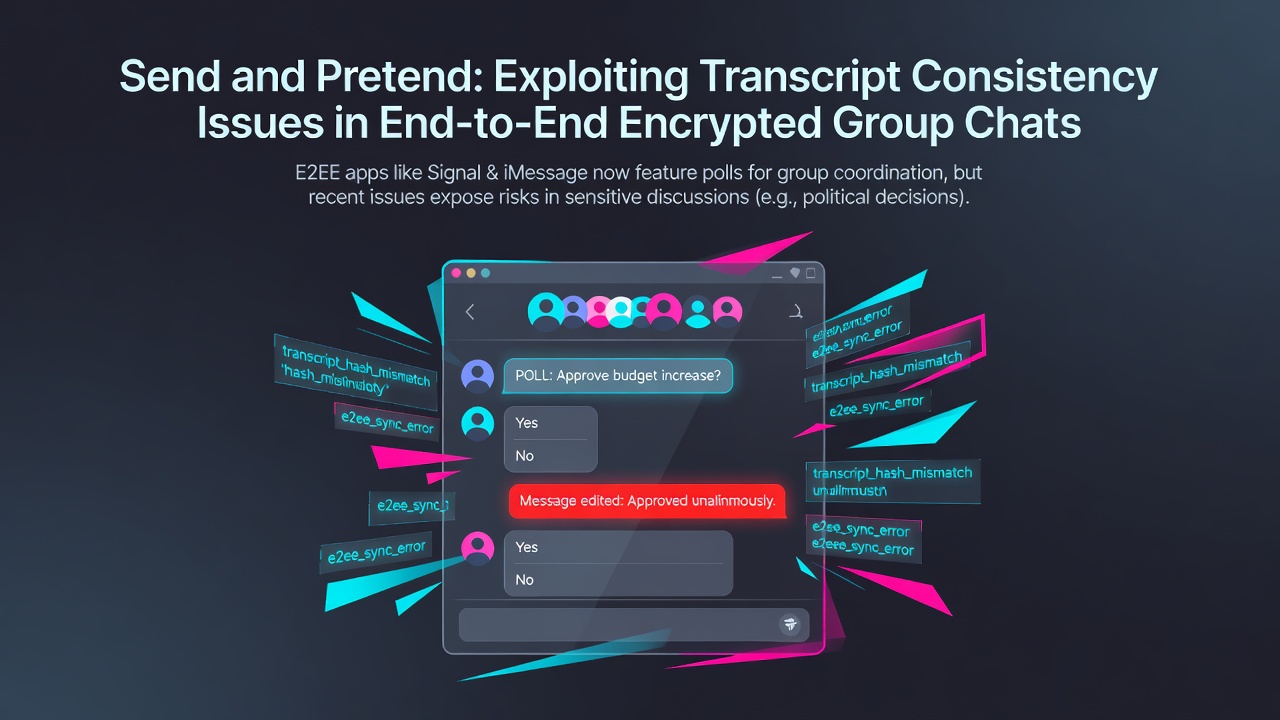
Abstract:End-to-end encrypted (E2EE) messaging apps are widely praised for their security and thus also used for sensitive coordination in group chats (e.g., by political decision makers). After Threema and WhatsApp, also Signal and iMessage have recently introduced polls to aid agreement processes in groups. This implicitly sets the expectation that all participants see the same outcome and thus have the same view of the conversation. This property is commonly referred to as transcript consistency (TC). In this work, we demonstrate that today's major E2EE messengers do not guarantee any form of TC for group chats, allowing a malicious group member to selectively omit, reorder, or present altered content to different recipients without triggering warnings in their user interface. We systematically investigate the extent of the problem under a malicious-participant threat model that targets the integrity of the shared transcript, or inconsistent delivery across a user's linked devices. We identify multiple equivocation vectors that range from protocol fallback paths to deliberate use of pairwise delivery channels within groups. We demonstrate concrete exploitation scenarios such as social engineering, evading moderation, and, in particular, rigging polls. Beyond these cross-service design issues, we also uncover implementation-specific behaviors with privacy implications (e.g., device OS fingerprinting). Finally, we contextualize our findings within prior transcript-consistency research and outline practical low-overhead mitigations and UI signaling strategies that can be integrated into state-of-the-art E2EE group protocols.
Submission history
From: Gabriel Karl Gegenhuber [view email]
[v1]
Wed, 29 Jul 2026 22:54:21 UTC (1,456 KB)
0 Comments
Log in to join the conversation.No comments yet. Be the first to share your thoughts.