
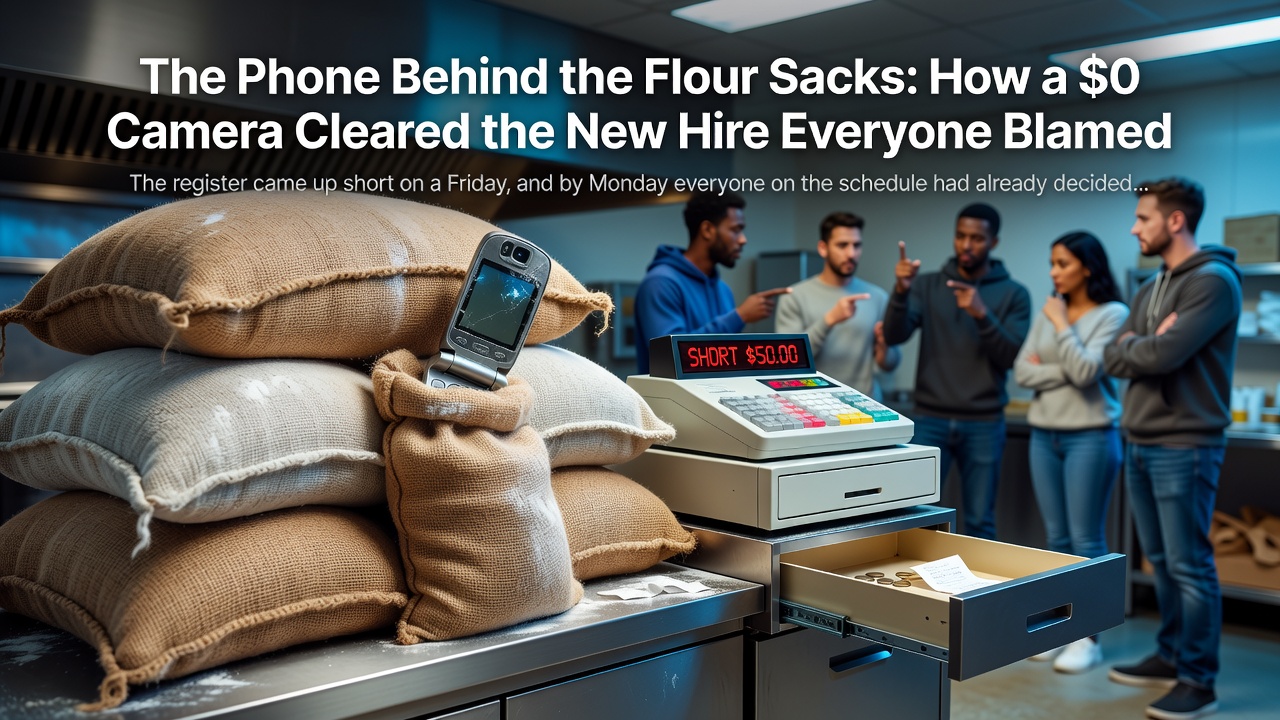
The register came up short on a Friday, and by Monday everyone on the schedule had already decided whose fault it was.
Marisol ran a small bakery — six tables, a case of morning pastries, a back room that smelled permanently of yeast and cinnamon. She'd opened it with her late husband's insurance money and eleven years of stubbornness, and she knew the arithmetic of the place the way she knew the arithmetic of a croissant: every gram accounted for, nothing to spare. So when the drawer started coming up light — nine dollars one week, twenty-two the next — and when bags of good bread flour and whole cases of European butter began evaporating from the storeroom faster than any recipe could explain, she felt it in her stomach before she felt it in the books.
The story wrote itself, the way these stories do. The shortfalls had started around the time she'd hired Deivis — nineteen, quiet, three weeks in the country, working the closing shift to send money home. Her most senior counter clerk, a woman named Paula who'd been there six years and whom Marisol had trusted with the keys, laid it out gently and completely: I don't like saying it, but it's the new kid. It started when he started. You do the math.
Marisol did the math. The math pointed at Deivis. And she almost fired him on the strength of it, because that is what "you do the math" usually gets you: a specific person blamed for a general suspicion.
What she set up instead, and what it actually was
I should be upfront about my stake here, because I'm the person who builds the app she ended up using, and I would rather undersell it than sell you a fairy tale.
Marisol did not install a "smart theft-detection system." There's no such thing, or nothing I'd trust with a teenager's reputation. What she did was take a phone that had been dead in a kitchen drawer since her last upgrade — an old Android with a cracked earpiece — and turn it into a plain camera she could actually look through from behind the counter.
The app is Background Camera RemoteStream. Its whole job is to take a spare phone and let you watch and record from it somewhere else, with no account, no subscription, and no shipping your footage off to some company's servers. She set it up at the prep table in under ten minutes:
- She installed it from the Play Store on the old phone. One tap — no "create an account to continue," no sideloading, no card on file.
- She started a recording session and locked the screen. The camera keeps running with the screen completely off, which mattered here for a dull, practical reason: the phone had to sit powered and inconspicuous on a shelf all day, and a bright display behind the flour sacks would have announced itself.
- She wedged it between two twenty-five-pound sacks on the storeroom shelf, lens pointed at the back door and the butter cooler — the two places things left from. When she was on the shop's own Wi-Fi, the app's built-in web server let her open a local address in the browser on the front-counter tablet and glance at the storeroom between customers, with nothing leaving the building. She didn't even need the reach-me-anywhere option; the whole drama happened inside one small building on one small network.
Two things she was careful about, and they're the difference between running a business and spying on the people who work for you.
The camera pointed at the stockroom — the butter, the flour, the back door — not at the break corner where staff ate lunch, not at the tiny office where they left their bags. It watched inventory, not people's private moments. And because the footage stayed on the phone, in her storeroom, and not in a cloud account that quietly keeps a rolling history of everyone's comings and goings on a server in another state, she decided what was ever looked at and what was never looked at. That distinction turned out to matter more than she expected.
The afternoon it answered the question
For four days, ordinary bakery footage: Deivis restocking the case, Marisol herself hauling flour, the produce delivery, a lot of nothing. She started to feel a little ridiculous about the sacks and the wedged phone.
On the fifth afternoon, during the dead stretch between lunch and the after-school rush, she glanced at the front-counter tablet out of habit while she boxed a dozen conchas.
Paula was in the storeroom. Not restocking. She watched Paula prop the back door, carry two cases of the European butter out to the alley in unhurried trips, and come back wiping her hands on her apron the way you do when you've finished a chore you've done many times before. A few minutes later the register would come up light again; Marisol could set her watch by it now.
Her first instinct was the useless one everybody has — to march into the storeroom mid-shift and make a scene in front of a room full of customers. Instead she did the boring, effective thing. She let the phone keep recording, finished the conchas, and waited until close.
Because the old phone had been writing the file to its own storage the whole time — not streaming into the ether, but recording to the device on the shelf — she had it. Not a hunch. Not "you do the math." A clip, with a time on it, of a specific person at a specific shelf doing a specific thing, four separate afternoons that lined up exactly with four short drawers.
She didn't post it anywhere. She didn't gather the staff for a humiliation. She copied the one relevant clip to a thumb drive — she could, because it lived on her phone and not inside some company's system with its own retention rules and its own idea of who owns the footage — and she sat down with Paula and, separately and first, with Deivis.
Deivis, it turned out, had spent five days quietly certain he was about to be fired for something he hadn't touched, and had said nothing because who would believe the three-week kid over the six-year veteran. Marisol believed him now, because she finally had the one thing that had been missing the entire time: not a stronger suspicion, but a piece of the world she could actually hold. She gave him the closing keys the following week.
Why I keep telling stories like this one
The honest version is better than the heroic one, so here it is.
The camera didn't catch anyone. It has no alerts, no AI, no motion tripwire that pinged Marisol the second the back door opened — she happened to glance at the tablet while she boxed pastries, and if she hadn't, she'd have caught it a day later, or a week. What the camera did was narrower and, honestly, more useful: it turned "it started when he started, you do the math" into a file she owned. It shrank the distance between a suspicion and the evidence for it — and, just as important, the evidence against it. A quiet nineteen-year-old kept his job and his name because the proof pointed where the proof actually went, not where the seniority did.
The rest of the honest version: a phone on a shelf is not a loss-prevention department. It had to stay plugged in — a screen-off camera sips power, but it doesn't run a full day on nothing, so it sat by an outlet behind the sacks. It isn't weatherproof, which is fine for a dry storeroom and would not be fine zip-tied over the alley door. The tidy on-network web view only worked because everything happened inside the shop on the shop's own Wi-Fi; watching from home would have meant the unlisted-live-stream path, with the few seconds of delay any live video carries. And none of it would have been decent if she'd aimed it at the break corner or the staff's bags instead of at the one shelf where the problem kept leaving from.
But that's the whole point. The technology's only job was to refuse to get in the way — no monthly fee to unlock the live view, no upgrade prompt holding the one clip she needed hostage, no routing her employees' workday through a data center so a stranger's server could keep a copy. It ran on a phone bound for a junk drawer, it cost nothing, and it kept the footage inside the four walls where it belonged. So the only real work left was the part that should be hard: paying attention, and being willing to find out you'd blamed the wrong person.
If you run a small place, you know cash and stock don't walk off by themselves, and you know how easily "it must be the new one" hardens into a decision. A spare phone in a drawer and a shelf pointed the right way won't run the business for you. But it can make sure that when you finally act, you're acting on what happened — not on who was easiest to blame.
Background Camera RemoteStream is free on Google Play — no account, no subscription, recordings stay on the device: play.google.com/store/apps/details?id=com.superfunicular.digicam. More about what it does — and what it deliberately doesn't — at superfunicular.com.
More reading:
- Where your footage actually lives, and why "local" matters when you need it later — the difference between a clip you own and a clip a company holds.
- Watching a room over your own network with the built-in web server (screen off, no cloud) — the engineering behind the feature that made the between-customers glance possible.
- Can an old phone really replace a cloud camera? An honest accounting of what you give up and what you get
0 Comments
Log in to join the conversation.No comments yet. Be the first to share your thoughts.